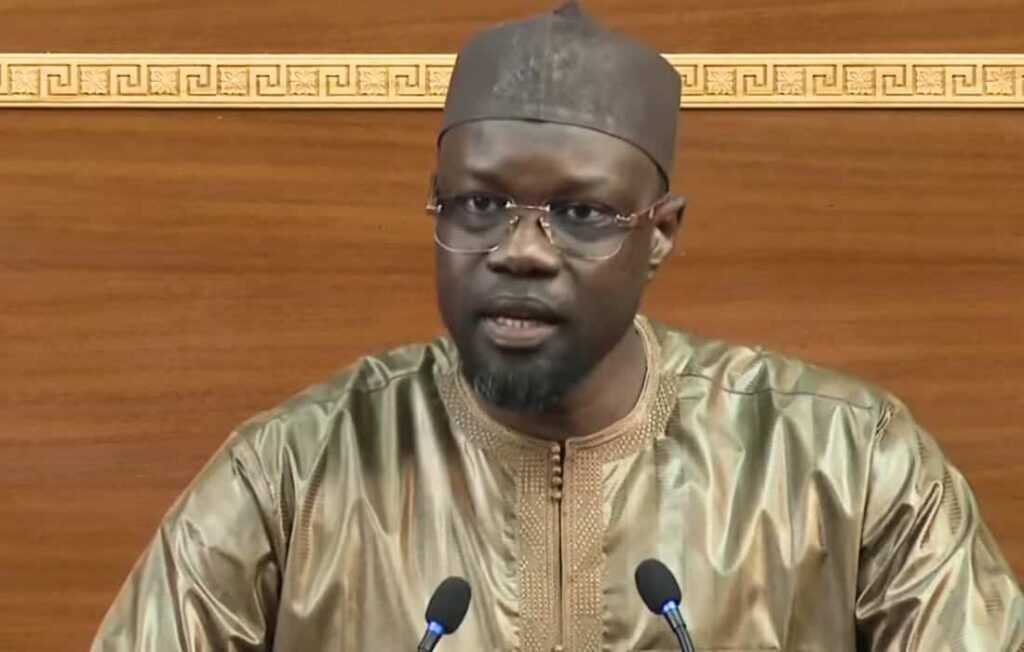
The Prime Minister of Senegal, Ousmane Sonko, recently framed the country’s stance on LGBT rights as a response to Western pressure, declaring it a « diktat » that threatens national sovereignty. Speaking before the National Assembly, he warned of a « tyranny of the West » allegedly attempting to « impose homosexuality » on Senegalese society. This rhetoric deepens an ongoing political divide between national autonomy and fundamental human rights, particularly as Senegal tightens its legal stance on same-sex relations.
The government’s position reflects a broader trend in which LGBT rights are increasingly used as a political battleground, pitting national identity against international human rights standards. This shift comes amid heightened legal restrictions and a climate of social stigma that has led to arrests and discrimination against LGBT individuals, as documented by human rights organizations.
LGBT rights in Senegal: a debate overshadowed by geopolitical tensions
Public reactions to LGBT rights in Senegal often center on themes of sovereignty and cultural autonomy. Social media and public discourse frequently echo slogans such as « these are our values » or « mind your own business », framing the issue as a matter of national pride rather than human dignity. This narrative diverts attention from the lived realities of LGBT individuals, whose daily existence is increasingly constrained by legal and social pressures.
A legal framework increasingly punitive
Senegal’s legal system has long criminalized same-sex relations under its Penal Code. Recent amendments in 2026 have escalated penalties to between five and ten years in prison, intensifying concerns about the enforcement of these laws. Beyond the courtroom, the consequences are far-reaching: LGBT individuals face systemic discrimination, arbitrary arrests, and violence, pushing many to live in secrecy to avoid persecution.
The debate extends beyond legal technicalities, touching on the fundamental rights to safety, dignity, and freedom from persecution. Human rights advocates emphasize that these violations are not abstract legal issues but real-world threats to individuals’ lives and well-being.
Why international concern over Senegal’s LGBT rights matters
The question of why external organizations engage with Senegal’s LGBT rights often arises. The answer lies in the principle of universal human rights—rights that transcend national borders. When individuals are criminalized or subjected to violence based on their sexual orientation, it becomes an international concern, not merely a domestic issue. Ignoring such violations would imply that human rights protections end at national frontiers, a principle the global community has long rejected.
Human rights: a Western imposition or a shared commitment?
A common misconception suggests human rights are an externally imposed concept. However, Senegal’s own Constitution, adopted in 2001, explicitly upholds the Universal Declaration of Human Rights as a cornerstone of its legal framework. This demonstrates that the country has voluntarily committed to protecting human rights, including the principle of non-discrimination.
Advocating for LGBT rights in Senegal is not about imposing foreign values—it is about holding the country accountable to its own constitutional and international obligations. The focus should remain on ensuring that no individual is punished or harmed for their identity, a principle already enshrined in Senegal’s legal and moral commitments.
LGBT identities: a timeless reality in Senegal
Some argue that LGBT identities are foreign to African societies, a recent import with no local roots. This claim is historically inaccurate. LGBT individuals have always existed in Senegalese society, contributing to its cultural and social fabric. Historical records and anthropological studies highlight figures such as the goor-jigeen, a traditional Senegalese identity that challenges rigid gender norms. These examples illustrate that discussions around gender and sexual diversity are not new but are deeply embedded in the region’s social history.
A debate shaped by deeper societal tensions
The discourse on LGBT rights in Senegal is intertwined with broader issues, including colonial legacies, political maneuvering, and social conservatism. While some frame the debate as a defense of national values, others warn of the dangers of dehumanizing rhetoric, which reduces LGBT individuals to a « threat » or « scourge ». Such language strips away the humanity of those affected, turning a human rights issue into a political football.
Human rights defenders stress that their work is not about cultural erasure but about protecting vulnerable individuals from harm. No one should face punishment, exclusion, or violence because of who they are—regardless of the justifications provided.
Global solidarity in defending human rights
Violations of LGBT rights are not confined to Senegal. Similar challenges exist in countries across Africa and beyond, from Russia to China. Human rights organizations respond to these abuses based on local conditions, available resources, and urgent needs. Their involvement does not imply a ranking of suffering but reflects a commitment to addressing injustices wherever they occur.
The principle of universality in human rights means that no individual should be left behind. While the methods of advocacy may vary, the core goal remains the same: to ensure that every person enjoys the dignity and safety they deserve.
Taking action: supporting LGBT individuals in Senegal
For those seeking to make a tangible difference, organizations are actively working to support LGBT individuals in Senegal. Initiatives include legal aid, emergency assistance, and advocacy campaigns aimed at challenging discriminatory laws and providing relief to those affected. Supporting these efforts can help turn the tide against injustice and offer hope to a marginalized community.
At its heart, this is a story about people—individuals whose lives are at risk due to laws and attitudes they cannot control. Their struggle is a reminder that human rights are not abstract ideals but lived realities that demand our attention and action.