
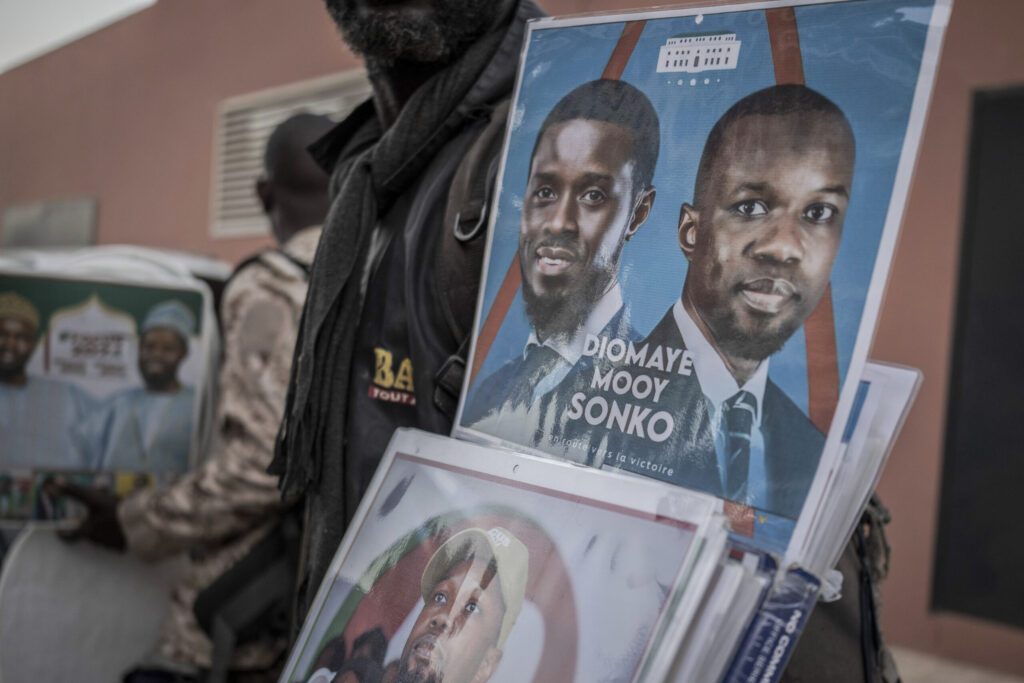
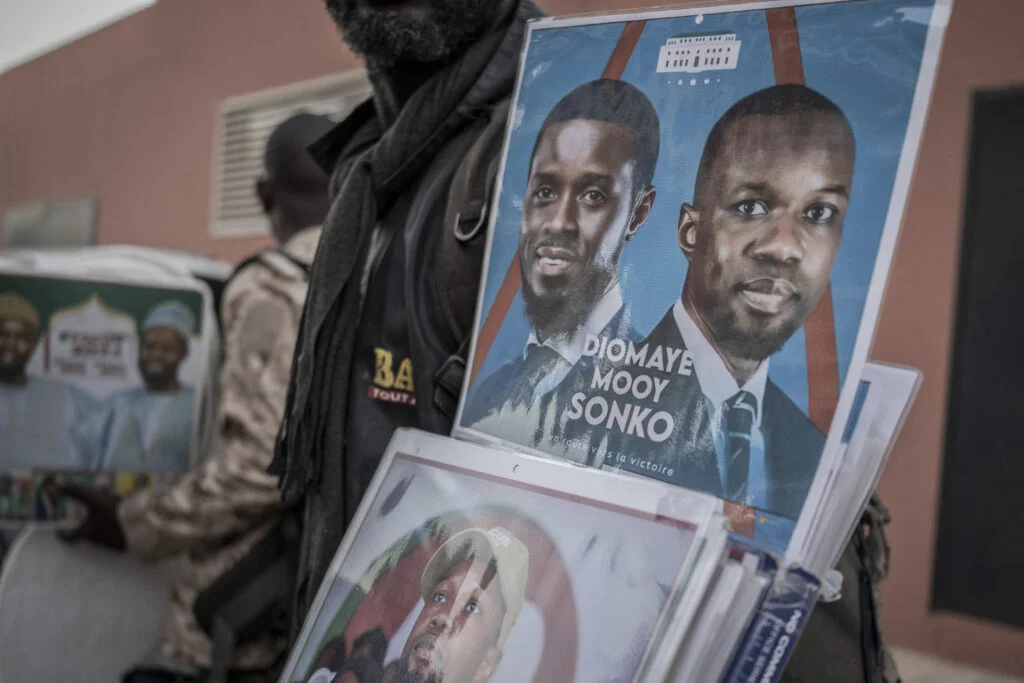
A vendor sells merchandise in support of Ousmane Sonko, Senegal's opposition leader, and Bassirou Diomaye Faye, presidential candidate, outside the venue of a news conference in Dakar, Senegal, on Friday, March 15, 2024. Ousmane Sonko and Bassirou Diomaye Faye were released after lawmakers approved amnesty for crimes linked to political protests between 2021 and 2024. Photographer: Annika Hammerschlag/Bloomberg via Getty Images
Political analysis / Senegal
Senegal’s political rift: president Faye and PM Sonko’s uneasy split
-

Caroline Roussy
Senior Research Fellow at IRIS, Africa Program Lead
On May 22nd, Ousmane Sonko was dismissed from his position as Prime Minister, potentially triggering a political crisis. For months, Sonko had described their relationship as a ‘gentle cohabitation’—a paradoxical claim given the inherent tensions of such arrangements, especially since both men emerged from the same political circle and maintained close ties as recently as 2024.
A friendship that seemed unbreakable
The bond between Bassirou Diomaye Faye and Ousmane Sonko began as students and strengthened during their time at the National School of Administration. They later pursued parallel careers as tax inspectors before co-founding the PASTEF party in 2014—a platform rooted in patriotism, ethics, and fraternity. By 2022, Faye had risen to become the party’s secretary-general while Sonko positioned himself for the presidential race.
The euphoria of March 24, 2024, remains vivid: their hard-fought victory symbolized more than political triumph—it was a moment of vindication after years of adversity. Both had been imprisoned during Macky Sall’s final days in office, their fates hanging by a thread. Yet within days, everything shifted. Mass protests erupted, international media flocked to Dakar, and Sall’s grip on power crumbled under pressure.
Freed from prison, they launched a lightning campaign under the slogan ‘Diomaye mooy Sonko, Sonko mooy Diomaye’ [‘Diomaye is Sonko, Sonko is Diomaye’]. With Sonko barred from running, Faye assumed the presidency, with his mentor’s full endorsement.
The victory appeared absolute, but questions lingered: was it Faye or Sonko who truly won the election? Faye, then relatively unknown, owed his ascent to Sonko’s towering popularity among Senegal’s youth.
Sonko had carved out a reputation as a political disruptor since 2019, defying expectations despite legal troubles and controversies. His connection with young Senegalese was unparalleled—fueled by a narrative of resistance and systemic change.
Political tandems in Senegal: a recurring pattern of division
Historical precedents suggest such alliances rarely survive the pressures of governance. The partnership between Léopold Sédar Senghor and Mamadou Dia, once seen as unshakable, dissolved into conflict over power structures and economic policy, culminating in Dia’s imprisonment in 1962.
Similarly, Abdou Diouf’s brief collaboration with Moustapha Niasse quickly soured. Under Abdoulaye Wade, the rift with Idrissa Seck—once touted as Wade’s successor—ended in Seck’s political sidelining and imprisonment, sparking mass protests.
Faye and Sonko’s split, though reminiscent of these patterns, began under unique circumstances: Sonko held the electoral legitimacy, while Faye lacked comparable political capital.
The roots of their growing divide
Unseen pressures likely exacerbated tensions. Advisors on both sides played a pivotal, if underestimated, role in shaping the schism.
Publicly, Faye and Sonko’s camaraderie faded into hostility. Over two years, grievances accumulated: disagreements over reform pace, handling of former regime figures, and judicial restructuring. Sonko openly criticized the administration’s inertia, particularly on economic strategy and debt negotiations with the IMF.
The breaking point came on November 8, 2025, during Sonko’s ‘Tera Meeting’ at Dakar’s Leopold Sédar Senghor Stadium. The event, billed as a progress report, became a show of force, with buses from across Senegal converging to demonstrate his enduring influence. The display underscored Sonko’s continued sway over the party’s base.
Faye responded by elevating Aminata Touré (‘Mimi’), a figure with ties to the previous administration, into a central role within the ruling coalition. This move was widely interpreted as Faye asserting independence from Sonko’s shadow.
For months, Faye had struggled to consolidate power under Sonko’s domineering presence. The equation proved unsustainable: Sonko and his allies frequently reminded observers of their contribution to Faye’s rise, positioning themselves as kingmakers.
What lies ahead?
Sonko’s dismissal brought temporary relief, as he posted on social media that he could finally rest at his home in Keur Gorgui. But the reprieve was short-lived.
On May 26th, National Assembly President El Malick Ndiaye resigned, and Sonko—leading the majority party with 130 of 165 seats—assumed the role. Reverting to opposition status, Sonko returns to a familiar arena where he once thrived.
This unprecedented scenario pits a president lacking his primary political ally against a legislature controlled by his former partner. The standoff risks unprecedented institutional clashes.
Can Faye govern convincingly without Sonko? The odds are uncertain. Might Sonko push for Faye’s removal? The answer remains unclear.
Yet beyond their personal feud, Senegal’s pressing challenges loom large: healthcare, economic stagnation, and a youth desperate for opportunities. Two years into this political transition, many promised reforms remain stalled, fueling public frustration.
Was this crisis inevitable? A question worth debating.

More Stories
Ousmane Sonko’s firm stance on Senegal’s FMI agreement demands full transparency
Senegal’s institutional crossroads: the unfolding dynamic between Ousmane Sonko and Bassirou Diomaye Faye
Minister abdourahmane diouf reignites feud with ousmane sonko over special credits reform