
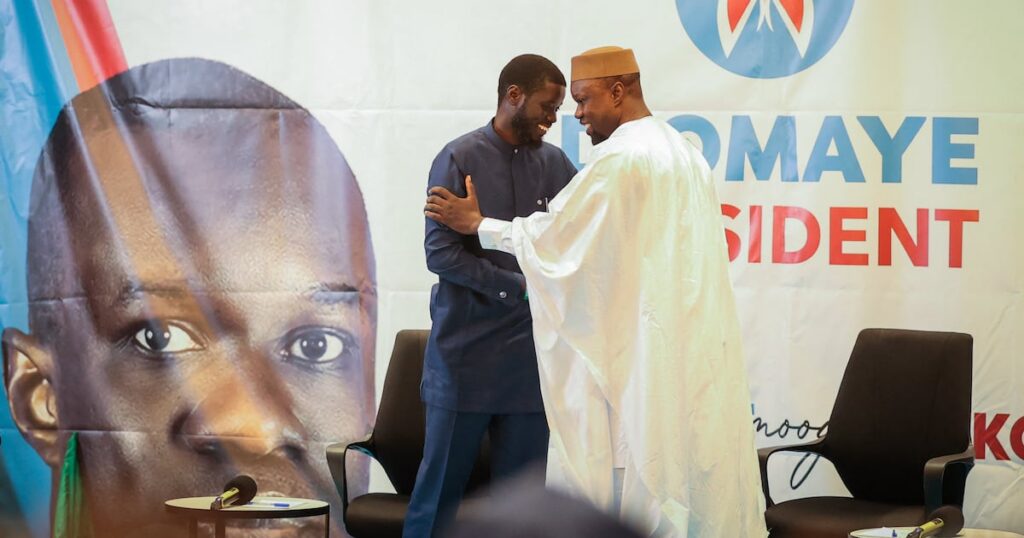
In Dakar’s political circles, from ministerial offices to grassroots neighborhoods, a growing consensus emerged in recent months: the alliance that propelled Senegal’s opposition to power was unraveling. The once-powerful campaign slogan « Diomaye mooy Sonko, Sonko mooy Diomaye » (Diomaye is Sonko and Sonko is Diomaye, in Wolof) had lost its resonance, replaced by a starker reality: « Diomaye is no longer Sonko ». Behind closed doors, the two men’s disagreements were no longer concealed.
The rift between President Bassirou Diomaye Faye and his Prime Minister Ousmane Sonko deepened with each passing week. Methodological differences, power struggles, and rivalries between their entourages turned their cohabitation into an untenable situation. The question wasn’t if the break would come, but when.
The calculated gamble of Ousmane Sonko
Ousmane Sonko had spent months methodically pushing his relationship with Bassirou Diomaye Faye to the brink. The Pastef leader understood that sharing power indefinitely with a president asserting his authority was unsustainable. Yet he also recognized that, in an open confrontation, his emotional and militant ties to the party’s base would likely work in his favor.
The true trap lay in forcing Diomaye Faye to choose between institutional authority and the party’s unity. By remaining in government while asserting his political autonomy, Sonko made the situation increasingly precarious. Each ambiguous statement, public disagreement, and subtle reminder of his status as the movement’s historic leader intensified the pressure on the president.
Diomaye Faye found himself in a no-win scenario. Accepting this form of shared leadership would paint him as weak, incapable of imposing his authority. Removing Sonko, however, risked portraying him as the one who shattered the Pastef’s founding pact and betrayed its original spirit in the eyes of many militants.
For Sonko, being dismissed was a strategic advantage. A forced departure allowed him to reclaim the role he never truly relinquished in the eyes of his base: the historic leader, the political martyr, and the central figure of Senegal’s break with the old system.
The danger of new sycophants
Bassirou Diomaye Faye may have fallen into a second trap. A new circle of courtiers now surrounds the president—political operators, former supporters of Macky Sall’s regime, opportunistic notables, and professional turncoats. Their message is consistent: « You are the president. Show who’s in charge. »
Such flattery aligns with the institutional architecture of Senegalese politics, where a prime minister appearing as a political equal to the head of state seems unnatural. Yet Diomaye Faye would do well to question the true motives of these new allies. Where were they when Sonko and he faced the judicial machine of Macky Sall’s regime? Where were they during the arrests, the bloody crackdowns on protests, and the smear campaigns against the Pastef? Many quietly enjoyed the privileges of the system they now condemn with revolutionary fervor.
These political chameleons thrive on division, amplifying rivalries and feeding competing egos. African political history is replete with movements that rose to power only to crumble under internal fractures. The danger for Diomaye Faye is real: believing that those who urged him to sever ties with Sonko genuinely seek to strengthen his power. Many may instead be working to weaken the Pastef and neutralize the political project it embodies.
The looming threat of a fractured Pastef
The power struggle is now out in the open, and it may favor Ousmane Sonko. Senegal’s political landscape remains unforgiving: the Pastef’s dominance stems from its militant base, a mobilized youth, and a powerful narrative forged during years of confrontation with Macky Sall’s regime. In this context, Sonko remains the movement’s central figure.
Even when barred from running in the presidential election and jailed, it was his name that galvanized the movement. For many Senegalese, Bassirou Diomaye Faye’s victory was seen as a proxy win for Sonko. While the president holds institutional legitimacy, his former prime minister retains a formidable popular and militant legitimacy. In any future political or electoral showdown, this factor could prove decisive.
If the Pastef splits between factions loyal to Diomaye Faye and those aligned with Sonko, there’s no guarantee the president would emerge victorious. Many cadres, elected officials, and militants may rally behind the figure they still view as the movement’s core. Bassirou Diomaye Faye lacks a fully independent political apparatus capable of counterbalancing Sonko’s influence—a critical vulnerability.
The curse of political heirs
The tragedy of political heirs is their inevitable desire to carve out their own identity. It’s human nature. No president can indefinitely accept being perceived as a figurehead without real authority.
Beyond personalities, the very coherence of the Pastef’s project is now in question. The movement was born from a promise of rupture: virtuous governance, sovereignty, social justice, and national dignity. Yet ego-driven conflicts have a way of diverting movements from their original mission, often with destructive consequences.
The irony? The Pastef’s opponents may ultimately benefit from a crisis they never had to engineer themselves.

More Stories
Ousmane Sonko’s firm stance on Senegal’s FMI agreement demands full transparency
Senegal’s institutional crossroads: the unfolding dynamic between Ousmane Sonko and Bassirou Diomaye Faye
Minister abdourahmane diouf reignites feud with ousmane sonko over special credits reform