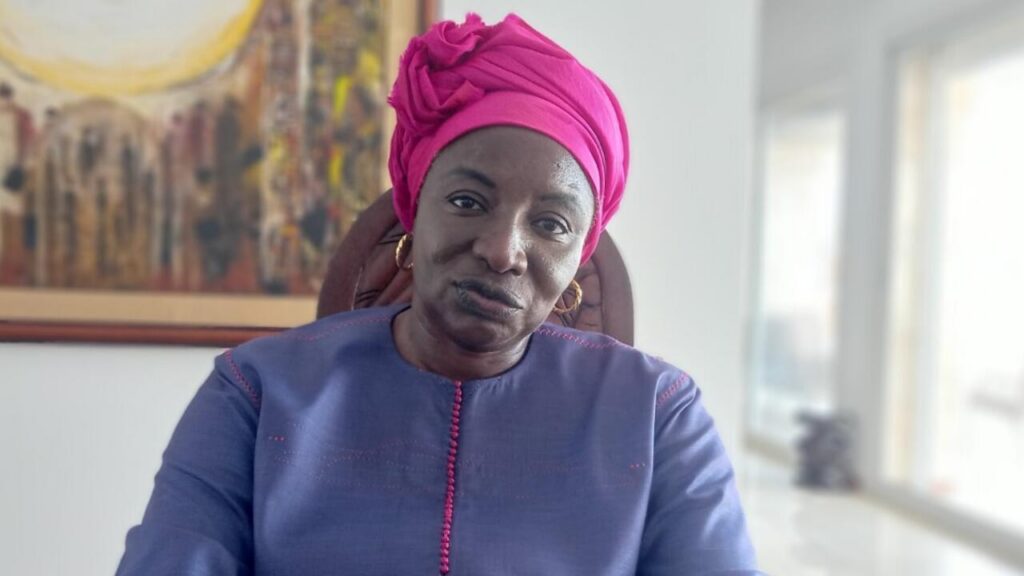
In Dakar, the political landscape remains tense following the formation of Senegal’s new government. Led by Prime Minister Ahmadou Al Aminou Mohamed Lô, the thirty-minister team—comprising technocrats and allies of President Bassirou Diomaye Faye—has sparked debate. Notably absent are key figures from the Pastef party, including its leader Ousmane Sonko, who declined participation. This absence underscores a growing divide between President Faye and Sonko, despite Faye’s own Pastef membership. Aminata Touré, supervisory general of the Diomaye Président coalition, addresses these dynamics as the featured guest in a candid discussion with our permanent envoy in Dakar.
a government born of democratic legitimacy
What does the composition of this new government reveal about Senegal’s democratic process?
Aminata Touré emphasizes the importance of democratic principles. “President Bassirou Diomaye Faye was democratically elected by 54% of Senegalese voters, and as such, he has the authority to appoint his Prime Minister and approve the government formed by them,” she explains. “This is a clear reflection of the president’s choices, in consultation with his Prime Minister. The focus here is on efficiency—beyond political debates, the priority for Senegalese citizens is to see tangible progress.”
The inclusion of some Pastef members in the government, despite the absence of major figures, further complicates the narrative. Touré clarifies that this is an “internal party matter,” not a reflection of broader democratic failure. “If everyone respects their roles and prioritizes the interests of Senegal, there’s no reason for institutional conflict,” she asserts. “The National Assembly, the executive, and the judiciary must each fulfill their responsibilities—including the Constitutional Council, which will review the constitutionality of laws.”
cohabitation or collaboration?
With Pastef holding a majority in the National Assembly, could governance become challenging?
Touré dismisses concerns about cohabitation, noting that “President Faye is a member of Pastef, and several ministers are as well.” The issue, she argues, is not one of institutional clash but of “personal interests overshadowing national priorities.” Her stance is firm: “We cannot afford endless domestic disputes. The people of Senegal need stability, not a perpetual political crisis.”
accountability vs. political infighting
Critics argue that excluding key Pastef figures signals a departure from the party’s promise of political accountability. How do you respond?
Touré pushes back against this interpretation, framing accountability as “a process of justice, not vendetta.” Drawing from her experience as former Minister of Justice, she distinguishes between “holding opponents accountable and settling personal scores.” “The president remains committed to accountability, but not to political witch hunts,” she states. “A judge’s ruling must be based on evidence, not personal animosity.”
debt restructuring: pragmatism over ideology
Ousmane Sonko has long opposed restructuring Senegal’s debt with the IMF. Will this government take a different approach?
Touré approaches the issue pragmatically. “Debt is not an ideological question—it’s a practical one,” she says. “Senegal owes money to creditors, and we must find a way to repay it.” She acknowledges the need for “reprofiling” and negotiations with partners, but warns against repeating the mistakes of past structural adjustments. “Restructuring in the 1980s led to social cuts and poverty—we cannot afford a return to that era,” she cautions. “The goal is to find a sustainable solution that benefits both the country and its people.”
the 2029 question: ambition or sabotage?
Could Pastef’s refusal to participate in the government be a strategic move to undermine President Faye’s agenda in favor of Ousmane Sonko’s 2029 presidential ambitions?
Touré rejects this notion, calling it “legitimate for anyone to aspire to the presidency.” Instead, she highlights the need for Senegalese voters to focus on “solving the country’s pressing issues rather than engaging in a three-year electoral campaign.” Her message is clear: “Sabotaging the government would mean betraying the very people we claim to represent.” She concludes with a call to let democracy function as intended: “We don’t have to agree on everything, but we must prioritize the nation’s interests.”
The interview underscores a pivotal moment in Senegal’s political journey—a test of whether democratic institutions can navigate internal divisions while delivering on the promises made to its citizens.