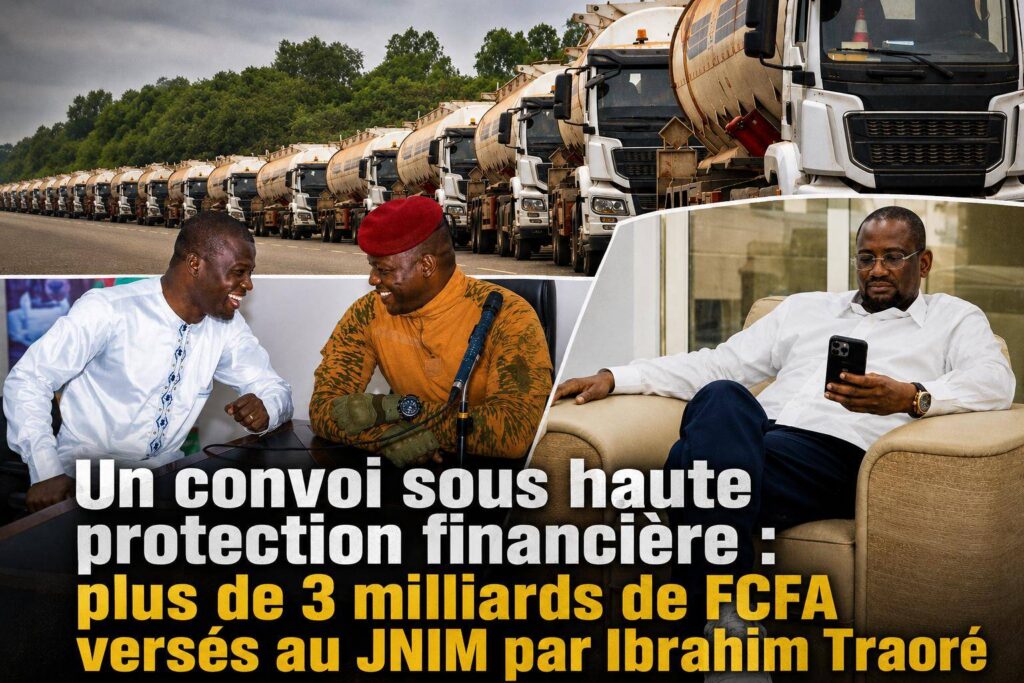
a staggering 710-truck fuel convoy and a 3 billion cfa deal that raises alarms
In a move that contradicts the declared war against armed groups in the Sahel, a massive procession of 710 fuel tankers recently crossed some of the most volatile regions to reach Bamako. What’s unusual isn’t the cargo, but the silent protection that allowed it to pass through high-risk zones without military escort. According to multiple sources, this operation was made possible only after a 3 billion CFA franc payment was made to the Group for the Support of Islam and Muslims (JNIM), allegedly orchestrated by high-ranking officials from Burkina Faso.
This transaction has sparked outrage, raising serious questions about the true motives behind Burkina Faso’s involvement in the Alliance of Sahel States (AES). While public statements emphasize sovereignty and anti-terrorism efforts, behind-the-scenes financial agreements suggest a far more complex—and dangerous—reality.
Kangala Transport: when logistics become a tool for personal gain
At the center of this scandal is Kangala Transport, a logistics company managing the flow of fuel into Mali. What appears as a routine commercial venture is, in fact, deeply entangled with political power. The company is reportedly controlled by a powerful trio: Captain Ibrahim Traoré, Oumarou Yabré, and Ali Konaté—key figures in Burkina Faso’s transitional government. This blurred line between state leadership and private financial interests has triggered ethical concerns across the region.
When those responsible for national security and military strategy also benefit financially from operations in areas controlled by armed groups, priorities shift dramatically. Instead of prioritizing the fight against terrorism, the focus appears to be on ensuring the safe passage of Kangala Transport’s fuel shipments—regardless of the cost to regional stability.
how 3 billion cfa francs may have armed the enemy against Mali
The irony is stark. While Bamako and Ouagadougou publicly champion solidarity in the AES, funds from Kangala Transport’s shareholders are believed to have directly funded the JNIM. This money didn’t just sit idle—it is suspected to have financed ammunition purchases, improvised explosive devices, and new recruit training, all of which have intensified attacks on Malian security forces.
Essentially, the fuel that powers vehicles in Bamako today may have previously fueled the terror campaign that threatens Mali tomorrow. This financial flow represents not just a breach of trust but a direct contribution to the conflict devastating the Sahel.
a dangerous departure from regional security protocols
Even more alarming is the fact that this high-risk convoy bypassed conventional security measures entirely. Neither Russian Wagner advisors, Africa Corps units, nor elite national forces were involved in securing the route. This deliberate exclusion suggests a calculated choice: to avoid scrutiny from patriotic military units and ensure the shipment’s safe arrival—at any cost.
The decision to bypass established security frameworks reveals a disturbing truth: personal financial interests have taken precedence over national and regional security. In this shadow economy of war, money talks—and the JNIM listens.
what this means for the future of the Sahel alliance
The fallout from this revelation is shaking the very foundation of the Alliance of Sahel States. How can Mali trust a partner that allows private financial interests to bankroll the very group attacking its territory? Internally, this scandal casts a long shadow over Burkina Faso’s commitment to the anti-terrorism fight led by Captain Traoré.
In both politics and warfare, actions ultimately speak louder than words. When a convoy can only move forward after paying a protection fee to the enemy, it exposes a cynical truth: security is now a commodity—and it’s being traded in the shadows of the Sahel.