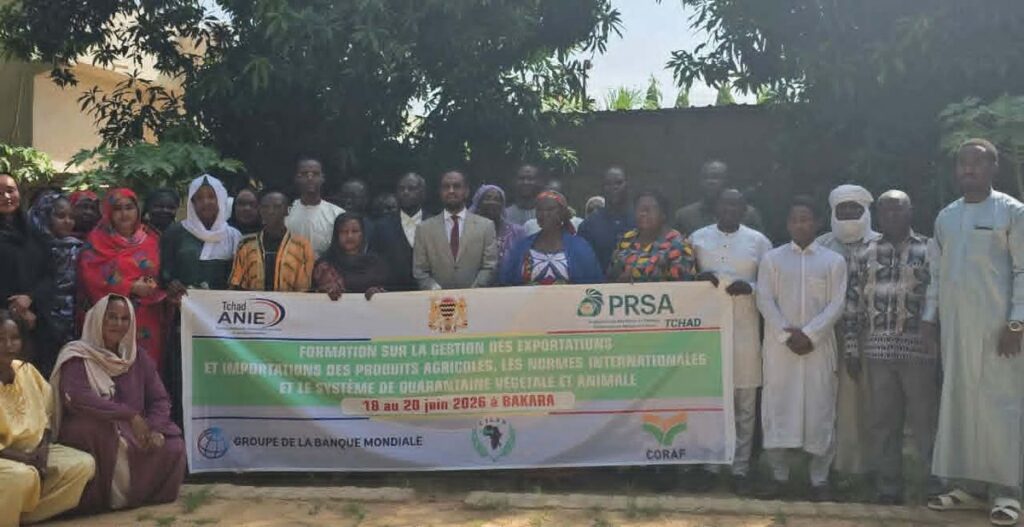
In a strategic move to bolster the country’s agricultural export sector, the World Bank and Chad’s National Investment and Export Agency (ANIE) jointly hosted a capacity-building workshop in Bakara. Focused on enhancing export management for agricultural products, the training targeted key challenges such as compliance with international norms, quarantine protocols, and customs procedures.
Overcoming export hurdles for local producers
During the session, Gotoraye Arnaud, Coordinator of the Agricultural Market Dashboard under the Agricultural Sector Resilience Programme (PRSA-TD), highlighted the persistent obstacles faced by Chadian farmers in accessing foreign markets. These include convoluted export procedures, stringent quality and safety standards, and rigorous sanitary and phytosanitary measures. The workshop aimed to address these pain points by equipping participants with practical knowledge in international certifications, export logistics, and risk mitigation.
Aligning with national economic ambitions
Dadi Adoum Arsin, Deputy Director-General of ANIE, emphasized that this initiative aligns with Chad’s broader economic vision. The government’s top priorities include diversifying the economy, promoting local production, fostering private sector growth, and boosting exports. This effort is also embedded in the Tchad Connexion 2030 National Development Plan, which seeks to position the private sector as a driver of job creation and regional economic integration.
To achieve this, Chad must not only increase production but also enhance its export capabilities. Strengthening export competitiveness is a critical step toward achieving economic sovereignty.
The African Continental Free Trade Area: a game-changer
The African Continental Free Trade Area (AfCFTA), now operational, presents a vast market of over 1.4 billion consumers. For Chad to capitalize on this opportunity, it must prioritize quality assurance, standardization, certification, and workforce upskilling. Without these investments, the country risks being left behind in the continental trade boom.
ANIE’s role in fostering export excellence
ANIE is committed to creating an enabling ecosystem where businesses have access to market intelligence, technical support, trade opportunities, and strategic partnerships. By acting as a facilitator, the agency aims to empower local enterprises, enhance their competitiveness, and position Chadian expertise on the global stage. This training session is a testament to that mission, bringing together public and private stakeholders from agriculture, health, production, and export promotion sectors.