
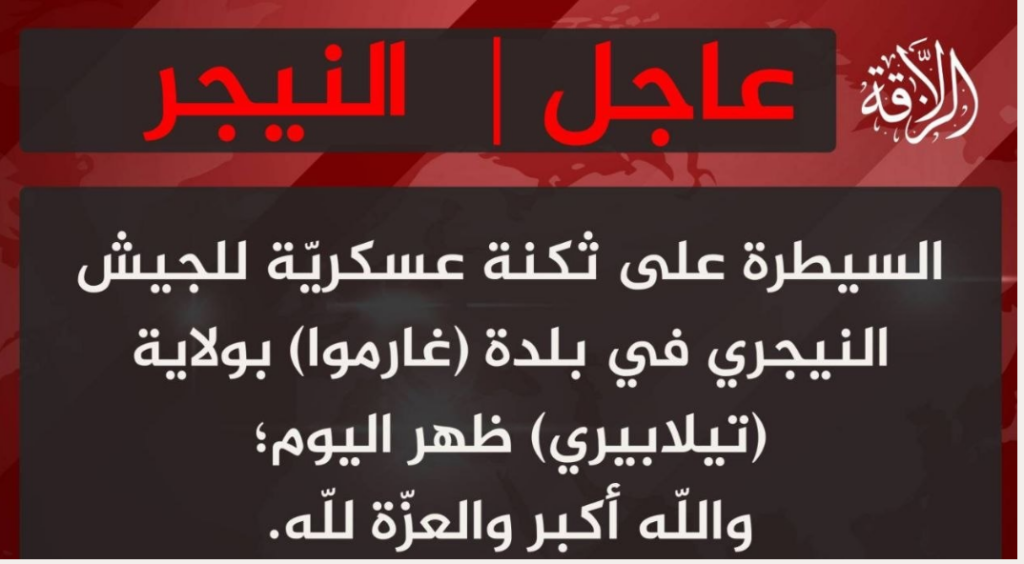
The sleepy locality of Garbougna, nestled in the heart of Niger’s Tillabéri region near the Malian border, became the site of an unprecedented tragedy on the morning of May 14, 2026. A coordinated assault by heavily armed militants left at least 67 people dead, including soldiers and civilians, in what local and military sources describe as one of the deadliest terror attacks in recent years.
The ambush: a well-orchestrated strike at dawn
Just before dawn, as the first light of day began to break over the three-border zone—where Niger, Mali, and Burkina Faso converge—a force of militants launched a devastating attack on a Nigerien military engineering unit stationed at Garbougna. The assailants, identified by intelligence reports as members of the JNIM (affiliated with Al-Qaeda), moved swiftly using motorcycles and pickup trucks to surround the camp.
Armed with heavy weaponry and explosives, the attackers overwhelmed the initial defenses of the Nigerien soldiers, who responded with fierce determination. However, the sheer scale and speed of the assault allowed the militants to breach the camp, turning the area into a chaotic battleground. The militants’ tactics reflected a high level of coordination, leaving little room for resistance.
Mixed casualties: soldiers and civilians pay the price
The provisional death toll of 67 has sent shockwaves through the region, with victims spanning both the military and civilian spheres. Among the fallen are soldiers from the Nigerien engineering corps, whose mission was to construct a critical bridge that would connect isolated communities and boost local trade. Tragically, the attack also claimed the lives of local workers, including drivers, equipment operators, and villagers who collaborated daily with the military on development projects.
Rescue operations are underway, with critically injured survivors being airlifted and transported overland to medical facilities in the region and Niamey. Search parties continue to scour the surrounding bushland for any remaining missing persons.
Targeting progress: how terror seeks to cripple development
The engineering unit targeted in Garbougna was not engaged in combat operations; instead, it was tasked with completing a vital infrastructure project—a bridge designed to alleviate the economic isolation of the Tillabéri region. By striking this unit, the JNIM has once again demonstrated its strategy of targeting symbols of state presence and development to instill fear and dependency among local populations.
For these militant groups, sabotaging infrastructure and disrupting public works is a deliberate tactic to undermine government efforts to restore stability. The attack on Garbougna underscores their intent to keep the region trapped in a cycle of poverty and insecurity, where fear dictates daily life.
The three-border zone: a powder keg of instability
The Garbougna attack is a grim reminder of the persistent volatility gripping the three-border zone, where the porous borders between Niger, Mali, and Burkina Faso allow militant groups to strike and retreat with impunity. Despite intensified joint military operations and bolstered defenses by Niger’s armed forces, the threat posed by these groups remains alarmingly high.
In Niamey, the capital, the outrage is palpable. Authorities have vowed that the sacrifice of those who perished will not be in vain, pledging to continue national reconstruction efforts in their memory. The attack serves as a stark illustration of the dual battles being waged in the Sahel: one against terrorism and the other for the restoration of peace and economic revival.
The resilience of the Nigerien people is once again being tested, as they face the daunting challenge of rebuilding after yet another devastating strike. The loss of 67 lives in Garbougna is not just a military setback—it is a direct attack on the future of Tillabéri’s communities, where hope and progress are as fragile as the infrastructure that binds them together.



More Stories
Niger: Tiani faces fallout from special forces anger after Russian intervention
Mali : 17 morts dans les rangs des dozos, le JNIM accentue sa pression
Sahel : le pari des juntes tourne-t-il à l’échec sécuritaire ?