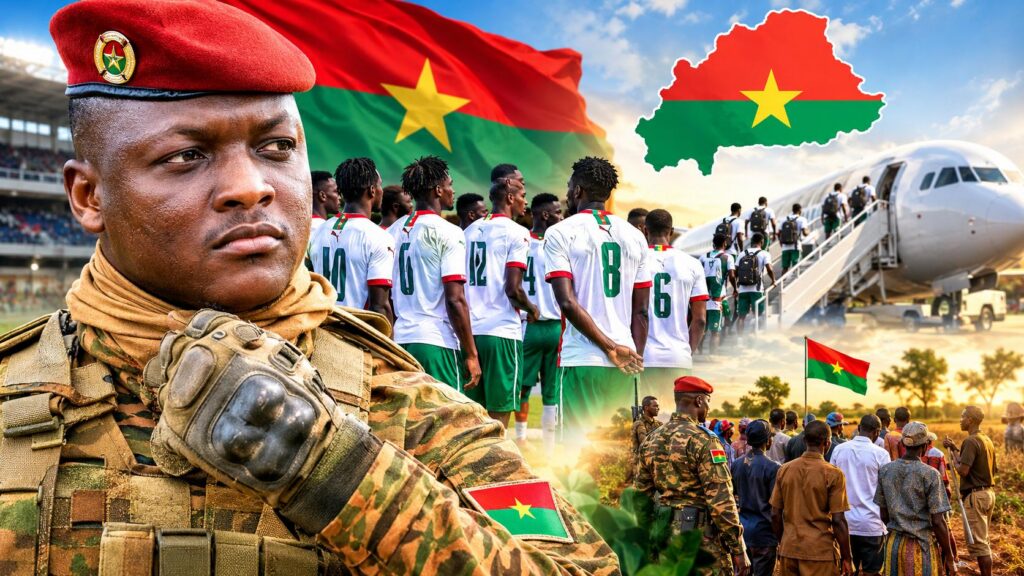
The reported requisition of Burkina Faso’s senior national football team, the Stallions, for what has been described as a “patriotic insertion” has ignited a wave of reactions across the country. What began as an unexplained absence from an international fixture in Argentina has rapidly evolved into a broader public conversation about the role of sport in national life, the reach of patriotic mobilisation, and the direction in which the nation is heading.
The fallout has been immediate and multifaceted. Supporters, sports administrators, and ordinary citizens alike have voiced their bewilderment at the prospect of the national squad being diverted from its sporting duties. For many, the image of the Stallions not on the pitch but engaged in activities framed as patriotic duty encapsulates a growing unease about the blurring of lines between sport and state imperatives.
Public reaction: a nation divided
Reactions have ranged from cautious understanding to outright dismay. Some observers acknowledge the gravity of the security situation that has shaped Burkina Faso’s public life for years and accept that extraordinary measures may sometimes be necessary. Others, however, question whether the requisition of a football team a symbol of national unity and joy represents a step too far.
The debate has spilled beyond sports circles. Commentators, civil society voices, and ordinary Burkinabè have taken to social media and public forums to ask a fundamental question: where should the boundary lie between civic duty and the preservation of normal life?
Voices from the stands
For the fans who have followed the Stallions through triumphs and disappointments, the episode has been particularly disorienting. The national team has long served as a rare point of collective pride, a space where political and social tensions are momentarily set aside. Its apparent co-optation into a mobilisation effort has left many wondering whether even football can remain untouched by the prevailing political climate.
The broader context: mobilisation as a way of life
To understand the significance of this episode, it must be placed within the wider trajectory of Burkina Faso’s recent history. For several years, the country has experienced an intense militarisation of public institutions and a concerted push to mobilise all segments of society around the national effort. The authorities justify these measures by citing the imperatives of a relentless security crisis.
Yet the extension of such logic into the realm of sport raises distinct questions. Sport, by its nature, operates on principles of merit, fair play, and international engagement that sit uneasily with the demands of permanent mobilisation. When a national team is asked to prioritise patriotic duties over competitive obligations, what message does that send about the value placed on sport itself?
An evolving doctrine
The notion of “patriotic insertion” appears to represent an evolving doctrine that seeks to align all sectors of national activity with the defence of the homeland. While the motivations behind such an approach may be understandable given the security context, its application to diverse fields including culture, education, and now sport suggests a systematic reorientation of public life.
What comes next? Scenarios and implications
As the situation stands, several possible paths lie ahead. The first is clarification: an official statement from the Burkinabè Football Federation, the Ministry of Sports, or other competent authorities could shed light on the exact circumstances of the team’s absence and the nature of the requisition. Such clarity would be welcomed by all stakeholders.
A second scenario is that the episode sets a precedent, encouraging further requisitions of athletes or sports institutions for non-sporting purposes. Should that occur, Burkina Faso risks alienating its sporting talent, damaging its international sporting reputation, and eroding the popular goodwill that national teams typically enjoy.
A third possibility is that the controversy prompts a reconsideration of how patriotic mobilisation is applied. The public debate now underway could lead to a recalibration, ensuring that sport retains its autonomy while still contributing to national cohesion in ways that do not compromise its integrity.
The importance of verification
It is essential to note that the available information remains preliminary. The account of the requisition stems from a single correspondent and has not been independently verified. Until official confirmation is obtained, definitive conclusions cannot be drawn. This caution is not a dismissal of the concerns raised but a recognition that responsible journalism requires distinguishing between allegation and established fact.
A crossroads for Burkina Faso
Regardless of the final outcome, the episode has already achieved something significant: it has forced a national conversation about the limits of patriotic mobilisation and the place of sport in a society under pressure. The questions raised are not merely about football; they touch on the kind of nation Burkina Faso aspires to be.
Can a country facing genuine security threats also preserve spaces of normalcy, joy, and international engagement? Can the Stallions continue to represent the hopes of a nation without being drafted into a broader political project? These are the questions that will define the coming months. The answers will depend on how the authorities respond to the current debate and whether they choose to reaffirm the distinct value of sport within the national fabric.
For now, Burkina Faso watches and waits. The ball, so to speak, is in the court of those who must clarify what happened and why and, more importantly, what it means for the future.