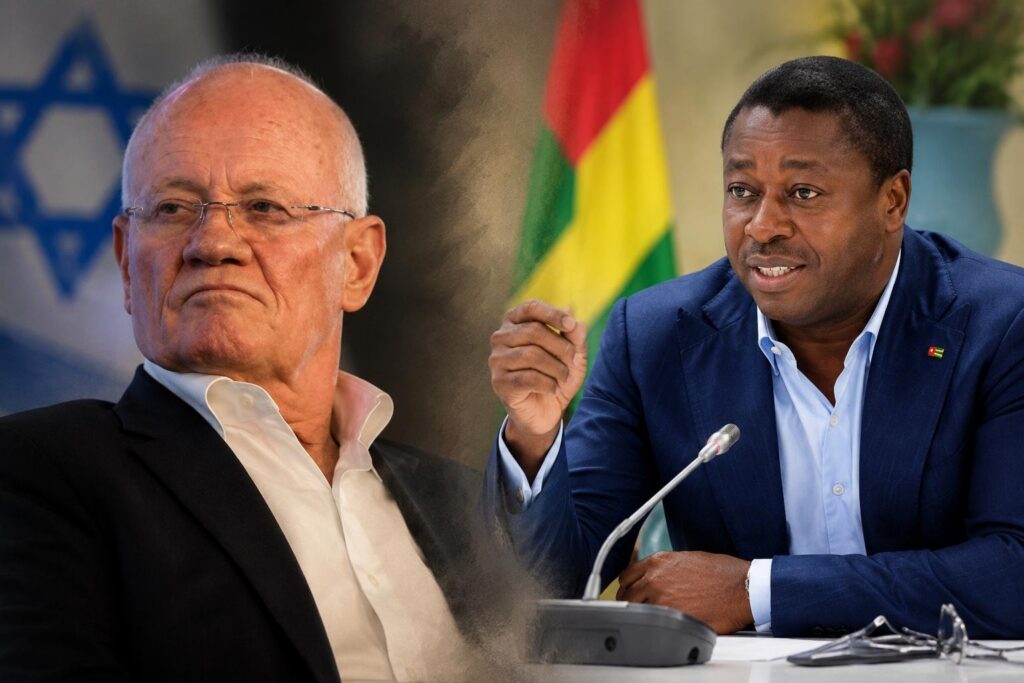
Recent investigative findings by journalist Thomas Dietrich cast a stark light on the intricate security mechanisms upholding Faure Gnassingbé’s regime in Togo. These revelations suggest that Danny Yatom, a former head of Israel’s Mossad, directly advises the Togolese head of state through his private security firm. While these details expose the extensive reach of state surveillance in Lomé, the profile of the investigative journalist, suspected of serving Russian interests, raises questions about the geopolitical undercurrents of these disclosures.
the gnassingbé dynasty: governance through fear
To fully grasp the significance of these revelations, one must consider the nature of the Togolese regime. Togo operates under a dynastic dictatorship. Faure Gnassingbé assumed power in 2005 following the death of his father, Eyadéma Gnassingbé, who had ruled with an iron fist for nearly four decades. For over two decades, the son has continued this policy of intimidation, quashing any aspirations for democracy.
In Togo, political opposition is systematically stifled, dissenting voices face harassment, and independent journalists endure constant threats of imprisonment or exile. It is within this atmosphere of state paranoia that the Lomé administration persistently seeks to fortify its security apparatus, ensuring the survival of the ruling clan.
the former mossad chief’s presence in Lomé
The most explosive aspect of the investigation centers on the direct involvement of high-ranking Israeli intelligence officials. Danny Yatom, previously director of the renowned Mossad, is reportedly a personal advisor to Faure Gnassingbé. In the late 2000s, Yatom, alongside his son Omer Yatom, established the consulting firm Dantov Global Consulting.
Through this private entity, Israeli espionage expertise is allegedly deployed to serve the Togolese presidency. Dantov Global Consulting doesn’t merely offer strategic recommendations; it actively organizes the head of state’s private security and supplies sophisticated geolocation and listening equipment. This advanced technological infrastructure serves a clear purpose: to monitor, track, and neutralize anyone deemed a threat to the regime, including opposition leaders, civil society activists, and media professionals.
technological repression: the june protests
The practical consequences of this security cooperation are evident on the ground. The investigation indicates that technologies provided by the Yatom’s company, already bound by a formal contract with the Togolese state, played a crucial role last June. When the Togolese populace peacefully took to the streets to demand reforms and protest the high cost of living, the popular uprising was brutally suppressed. Geolocation and communication interception tools facilitated the identification, targeting, and apprehension of organizers before the protests could gain significant momentum. To preserve his family’s hold on the nation, Faure Gnassingbé appears willing to forge dangerous alliances, even importing military-grade espionage methods to turn against his own citizens.
thomas dietrich: a messenger for the kremlin?
While the content of the investigation is alarming for human rights in Togo, the identity of its author, Thomas Dietrich, raises profound questions regarding its impartiality. Known for his strong anti-Western stances, Dietrich is increasingly identified by African geopolitics specialists as an agent of influence serving Russian interests.
The publication of this damning report against a traditional ally of Israel and Western powers aligns perfectly with Moscow’s information warfare strategy across the African continent. By targeting Togo and Israeli expertise, this investigation seeks not only to expose a dictator but also to weaken rival spheres of influence for the Kremlin in West Africa. Dietrich’s lack of transparency regarding his own connections and funding casts a legitimate shadow of suspicion over his true professional motivations.
The Dantov Global Consulting affair highlights the troubling trajectory of a desperate Togolese regime, prepared to go to any lengths to retain power, including transforming the nation into a laboratory for technological surveillance. However, this exposé loses some of its moral weight when it potentially becomes an instrument of propaganda for another imperialist power. Caught between Faure Gnassingbé’s dictatorship and Thomas Dietrich’s geopolitical opportunism, the Togolese people remain the overlooked victims of this shadow war, deprived of their freedom by the technologies of some and instrumentalized by the rhetoric of others.