
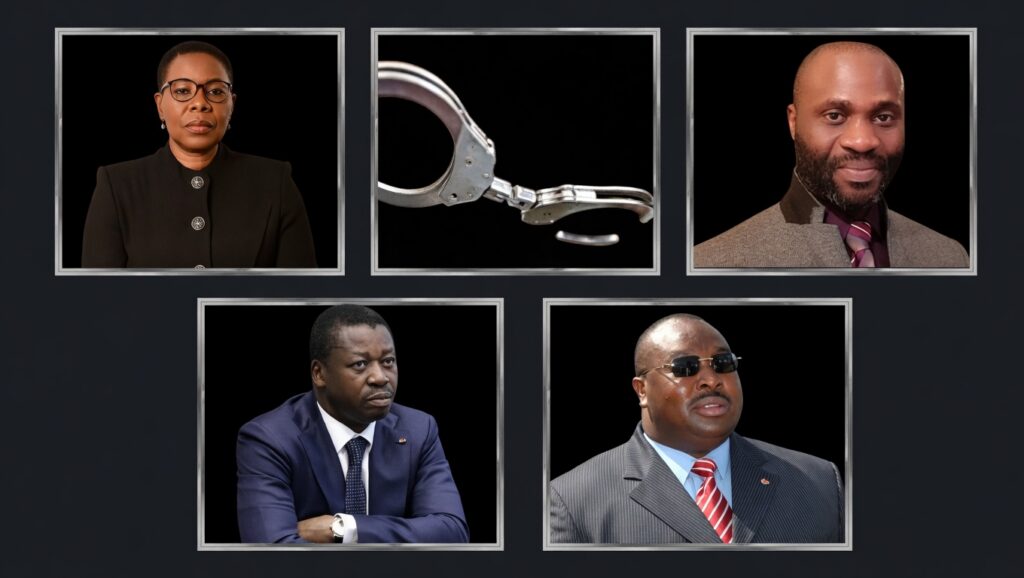
A significant strain is currently evident between Togo’s political establishment and its judicial system. At the core of this dispute lies the alleged failure to implement a Lomé Court of Appeal ruling that mandated the release of thirteen individuals. Amidst claims of arbitrary actions and assertions of national security imperatives, the nation finds itself grappling with a deepening institutional crisis of trust.
The core of the dispute: a disregarded court order?
The issue escalated to a national level when various opposition coalitions, including the Dynamique Monseigneur Kpodzro (DMK), the Dynamique pour la Majorité du Peuple (DMP), and the Togo Debout (TPAMC) movement, publicly condemned the ongoing detention of thirteen citizens, despite a judicial decision favoring their release.
The facts
According to legal representatives for the detainees, the Lomé Court of Appeal had formally issued an order for these individuals’ liberation. However, several weeks following the deliberation, the persons concerned remain incarcerated.
The accusation
For the opposition, this situation constitutes a «judicial kidnapping,» where the executive branch appears to supersede the authority of the judiciary.
Prominent figures
Among those whose cases have become central to this crisis are Jean-Paul Omolou, a well-known diaspora figure, along with Marguerite Gnakadé and Honoré Sitsopé Sokpor. Their plights have come to symbolize the broader struggle for an independent judiciary.
A legitimacy crisis extending to ECOWAS
The arguments put forth by civil society organizations are not confined solely to national jurisdictions. They highlight a pattern of «institutional resistance» to supranational rulings.
«Togo seems to be disregarding not only its own statutes but also the verdicts of the ECOWAS Court of Justice,» lamented a spokesperson for the TPAMC.
This disregard for the regional court’s judgments, according to critics, serves as evidence of political influence that is stifling the judicial system. This impasse raises a fundamental question: what purpose do legal appeals serve if orders for release are not upheld?
Two contrasting visions of the Republic
The ongoing debate sharpens the divide between two distinct philosophies regarding state governance:
The government’s perspective (stability)
- Priority on national security: Authorities frequently justify their firm stance by emphasizing the imperative to prevent public disturbances.
- Administrative autonomy: The government refutes any allegations of interference, citing ongoing administrative processes.
The opposition’s perspective (human rights)
- Adherence to due process: For opposition groups, no security concern can legitimize the disregard of a definitive order for release.
- Condemnation of arbitrariness: The utilization of imprisonment as a tool for political incapacitation is vehemently denounced.
Demands: charting a path out of the crisis?
To alleviate the prevailing social tensions, human rights organizations and opposition parties are calling for three immediate actions:
- The prompt implementation of all judicial decisions mandating releases;
- The termination of prosecutions deemed to be politically motivated;
- A genuine dialogue concerning the reform of the judicial system to ensure its impartiality.
A crucial test for Togolese democracy
Beyond the specific individuals mentioned, it is the very credibility of the judicial institution that hangs in the balance. If justice is meant to be the ultimate safeguard against arbitrary power, then its inability to enforce its own rulings severely undermines the social contract. The government, which advocates for progress and stability, confronts a significant challenge: demonstrating that Togo operates as a state governed by law, where the rule of law prevails over the law of force.
The matter remains unresolved, and the international community, particularly ECOWAS, is intensifying its scrutiny on Lomé.



More Stories
Niger: Tiani faces fallout from special forces anger after Russian intervention
Crisis in Niger, IMF agreement in Sénégal, and Moroccan elections: Five essential stories
RDC-Israël : un rapprochement aux enjeux multiples