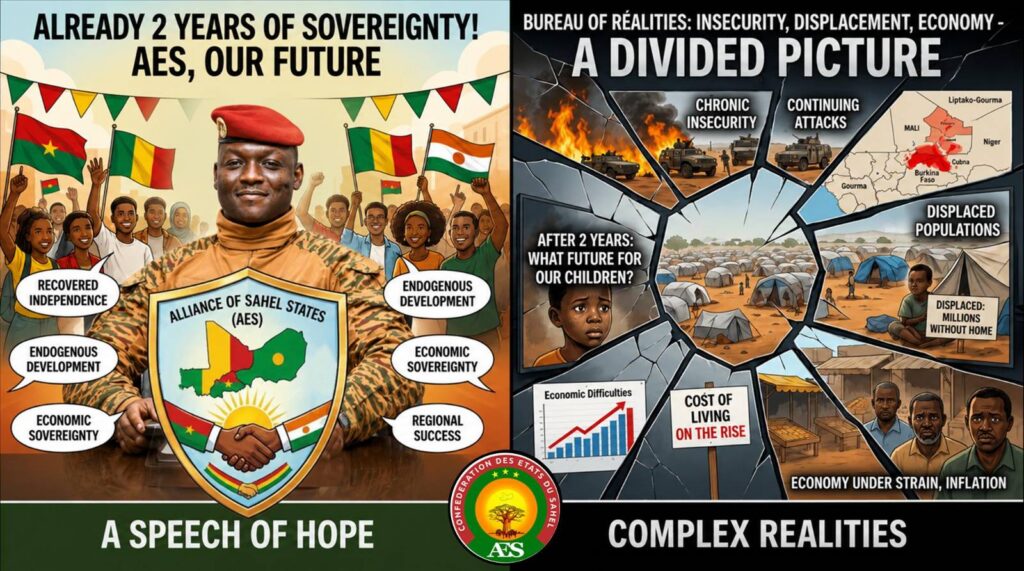
Assessing the AES Alliance: Promises vs. Reality After Two Years
Two years after the establishment of the Confederation of Sahel States (AES)—an alliance uniting Burkina Faso, Mali, and Niger—its leaders continue to champion the initiative as a landmark achievement, emphasizing sovereignty, regional solidarity, and strengthened cooperation. While this narrative resonates with certain segments of the public, it has yet to fully persuade critics who demand tangible progress.
The leaders of the AES have repeatedly highlighted advancements in diplomacy, defense, and institutional frameworks. Yet, on the ground, the fundamental challenges that drove the formation of this alliance remain unresolved.
Sovereignty as a Political Mantra
The rhetoric surrounding sovereignty has become central to the narrative of the AES. However, true sovereignty extends beyond mere disengagement from traditional partners or shifts in international alliances. It is fundamentally about a state’s capacity to safeguard its citizens, uphold institutional integrity, sustain economic stability, and provide opportunities for its youth.
Despite frequent claims of military triumphs, armed groups continue to operate across vast territories in all three nations. Civilians remain under constant threat of violence, while mass displacements and persistent humanitarian crises persist as daily realities. Economic integration, another cornerstone of the alliance, has also fallen short of expectations. Trade flows remain sluggish, fiscal constraints endure, and purchasing power declines for many households, leaving observers skeptical about the alliance’s practical benefits.
Public Expectations vs. Political Priorities
For the citizens of the AES member states, the true measure of governance lies in tangible improvements to their lives. Security, access to healthcare, education, employment, and infrastructure are the benchmarks by which leaders are judged—not abstract declarations of independence.
Moreover, the emphasis on sovereignty risks overshadowing critical issues such as governance, transparency, and accountability. A regional union cannot sustain public trust without robust institutions, effective public policies, and responsible resource management. The alliance’s long-term viability hinges on its ability to deliver measurable benefits to its people, rather than rely solely on political rhetoric.
A Balancing Act Ahead
Undoubtedly, the AES represents a significant shift in West Africa’s political landscape. Yet, its legacy will be determined not by the volume of its leaders’ pronouncements, but by the concrete outcomes it produces. Citizens in Burkina Faso, Mali, and Niger are no longer satisfied with lofty ideals; they demand results.
The success of this alliance will ultimately be judged by its capacity to address the persistent security threats, economic hardships, and social inequalities that continue to afflict the region. Until such progress is evident, the narrative of sovereignty—however compelling—will remain incomplete.