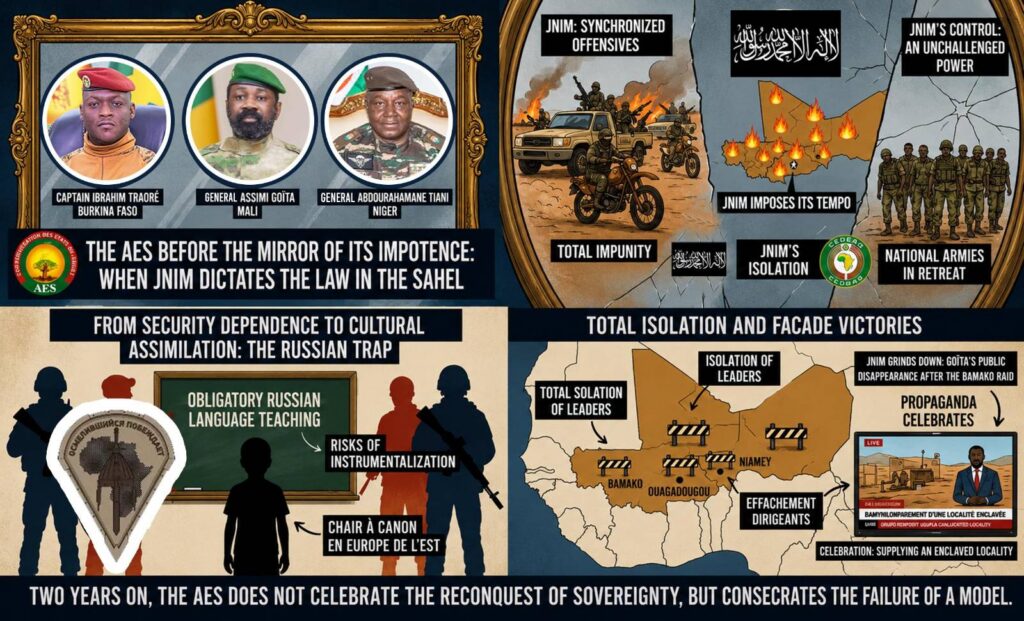
Two years in, Sahel States Alliance’s bold promises fade against relentless jihadist onslaught
The Alliance of Sahel States (AES) entered the regional stage with fanfare and defiant rhetoric, yet its two-year anniversary reveals a sobering truth: the only force dictating terms on the ground remains the Group for the Support of Islam and Muslims (JNIM), a terror network whose operational precision continues to outmaneuver national armies.
The military juntas in Bamako, Ouagadougou, and Niamey have rallied under a banner of sovereignty, but their political amateurism and bombastic declarations are crumbling against the JNIM’s devastating efficiency. Coordinated attacks across multiple strategic zones have exposed the fragility of armies supposedly better equipped, while coordinated intelligence sharing and Moscow’s backing have failed to stem the tide.
From security dependence to cultural assimilation: the Russian gambit
Facing this security void, the AES leadership has embraced a deeper bond with Russia—one that extends beyond military contracts or the deployment of Wagner Group remnants (now rebranded under Africa Corps). The announcement that Russian will be introduced into Burkina Faso’s school curriculum starting next academic year signals a deliberate ideological shift.
Officially framed as an act of cultural decolonization, the move is far more insidious. By embedding Russian language and cultural influence at the primary education level, the junta is laying the groundwork for long-term psychological and structural alignment with Moscow. The concern is not merely linguistic: once Burkinabè students are sent to Russia for higher education, they may be groomed for roles that extend beyond academia. In a geopolitical climate marked by global confrontation, a chilling possibility emerges—these young citizens could be mobilized as human shields or cannon fodder in conflicts far removed from the Sahel, all under the guise of academic exchange and Moscow’s military support.
Isolation and hollow victories as terror tightens its grip
While the junta pursues this cultural realignment, the JNIM continues to erode state authority. Its campaign has effectively paralyzed the three regimes, reducing their leaders to isolated figures, often confined to backstage maneuvering. The prolonged absence of Mali’s transitional leader, Assimi Goïta, from public view following a deadly raid in Bamako—allegedly claiming the life of the Defence Minister—epitomizes this deepening irrelevance.
State propaganda, once a pillar of regime legitimacy, now celebrates minor logistical successes—such as the resupply of a remote village—as major triumphs. These are admissions of defeat in all but name. Two years after its inception, the AES is not celebrating a return to sovereignty; it is mourning the collapse of a flawed model. By conflating wartime propaganda with genuine military strategy and swapping one foreign dependency for another—this time with Moscow—the juntas have not liberated the Sahel. They have merely exchanged one form of subjugation for another, with the region’s youth bearing the heaviest burden.