
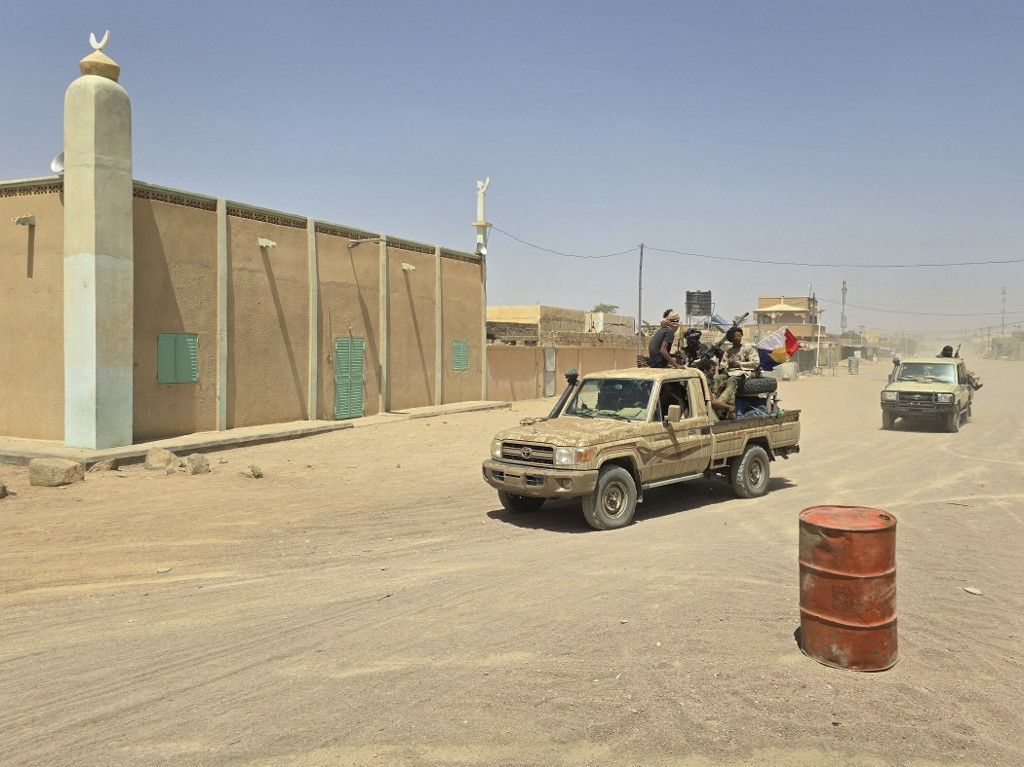
Tuareg rebels of the Azawad Liberation Front (FLA) coalition ride on the back of a pickup truck in Kidal, on April 26, 2026. April 25, 2026's shock attacks, synchronised by Tuareg rebels of the Azawad Liberation Front (FLA) coalition and the jihadist Group for the Support of Islam and Muslims (JNIM), targeted several areas in the vast arid country. Fighting resumed on April 26 in several areas, including Kita near Bamako, Kidal, Gao and Severe. Tuareg rebels meanwhile announced an agreement allowing Russian forces backing Mali's army to withdraw from the northern city of Kidal, which they claimed was "totally" under their control. (Photo by AFP) / The erroneous mention[s] appearing in the metadata of this photo by - has been modified in AFP systems in the following manner: [Removes byline]. Please immediately remove the erroneous mention[s] from all your online services and delete it (them) from your servers. If you have been authorized by AFP to distribute it (them) to third parties, please ensure that the same actions are carried out by them. Failure to promptly comply with these instructions will entail liability on your part for any continued or post notification usage. Therefore we thank you very much for all your attention and prompt action. We are sorry for the inconvenience this notification may cause and remain at your disposal for any further information you may require.
Jnim: al-qaeda’s rising power in the Sahel and its threat to Bamako
The Jama’at Nusrat al-Islam wal-Muslimin (Jnim) is tightening its grip on Mali. The capital Bamako now faces an imminent threat from this Al-Qaeda-affiliated jihadist group, which seeks to establish an Islamic emirate in the heart of the Sahel. Here’s what you need to know.
The Jama’at Nusrat al-Islam wal-Muslimin (Jnim) stands at the gates of Bamako, Mali’s capital. If the city falls, this extremist group—already the most dominant jihadist organization in the Sahel—would seize control of vast swaths of the country. With ties to Al-Qaeda, Jnim has become the driving force behind the ongoing insurgency in Mali, where it continues to push back government forces and Russian-backed mercenaries.
Origins and leadership
Formed on March 2, 2017, Jnim emerged from the merger of four existing jihadist factions operating in the region. United under the Al-Qaeda banner, the group quickly established itself as a formidable force. Its leader, Iyad Ag Ghali, a former Tuareg rebel and diplomat, assumed the role of emir. Since France’s withdrawal from the Barkhane operation, Jnim has gained significant momentum, exploiting the power vacuum.
Ideology and goals
Jnim’s ideology is rooted in a strict interpretation of Islam. The group’s ultimate objective is the creation of an Islamic emirate spanning the Sahel region. In September 2025, Jnim imposed economic blockades around key cities to weaken local defenses and set the stage for larger-scale offensives. By late April, the group had launched a coordinated attack alongside Tuareg rebels against Mali’s military junta, deploying approximately 5,000 fighters and achieving notable territorial gains.
Inside Jnim’s strategy and influence
Military and political maneuvers
Jnim’s rise has been marked by a combination of military prowess and strategic alliances. The group’s alliance with Tuareg rebels has amplified its reach, enabling it to challenge Mali’s fragile junta. With Bamako under siege, the threat of a prolonged conflict looms large, raising concerns about regional stability.
Economic and social impact
Beyond its military campaigns, Jnim has used economic blockades to destabilize regions under government control. These tactics not only disrupt local economies but also erode public trust in the junta’s ability to provide security and stability.
As Jnim advances, the international community watches closely, aware that its victory could have far-reaching consequences for the Sahel and beyond.



More Stories
Niger: Tiani faces fallout from special forces anger after Russian intervention
Crisis in Niger, IMF agreement in Sénégal, and Moroccan elections: Five essential stories
RDC-Israël : un rapprochement aux enjeux multiples