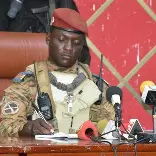
The recent statements by Captain Ibrahim Traoré have reignited debates in Burkina Faso regarding the nature of his authority and the country’s political trajectory since the September 2022 coup d’état. Far from ambiguous, his declarations reflect a clear willingness to embrace the unconstitutional nature of his rise to power, presenting this rupture as a new political paradigm.
The facts are unequivocal: Ibrahim Traoré did not ascend to leadership through universal suffrage. His ascent followed a military takeover that ousted Lieutenant-Colonel Paul-Henri Sandaogo Damiba, who himself had come to power through an earlier coup against President Roch Marc Christian Kaboré. This succession of military overthrows underscores a profound deviation from the democratic principles that normally underpin a head of state’s legitimacy.
Legitimacy through force: a dangerous precedent
While some may argue that the circumstances of his rise are less critical than the discourse surrounding it, the implications are deeply concerning. By openly justifying his power grab as inherently legitimate, Ibrahim Traoré appears to endorse the notion that force—when backed by fleeting popular support—can serve as an acceptable means to power. Such a stance risks establishing a dangerous precedent where future grievances could similarly justify further military interventions, thereby eroding institutional stability and entrenching chronic instability.
The illusion of governance: rhetoric overshadows results
Proponents of the current regime often highlight restored sovereignty, a break from foreign influence, and a resurgence of national pride as key achievements. While these themes resonate with the public, they cannot substitute for tangible governance outcomes. History demonstrates that patriotic slogans, no matter how compelling, do not replace economic performance, security, or the proper functioning of institutions.
Increasingly, political communication dominates governance. Patriotism is celebrated in speeches, symbols flood public spaces, and social media amplifies displays of support. Yet, behind this veneer, pressing questions persist: Has terrorism been curbed? Have lost territories been reclaimed? Have living conditions improved? These are the benchmarks by which the regime must be judged—benchmarks that remain unmet for many Burkinabè.
Security and survival: the unmet expectations
Security remains the most critical yardstick for the government. Despite announced reforms and military restructuring, attacks continue unabated in numerous regions, displacing populations and deepening a humanitarian crisis affecting hundreds of thousands. In some areas, civilians live under constant threat from armed groups, while access to healthcare, education, and essential services remains severely disrupted.
The economic landscape mirrors these challenges. Insecurity stifles agriculture, trade, and investment, leaving families struggling to meet basic needs. Job opportunities remain scarce, purchasing power continues to decline, and the promise of stability—so fervently hoped for after 2022—has yet to materialize.
Consolidation of power: a growing concern
Critics also warn of an alarming centralization of authority. Spaces for dissent are shrinking, with journalists, civil society actors, and opposition figures operating in an environment where criticism is increasingly equated with disloyalty. This conflation of national pride with uncritical support for the regime represents a dangerous erosion of democratic norms. True patriotism, after all, does not demand blind allegiance to those in power.
The adage « Power corrupts, and absolute power corrupts absolutely » holds particular resonance here. History is replete with leaders who, intoxicated by their own popularity or sense of mission, come to view their continued rule as vital to the nation’s survival. This mindset often leads to the suppression of dissent, the marginalization of opponents, and the conflation of personal ambition with national interest.
As power becomes more concentrated and its authority framed as unassailable, the risk of disconnect from ground realities grows. Applause at rallies, well-crafted communications, and orchestrated displays of loyalty cannot replace honest assessments of performance. True legitimacy is not forged in declarations or force, but in the protection of citizens, the safeguarding of freedoms, the improvement of living conditions, and the understanding that power is a means, not an end.
Ibrahim Traoré’s legacy will ultimately be measured against these standards. Until concrete progress addresses the security, economic, and social crises gripping Burkina Faso, the questions surrounding his legitimacy and the sustainability of his leadership will continue to shape the nation’s political discourse.