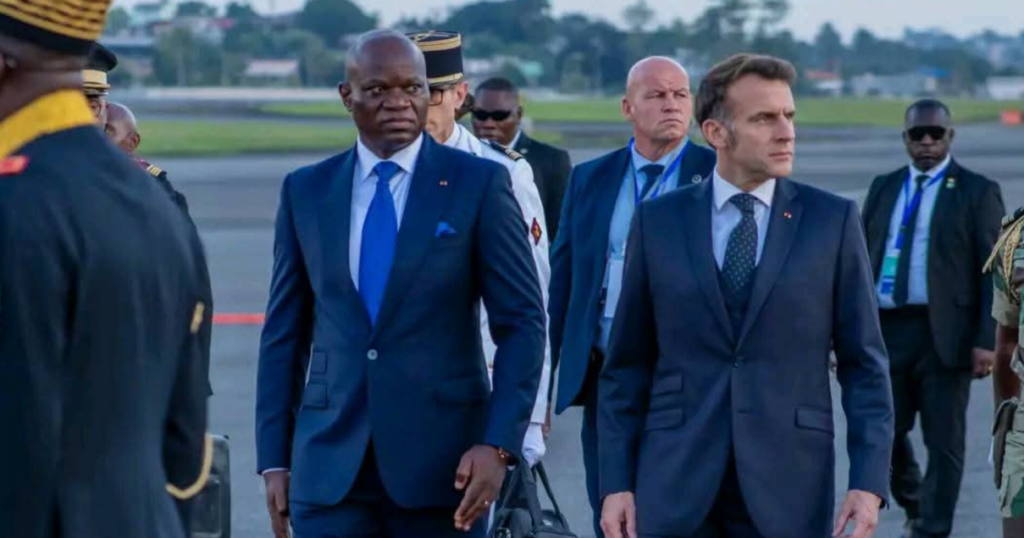
For three pivotal days, Gabon’s President, General Brice Clotaire Oligui Nguema, embarked on a high-stakes State visit to France. At the heart of discussions with his counterpart Emmanuel Macron were two critical issues: redefining the status of the Camp de Gaulle military base and accelerating the local transformation of manganese mining. This mission reflects Gabon’s pursuit of a new partnership model, distinct from the abrupt ruptures seen elsewhere on the continent, blending sovereign assertion with pragmatic economic negotiations.
Rethinking Camp de Gaulle: sovereignty meets cooperative evolution
The military dimension dominated the diplomatic agenda during the Elysee talks. The Camp de Gaulle, home to the French Elements in Gabon (EFG), has long symbolized France’s military presence in Central Africa. Yet, its continued operation under outdated frameworks is no longer tenable. As France reconfigures its military footprint across West and Central Africa, Gabonese authorities have already witnessed a significant reduction in French troop numbers.
President Oligui Nguema’s strategy avoids hasty confrontation. Instead, Libreville is pushing for a gradual renegotiation aimed at transforming the base into a co-managed training center or limiting French presence to minimal technical cooperation and counter-piracy efforts in the Gulf of Guinea. This approach allows Gabon to showcase restored national sovereignty to its citizens while preserving essential security ties. For France, the challenge is to adapt without alienating a key regional ally—a lesson learned from recent setbacks in neighboring countries.
Manganese and the push for local industrialization
The economic pillar of the Franco-Gabonese discussions centered on manganese, Gabon’s second-largest export after oil. As the world’s second-largest producer, Libreville is determined to break free from its colonial-era role as a raw material exporter. During meetings in Paris, President Oligui Nguema delivered a clear ultimatum to French industrialists and Eramet’s local subsidiary, Comilog: future industrial cooperation hinges on local processing and value addition.
Gabon’s demands are unambiguous: fairer profit-sharing, job creation for its youth, and financial and technological support for high-value processing plants. This stance aligns with the global energy transition, where manganese is a critical component in electric vehicle batteries. By insisting on local transformation, Gabon aims to capture a larger share of the mineral’s economic value.
Libreville’s middle path challenges Sahel’s confrontational approach
This State visit underscores Gabon’s unique diplomatic doctrine. While juntas in the Alliance of Sahel States (AES)—Mali, Niger, and Burkina Faso—have embraced dramatic ruptures with former colonial powers, Gabon is charting a different course. President Oligui Nguema’s strategy highlights the pitfalls of the AES’s confrontational posture: swapping one dependency for another while risking economic isolation and instability under the guise of sovereignty.
Gabon’s model is one of Realpolitik. Without fanfare or abrupt breaks, Libreville is renegotiating terms with Paris while diversifying partnerships with China, Turkey, and India. This pragmatic balancing act challenges the simplistic narrative that asserting African agency requires rejecting Western cooperation outright.
The authoritarian shadow over democratic promises
Despite Gabon’s outward diplomatic confidence, internal governance raises concerns. The government’s frequent internet shutdowns and social media restrictions—justified as measures to curb misinformation and maintain public order—paint a different picture. Critics argue these measures reflect an authoritarian drift that undermines the regime’s claims of openness.
During informal exchanges, French diplomats privately emphasized the importance of upholding fundamental freedoms and free expression. For President Oligui Nguema, the challenge is delicate: maintaining domestic stability while preserving the international credibility he has worked to build.
The art of the delicate balance
As the State visit concludes, the strategic stakes for Gabon are clear. By recalibrating French military presence and advancing local industrialization of manganese, President Oligui Nguema has reaffirmed his foreign policy vision: sovereign, unapologetic, and development-focused. The true test lies ahead—translating these diplomatic victories into tangible progress on the ground.
For Gabon’s strategy to succeed fully, the government must also address internal concerns, particularly the need for democratic openness and unrestricted communication. The country’s transition will hinge not only on its negotiating prowess in Paris but also on its ability to foster a free and vibrant society in Libreville.