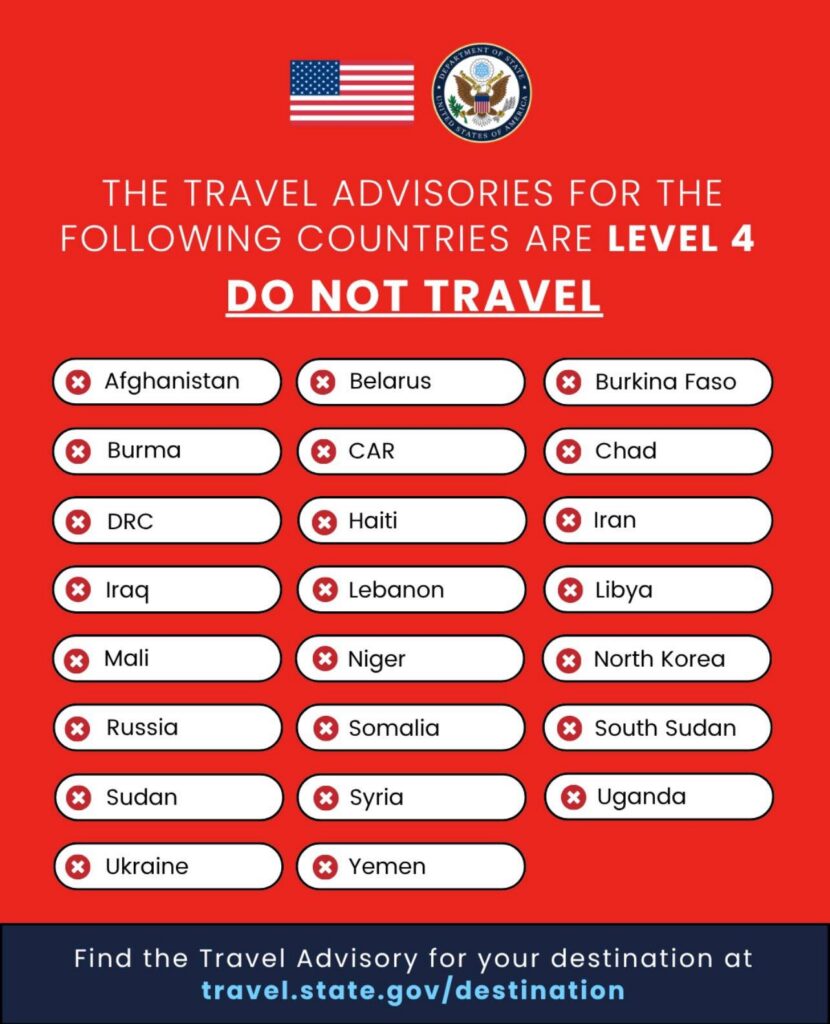
The United States Department of State has once again issued its most severe travel advisory, placing 23 countries under a “do not travel” classification—Level 4. Among the nations facing this heightened warning are Burkina Faso, Mali, and Niger, three key members of the Alliance of Sahel States (AES). The decision underscores a dramatic escalation in security threats across the Sahel, a region now recognized as a global hotspot for instability and violent extremism.
Why the extreme warning? Washington’s rationale
The U.S. government’s travel advisory system is designed to reflect real-time risks to American citizens abroad. Level 4—”do not travel”—signifies the highest degree of caution, indicating areas where risks of kidnapping, armed attacks, or terrorism are deemed extreme. In the case of the Sahel, the State Department has cited both the rapid territorial expansion of militant groups and the collapse of state authority in peripheral zones as primary drivers of this dire assessment.
American officials have also emphasized that consular and emergency assistance in these countries is likely to be severely restricted or even unavailable due to the withdrawal of non-essential diplomatic staff. This compounds the danger for travelers, who would have little to no support in the event of a crisis.
AES in the crosshairs: three nations under siege
The inclusion of Burkina Faso, Mali, and Niger in the highest-risk category is not an isolated decision but a reflection of a deteriorating regional security landscape. The AES, formed in 2023 as a mutual defense pact between these three countries, was meant to counter militant threats through strengthened cooperation. Yet, the alliance has coincided with a period of intensified instability, fueled by political transitions and the withdrawal of Western military partners.
Several deep-rooted factors contribute to the crisis:
- State withdrawal: Central governments in the Sahel have progressively lost control over vast rural and border areas, leaving populations vulnerable to militant incursions.
- Economic despair: Chronic poverty and lack of economic opportunity make recruitment into armed groups an attractive option for disaffected youth.
- Shifting alliances: The departure of French and European forces has created a vacuum that militant groups have exploited, while new partnerships—particularly with Russia—are still unproven in terms of operational effectiveness.
Burkina Faso: a nation under siege
Burkina Faso has become the epicenter of the Sahel’s crisis. Militant groups now control or encircle significant portions of the country, enforcing brutal blockades on dozens of towns. Supply convoys and military outposts face near-daily attacks, forcing mass internal displacement and leaving entire communities cut off from food, medicine, and humanitarian aid.
Mali: from north to south under threat
Mali’s security situation has deteriorated further following the departure of the United Nations peacekeeping mission (MINUSMA) and the resurgence of rebel violence in the north. Militant groups have capitalized on the resulting power vacuum, launching coordinated offensives that now threaten the southern regions, including areas near Bamako—the capital once considered relatively safe.
Niger: triple frontline under pressure
Niger faces a dual security challenge. In the west, along the triple border with Mali and Burkina Faso, militant activity remains intense. In the southeast, near Lake Chad, Boko Haram and the Islamic State’s West Africa Province (ISWAP) continue to stage deadly attacks. Despite efforts to reorganize its armed forces, persistent insecurity and regional diplomatic tensions hinder cross-border cooperation and effective counter-terrorism efforts.
A global snapshot: beyond the Sahel
The U.S. advisory is not limited to Africa. Russia remains under Level 4 due to the ongoing conflict in Ukraine, arbitrary detentions of American citizens, and an unpredictable legal environment. In the Democratic Republic of Congo, eastern regions—particularly those contested by the M23 rebel group—are plagued by relentless violence, civilian massacres, and kidnappings. Chad, sandwiched between the Sahel and Sudan’s war, faces spillover threats from both terrorism and regional instability.
Consequences beyond the travel warning
The “do not travel” classification carries significant economic and humanitarian repercussions. For Sahel nations already struggling with poverty and underdevelopment, the advisory acts as a deterrent to foreign investment. Multinational corporations hesitate to deploy staff due to exorbitant insurance costs, while NGOs face severe restrictions on accessing crisis zones—limiting critical aid to millions in need of food, healthcare, and education.
The announcement also highlights the broader failure of decade-long stabilization efforts in the Sahel. Despite political transitions and realignment with new partners, military solutions have proven insufficient. Without addressing governance failures, social inequality, and the lack of basic services, the region’s security map will likely remain scarlet—a warning that resonates far beyond Washington’s diplomatic corridors.