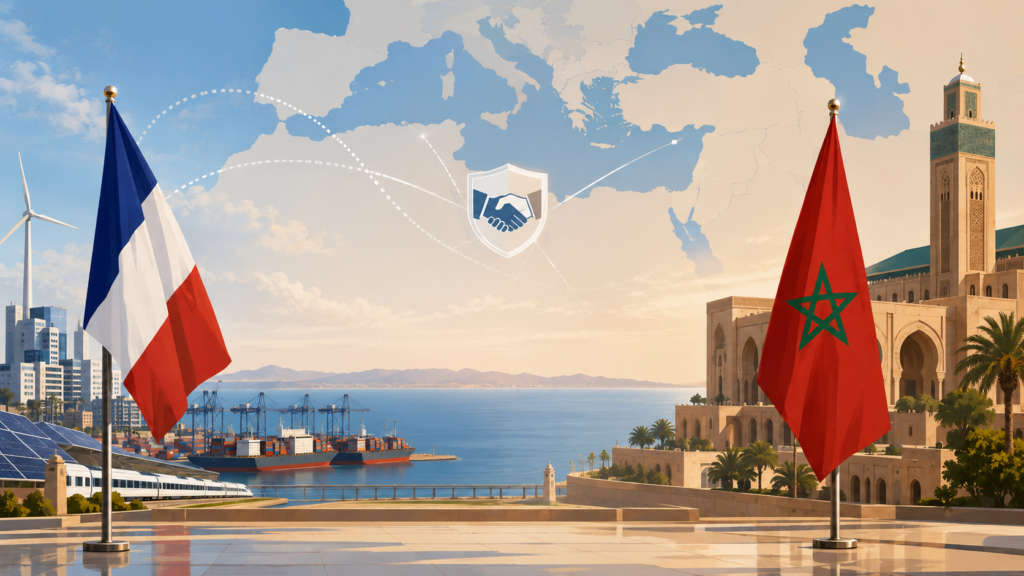
During two intensive days in Rabat, French Prime Minister Sébastien Lecornu led a high-level delegation of twelve ministers in a visit that transcended routine diplomacy. Far from a symbolic gesture, this official trip underscored the deepening partnership between France and Morocco, signaling a decisive turning point in bilateral relations after a period of relative distance in early 2024. Marking the first intergovernmental meeting of this magnitude since 2019, the visit solidified the transition into a new phase—one defined by an exceptional partnership slated for formalization through a comprehensive bilateral treaty.
This development aligns with the analysis presented in my recent book, Morocco, the Power of Stability, published by Éditions du Cherche Midi. In a Mediterranean and Middle Eastern landscape scarred by recurring crises, the Kingdom has emerged as one of the few stable anchors on which France can—and must—rely for long-term strategic support.
Stability in a region reshaped by upheaval
From the Sahel to Libya, from persistent tensions in the Middle East to the unresolved complexities surrounding Iran’s nuclear negotiations, the post-Arab Spring era has witnessed a proliferation of flashpoints. The Mediterranean has reasserted itself as a critical frontier where terrorism, migration flows, energy rivalries, and great-power competition converge. Amid this volatility, Morocco stands apart. The Kingdom has not only maintained remarkable political stability but has also modernized its economy, infrastructure, industrial base, and defense capabilities. Its credibility as a partner has grown among the United States, the European Union, Gulf monarchies, and increasingly across the African continent. Through a diplomacy rooted in dialogue and pragmatism, Morocco has cultivated the rare ability to engage with actors who have otherwise ceased direct communication—a skill that now serves as a cornerstone of its geopolitical influence.
France’s indispensable North African partner
The trajectory of Franco-Moroccan relations shifted significantly following France’s backing of Morocco’s sovereignty over the Sahara and the landmark state visit by President Emmanuel Macron to Rabat in October 2024. These milestones catalyzed the launch of an exceptional strengthened partnership, designed to structure cooperation across security, defense, energy, industry, innovation, infrastructure, and culture.
The scale of Prime Minister Lecornu’s visit—accompanied by a dozen ministers—demonstrates that this ambition has evolved beyond diplomatic declarations to become actionable policy. From defense and intelligence-sharing to domestic security, investment, energy, transport, artificial intelligence, and vocational training, few bilateral initiatives have ever mobilized such a breadth of sectors under a single political will.
Such coordinated governmental engagement reflects a shared commitment to building a durable, mutually beneficial relationship between two nations whose strategic interests increasingly converge.
A foundation of trust and shared interests
Morocco is no longer merely a neighbor south of the Mediterranean; it has become a vital ally in the fight against terrorism, a linchpin of stability in the Sahel, an industrial hub oriented toward Europe, a logistics gateway connecting the two shores of the Mediterranean, and a strategic entry point into Sub-Saharan Africa.
In an era marked by fragile supply chains, escalating migration challenges, and shifting energy alliances, the value of such a reliable partner cannot be overstated. Franco-Moroccan cooperation in intelligence and counterterrorism is widely regarded as one of the most effective globally. This trust was not forged overnight—it is the result of years of collaboration and shared strategic vision.
A partnership built on mutual benefit
The Franco-Moroccan relationship today rests on more than historical ties or human connections—it is grounded in a clear geopolitical reality. As Europe seeks to secure its supply routes, deepen its presence in Africa, and stabilize its southern neighborhood, Morocco has emerged as a natural partner. Its industrial growth, leadership in port infrastructure centered around Tanger Med, commitment to renewable energy, and expanding footprint across Africa position it at the heart of new Euro-African value chains.
From automotive and aerospace industries to green hydrogen, rail infrastructure, artificial intelligence, security cooperation, and cross-border investments, few international partnerships have simultaneously catalyzed progress across so many strategic domains. While many global alliances falter under geopolitical strain, the one uniting Paris and Rabat proves that a relationship anchored in political trust, mutual respect, and aligned interests can yield tangible, far-reaching outcomes.
The events of recent months—culminating in this historic ministerial visit—only reinforce a growing conviction: in a Mediterranean strained by conflict and a Middle East in flux, Morocco has become one of France’s most solid, reliable, and strategically vital partners. This exceptional alliance is no longer merely a legacy of history; it is a strategic choice for the future. As global upheavals reshape alliances, France stands to gain by making Morocco its principal partner south of the Mediterranean.