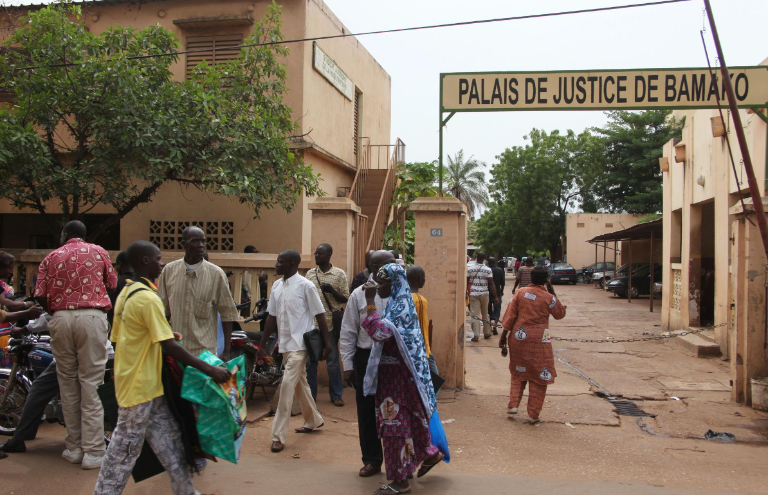
The verdict in Mali’s most contentious land scandal has left the nation questioning who ultimately pays the price when public property is carved up beyond recognized limits. Ex-Mayor Adama Sangaré now faces a decade behind bars after a court ruled that his signature on parcels near Bamako-Sénou International Airport crossed the line from municipal policy into criminal territory. For citizens, businesses and the public purse alike, the fallout is immediate—and it is still growing.
How a municipal routine became a criminal file
The Chamber of Economic and Financial Crime did more than simply overturn years of urban-planning decisions—it redefined where administrative discretion ends and criminal intent begins. Sangaré, who once helmed Bamako’s urban district, maintained throughout that every lot he processed followed the letter of Mali’s domestic laws and presidential directives. His defense team argued that the irregularities, even if acknowledged, amounted to administrative missteps rather than the falsified titles and embezzled funds the prosecution alleged. The court saw it differently, and the ten-year sentence reflects that divergence.
From presidential word to prison cell
Court filings cite an alleged oral instruction from former president Ibrahim Boubacar Keïta, dated 2014, authorizing the allocation of state-held land in the airport buffer zone. Sangaré’s attorneys insist the instruction shielded him from individual liability, yet the judges concluded that verbal orders cannot nullify statutory safeguards protecting public assets. The defense also pointed to a prior Supreme Court ruling that purportedly blessed similar prior allocations; the trial chamber dismissed that precedent, asserting that it addressed a different legal question altogether. With that objection overruled, the prosecution’s narrative gained momentum.
Financial fallout: who foots the demotion and demolition bills?
The bench ordered Sangaré to repay more than 483 million West African CFA francs—covering demolition costs and damages to the national estate—as well as an additional 50 million CFA in civil damages. Prosecutors had originally sought fifteen years incarceration plus similar reparations, arguing that Sangaré personally approved fee waivers worth 49.39 million CFA for favored applicants. The former mayor countered that fee waivers fell within his delegated authority as district chief, and that disbursement oversight rested with specialized state services that were never placed under his command.
Co-defendants receive matching penalties—with one exception
Sangaré shares the prison cell time with two former sub-prefects—Daha Keïta and Ibrahim Koïta—each sentenced to the same ten years. Three other municipal officials—Adam Aïché Traoré, Fatouma Samassékou and Bourama Komagara—received identical terms, although Traoré and Samassékou benefited from partial suspension of their sentences. The most severe penalty—twenty years without parole—fell on Souleymane Dagnon, former mayor of Bamako’s Commune VI, who was tried in absentia after failing to appear at any hearing. Sékou Keïta, by contrast, walked free after the tribunal found insufficient evidence linking him to the alleged scheme.
The public prosecutor had initially demanded twenty years for Dagnon and fifteen years for the remaining quartet, underscoring the gravity with which authorities view the systematic overstepping of land-management boundaries.
Next stop: the appeal that could redraw the land map
Within days of the verdict, Sangaré’s lawyers filed notice of appeal, setting the stage for a second judicial round that could either confirm the sentence or rewrite the entire narrative. Legal analysts say the appellate court will scrutinize two pivotal questions: first, whether the lower bench correctly separated administrative misconduct from criminal conduct; second, whether an alleged presidential directive can shield a local official from personal accountability. Until those questions are resolved, every parcel awarded, every building demolished and every public franc disbursed remains in legal limbo.
Lessons for Mali’s land governance—and its citizens
Beyond the individual fates, the case lays bare systemic cracks in Mali’s land administration. It reveals how easily municipal prerogatives can be stretched beyond statutory limits, how quickly public funds can be diverted under the guise of reconciliation projects, and how hard it is for courts to disentangle political instructions from legal obligations. For residents living in the shadow of Bamako-Sénou’s runways, the verdict offers a cautionary tale: when public real estate is traded like private commodity, everyone—rich or poor—ends up paying the price, whether in inflated land costs, vanished infrastructure budgets or, as in Sangaré’s case, a prison cell.