
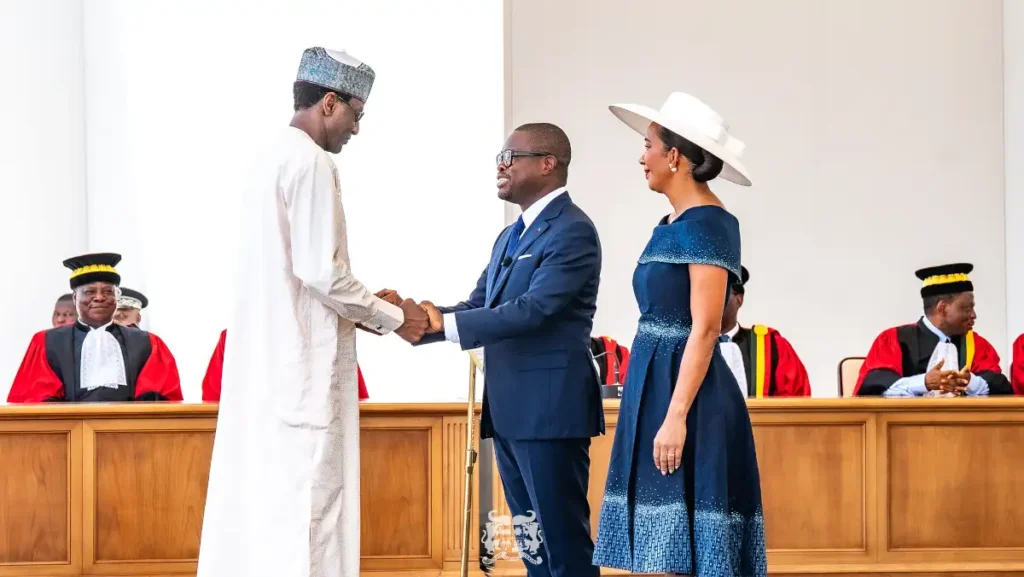
Cotonou witnessed a historic moment on May 24, 2026, as the nation inaugurated its new president, Romuald Wadagni. Beyond the formalities of the ceremony, the guest list spoke volumes about a potential shift in Benin’s political landscape. Opponents, former heads of state, West African diplomats, and figures once sidelined from power converged at the event, signaling a possible turning point in the country’s trajectory.
What stood out most was the presence of long-time political figures who had previously clashed with the outgoing administration. Former presidents Nicéphore Soglo and Boni Yayi, both influential in Benin’s democratic history, made appearances that underscored a commitment to institutional stability. Soglo, known for his sharp criticism of the previous government, even campaigned actively for Wadagni, further emphasizing the symbolic weight of this gathering.
The symbolic gestures extended beyond mere protocol. Political rivals sharing the same space, exchanging handshakes, and engaging in conversations sent a powerful message. For years, Benin’s political climate had been strained by debates over electoral reforms, opposition leader exiles, and disputes over party system changes. The sight of former adversaries uniting under one roof suggested a thawing of tensions.
From symbolism to stability: the road ahead
Analysts suggest Wadagni’s technocratic background may be key to fostering broader consensus. A former Finance Minister, his reputation lies in economic management and administrative efficiency—qualities that could resonate even among critics of the previous regime. Unlike the divisive atmosphere surrounding Patrice Talon’s 2016 inauguration, Wadagni’s presidency appears to offer a fresh start centered on pragmatism.
Regional diplomacy takes center stage
The ceremony also drew significant regional participation, with delegations from the AES alliance—Niger, Burkina Faso, and Mali—joining counterparts from Nigeria and Togo. This diplomatic turnout was no coincidence. In a Sahel plagued by security threats and political instability, Benin’s role as a stable neighbor is critical. The event underscored Benin’s willingness to rebuild regional trust, particularly in security cooperation, given its own northern border threats.
While internal political fractures remain, the gathering sent a message of regional confidence. Benin’s reputation as a stable democracy contrasts sharply with its neighbors’ turbulence, and the presence of foreign delegations reinforced that perception. Yet, the real test lies in translating this moment into sustained dialogue.
Can diplomacy outlast the ceremony?
Observers caution against over-optimism. Symbolic gestures, while meaningful, must translate into tangible actions. Wadagni inherits a country transformed economically but still divided politically. His challenge will be to bridge institutional gaps, restore trust among opposition forces, and consolidate governance without repeating past conflicts.
One certainty emerged from the inauguration: it brought together actors who had long operated in adversarial silos. In a West Africa grappling with democratic backsliding, Benin’s momentary unity around Wadagni’s transition stands as a hopeful sign. Whether it heralds a new era of reconciliation remains to be seen.

More Stories
Niger: Tiani faces fallout from special forces anger after Russian intervention
Mali : 17 morts dans les rangs des dozos, le JNIM accentue sa pression
Sahel : le pari des juntes tourne-t-il à l’échec sécuritaire ?