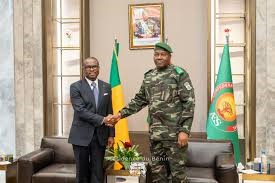
In a bold diplomatic initiative, Benin’s President Romuald Wadagni has launched his first official tour beyond national borders, targeting three Sahelian capitals in a single week. The mission: to mend strained regional ties and reopen channels of cooperation that have frayed since 2023 amid escalating security threats and political tensions.
Security and trade emerged as the twin pillars of this diplomatic offensive. The President’s itinerary included Abuja, Niamey, and Ouagadougou, where he sought to rebuild direct dialogue with Nigeria, Niger, and Burkina Faso. The economic stakes are high: Nigeria remains Benin’s largest trading partner, and its cooperation is vital for combating armed groups in the Lake Chad basin. Wadagni underscored the urgency of reopening the Lagos-Cotonou trade corridor, whose persistent blockades are crippling both economies.
In Niger and Burkina Faso, the focus shifted to cross-border coordination. Rising jihadist incursions in Benin’s northern regions—particularly Atacora and Alibori—have made isolated responses untenable. Concrete steps discussed included renewed intelligence-sharing and the partial reopening of trade flows, though no binding agreements were finalized.
Diplomacy without political conditions
Wadagni’s approach deliberately sidestepped contentious political alignments, favoring pragmatic problem-solving over ideological posturing. This marks a sharp departure from previous years, when Benin’s foreign policy was often shaped by shifting stances on the Economic Community of West African States (ECOWAS) and military-led transitions in neighboring countries.
Navigating a fractured regional landscape
The diplomatic tightrope is evident: while Nigeria remains an active ECOWAS member, Niger and Burkina Faso have exited the bloc to form the Alliance of Sahel States. Benin must now balance credibility with ECOWAS and Western partners against the risk of alienating neighbors with whom it shares a 700 km border and daily human exchanges.
Security challenges loom large. Any bilateral agreement risks failure without clear legal frameworks and logistical support for joint patrols. Border communities are particularly eager for progress on two fronts: reopening markets and securing rural roads.
A focus on tangible cooperation
Wadagni appears to be betting on a “project-based” diplomacy. Rather than resolving political rifts upfront, he is prioritizing technical accords on water, energy, and cross-border mobility. The goal? Create shared interests so costly that disengagement becomes unthinkable for all parties involved.
Should visible results materialize by late 2027, Benin could reclaim its role as a regional facilitator. The alternative—protracted negotiations yielding little on the ground—risks leaving Benin drained while insecurity spreads unchecked.
The first real test will come when Niamey and Ouagadougou act on promises to secure the northern trade corridor. Without progress by year’s end, the rhetoric of pragmatism will ring hollow.