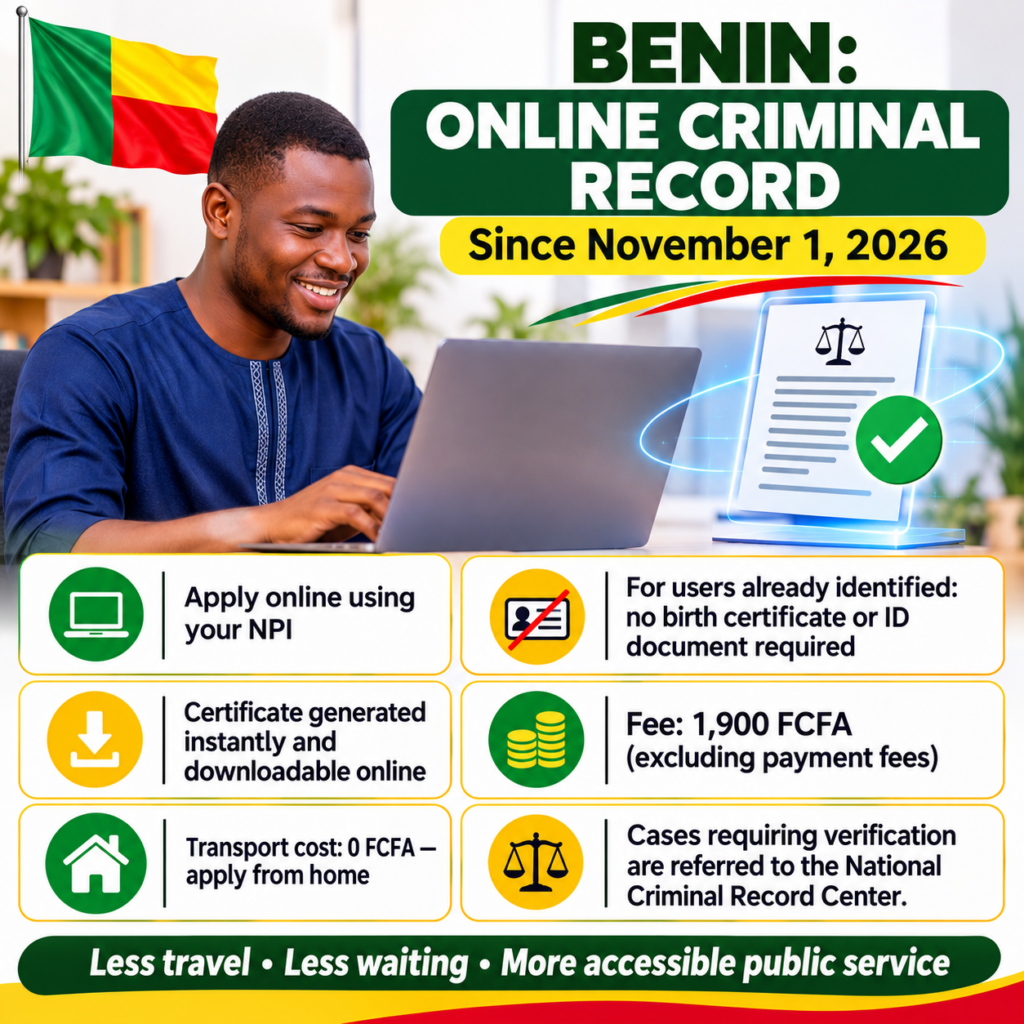
Real-world impact: Benin’s digital case file system transforms citizen experiences
For years, Benin’s citizens faced costly trips, long waits and bureaucratic hurdles to obtain criminal records. Today, the government’s new online system eliminates those barriers, delivering instant access to justice-related documents without travel or extra paperwork marking a tangible economic and practical shift for people nationwide.

From paper trails to digital solutions: ending logistical nightmares
Before online access became standard, citizens had to travel to government offices, often waiting hours or days for a criminal record, known locally as the casier judiciaire. Many residents of rural areas spent entire days away from work and home, while diaspora members relied on intermediaries or expensive round-trip travel. These hidden costs placed a disproportionate burden on low-income families and small business owners who needed the document for employment, education or legal reasons.
With the new system rolled out nationally and live since November 2026 users with verified identity records can download their official criminal record digitally using a National Identification Number (NIN). No birth certificate or photo ID is required if the government already holds the data. The document costs 1,900 FCFA (excluding payment fees), but the real savings come from what’s no longer spent: transport, time and repeated trips.
What it means for everyday life: time saved, money regained
The digital shift is more than convenience it reshapes how people manage their lives. Workers avoid unpaid leave. Students submit applications faster. Rural residents stop relying on family members to stand in line. And Beninese abroad complete legal procedures from anywhere in the world, sidestepping courier delays and foreign exchange fees.
The total cost of an in-person request transport, meals, possible lodging and lost wages often exceeded 5,000 FCFA. Now, that figure drops to zero for direct online users. Even when administrative fees remain the same, the overall expenditure drops sharply. Over a year, frequent users can save enough to cover utility bills or school supplies resources that directly improve household welfare.
Who benefits the most?
Urban professionals: Gain back hours each month that were once spent in queues.
Rural families: Avoid multi-day trips to regional capitals like Parakou or Natitingou.
Job seekers: Receive documents in minutes for urgent employment verification.
Diaspora members: Submit requests electronically without coordinating domestic travel or paying intermediaries.
Technical backbone: ensuring security without slowing progress
The online system relies on a secure government portal linked to the National Identification System. When a user enters their NIN, the platform autofills personal details name, date of birth, residency status eliminating the need to upload supporting documents for pre-verified citizens. Once submitted, the record is generated in real time and available for download within seconds.
Not all cases are eligible for automatic approval. Requests flagged for manual review such as name discrepancies or unresolved legal status are redirected to the National Criminal Record Center. This dual-layer process maintains integrity without sacrificing speed for the majority of users. The system also logs each transaction, creating an audit trail that prevents fraud and duplication.
A model for Africa? How Benin’s approach could change the continent
Benin’s digital case file system isn’t just a local success it’s a blueprint for administrative transformation across the region. In many African countries, citizens still endure multi-step, paper-heavy processes to access basic legal documents. Average waiting times can stretch beyond a week, and unofficial ‘facilitation fees’ inflate costs for the poorest.
By prioritizing citizen experience over administrative tradition, Benin demonstrates that technology can deliver immediate economic value. Reducing physical queues frees time for work and family. Cutting transportation expenses shifts household budgets toward food, education or health. Most importantly, it proves that digital public services don’t have to be aspirational they can be practical today.
Governments from Togo to Senegal have already expressed interest in piloting similar models. The lesson is clear: digital access isn’t a luxury. When designed inclusively and deployed securely, it becomes an engine of equity converting administrative delays into economic opportunity.
Beyond forms and fees: what digital transformation really means
Benin’s modernization began in 2020 with early digitization of civil documents. Passports, birth certificates and residency permits followed. But the criminal record breakthrough marks a turning point: it removes a long-standing psychological barrier between citizens and the state. No longer must people feel they are ‘begging’ for documents. Instead, they retrieve what they’re entitled to, as a right not a privilege.
This shift reflects a deeper philosophy: public administration should serve people, not the other way around. The success isn’t measured in press releases, but in hours saved and wallets preserved. It’s visible in the quiet relief of a rural farmer who uploads her record from a village cybercafé, or a young graduate in Cotonou who secures a job offer the same afternoon she applies.
As Benin continues this journey, the challenge shifts from technology adoption to digital inclusion. Not everyone owns a smartphone or trusts online portals. The government now faces the next milestone: ensuring no citizen is left behind in a system that favors convenience over capability. Equitable access means more than availability it means capability, trust, and real-world utility.
Conclusion: a digital breakthrough with tangible results
Benin’s online criminal record system is more than an upgrade it’s a correction of inequity. By turning a once-time-consuming, costly obligation into a fast, free and remote process, the government has delivered a measurable benefit to citizens across the country and beyond. Time saved is opportunity gained. Money spent on transport is now spent on growth.
This is how digital transformation should work: not as a distant goal, but as a daily improvement. When a public service becomes seamless, the ripple effects are felt in livelihoods, businesses and communities. Benin’s experience offers a compelling case one that other African nations are likely to study closely in the months ahead.
By Emmanuel Mbarga — Journalist