West African markets drive Benin’s export surge in 2026
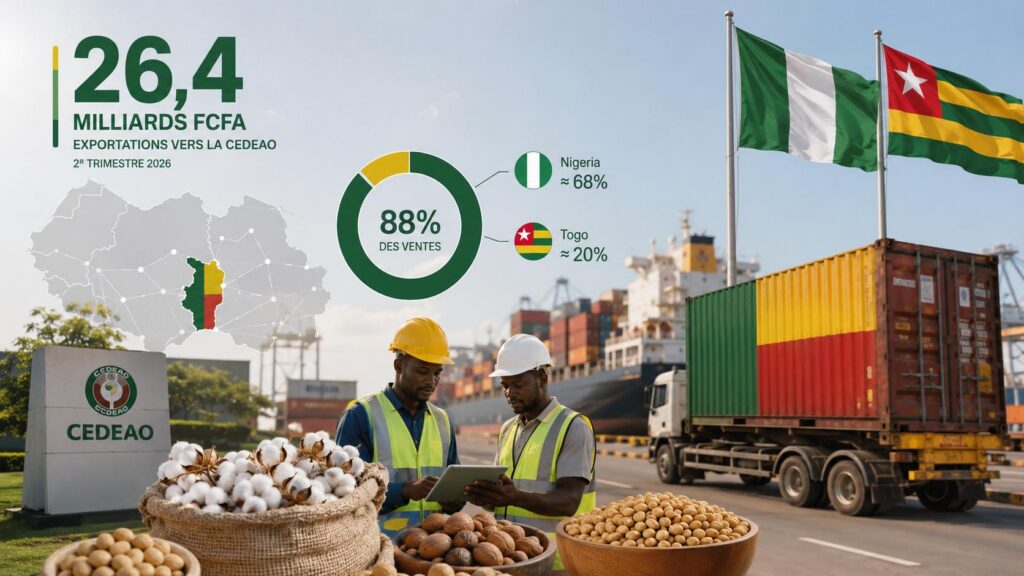
Benin’s economic momentum is gaining traction across West Africa, with regional trade figures showing remarkable growth. In the second quarter of 2026, the country exported goods worth 26.4 billion West African CFA francs to Economic Community of West African States (ECOWAS) member countries. This performance reflects both the nation’s expanding commercial footprint and the tangible results of its ongoing economic transformation strategy launched in 2016.
The export surge isn’t merely about numbers—it’s about strategic partnerships. Nigeria and Togo emerged as the primary beneficiaries, jointly accounting for 87.8% of Benin’s total ECOWAS exports. Nigeria alone absorbed 56.1% of these regional sales, while Togo contributed 31.7%. Côte d’Ivoire rounded out the top three with 5.1% of the export value.
Nigeria remains Benin’s commercial gateway
The Nigerian market continues to offer unparalleled opportunities for Beninese businesses. The country’s massive consumer base, industrial demand and cross-border trade dynamics make it an essential partner. During the reporting period, Benin’s oil and bituminous mineral exports to Nigeria reached 7.6 billion CFA francs, representing over 8,500 metric tons. Iron and steel bars for re-export followed at 3.3 billion CFA francs, with soya bean oil and its fractions contributing another 2.3 billion CFA francs.
Local transformation fuels regional competitiveness
Since the current administration took office in 2016, Benin has prioritized economic modernization, infrastructure development and agricultural transformation. The goal extends beyond raw material exports to building higher-value domestic production chains. For example, cotton exports to Togo included 1.5 billion CFA francs worth of cotton seeds and 700 million CFA francs in unprocessed cotton fabrics.
These developments signal a shift toward more sophisticated industries. The textile sector, built on Benin’s historic cotton industry, is evolving from simple fiber production to finished goods manufacturing. This evolution promises to create new employment opportunities and retain more economic value within the country.
Regional trade as an economic catalyst
Benin’s export growth translates directly into expanded business activity across multiple sectors. Increased production requires more raw materials from local farmers, additional processing by manufacturers, and enhanced logistics services. The ripple effects extend to transportation providers, warehouse operators, customs brokers and retail networks—creating a multiplier effect throughout the economy.
The benefits extend to households as well. More productive industries generate jobs, particularly for young workers. Improved infrastructure reduces transportation costs and delivery times, while new industrial zones offer alternative career paths beyond traditional agriculture.
Diversification remains key to long-term success
While Nigeria and Togo dominate current export patterns, Benin’s trade portfolio shows promising signs of geographic expansion. Côte d’Ivoire, the third-largest destination, imported unprocessed cotton fabrics worth 1 billion CFA francs, along with printed materials, water-based paints and certain plastics. This diversification reduces dependency on any single market while opening new revenue streams.
The path forward requires strengthening Côte d’Ivoire and other ECOWAS markets while developing new processed products. Priority sectors include enhanced agricultural processing, textile manufacturing, food production and light manufacturing. The strategic objective isn’t simply to export more—it’s to create, transform and sell at higher value points within these growing regional markets.
Building a more integrated west african economy
Benin’s geographic position at the heart of West Africa provides a strategic advantage. With direct access to Nigeria’s vast market and strong connections to neighboring economies, the country is well-positioned to become a regional trade hub. Since 2016, government policy has focused on infrastructure development, industrialization and improving the business environment to capitalize on these natural advantages.
The second quarter 2026 trade figures represent more than just commercial success—they demonstrate Benin’s growing capacity to leverage regional integration for national development. The next phase will focus on translating these commercial gains into sustainable employment, increased household incomes and higher-value domestic production. When regional trade becomes both an export driver and a catalyst for improved living standards, the country’s economic trajectory will have achieved its full potential.