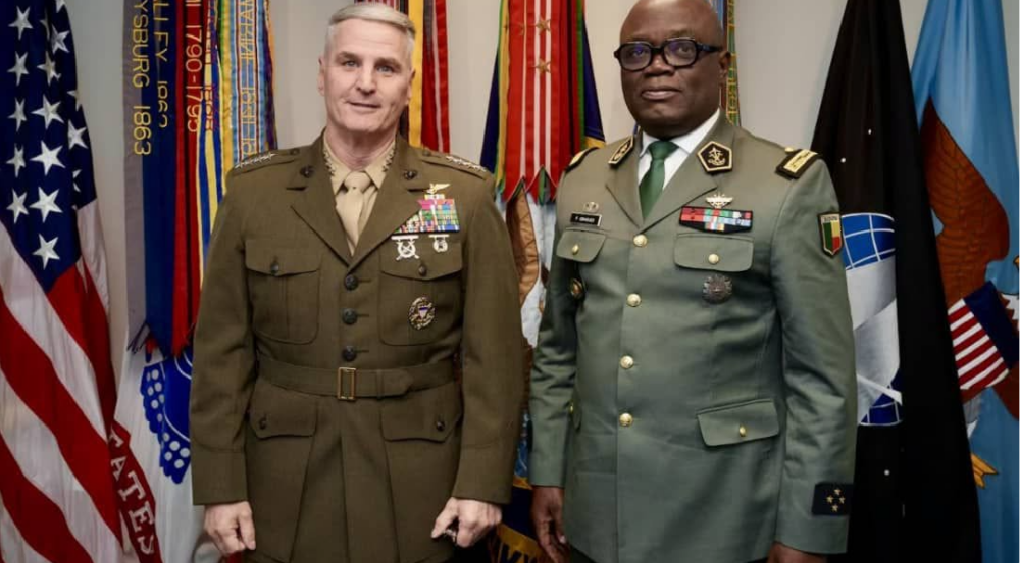
Cotonou and Washington align on regional security priorities
In a move underscoring shared strategic interests, senior military leaders from Bénin and the United States convened at the Pentagon this month to deepen defense cooperation. The high-level meeting between Lieutenant-General Fructueux Gbaguidi, Chief of Staff of the Bénin Armed Forces, and General Christopher J. Mahoney, Vice Chairman of the U.S. Joint Chiefs of Staff, signals a strengthening partnership aimed at bolstering regional stability.
The timing of the visit reflects a broader effort by Cotonou to enhance its security capabilities while maintaining a balanced approach to international alliances. Official statements from the U.S. side highlighted the “robust and enduring” nature of the security partnership, emphasizing Bénin’s role as a key democratic actor in West Africa’s fight against terrorism.
From protocol to partnership: a strategic shift in defense ties
The meeting follows a series of high-level exchanges, including a 2025 visit by AFRICOM leadership to Cotonou, where Bénin was formally recognized as a strategic security partner. Discussions at the Pentagon focused on counterterrorism, border security, and joint military initiatives, with both sides reaffirming their commitment to a safer, more stable Sahel.
Analysts view this engagement as more than symbolic. In an era of asymmetric warfare and cross-border threats, Bénin has positioned itself as a proactive player, investing in military training, intelligence-sharing, and territorial surveillance to prevent spillover from neighboring conflicts.
Diversifying alliances: why Cotonou refuses to rely on a single partner
While U.S. cooperation remains pivotal, Bénin’s security strategy is built on diversification. Over the past two years, Cotonou has expanded military ties with African nations, including South Africa and Nigeria, while actively participating in regional security frameworks.
For instance, a 2025 joint military commission with South Africa focused on asymmetric threat response, while cross-border initiatives with Nigeria aim to curb transnational crime and terrorism. This multi-pronged approach reflects a pragmatic understanding: no single nation can address Sahel-based insurgencies alone.
Democracy as a security asset
Beyond military cooperation, Bénin’s political stability has become a cornerstone of its international credibility. In a region plagued by coups and institutional instability, Cotonou’s adherence to democratic norms has earned it favor with Western partners, including the U.S. and European allies.
The Pentagon’s recent remarks linking security, stability, and democracy underscore this advantage. By positioning itself as a reliable democratic partner, Bénin has kept diplomatic channels open with both Western capitals and African states, strengthening its negotiating power.
The unresolved rift with the Sahel Alliance
Despite repeated overtures, cooperation between Bénin and the Alliance of Sahel States (Burkina Faso, Mali, Niger) remains strained. While Cotonou has expressed willingness to collaborate on counterterrorism—most recently during a 2026 visit by President Romuald Wadagni to Ouagadougou—political mistrust persists.
Meanwhile, the AES has forged its own security architecture, including a unified force announced in 2025. Yet experts warn that isolated regional strategies risk leaving gaps in intelligence and operational coordination. Terrorist groups, after all, do not respect borders.
What’s next for Bénin’s security roadmap?
The Pentagon talks mark another milestone in Bénin’s defense modernization. Moving forward, priorities include enhanced intelligence networks, rapid-response capabilities, and deeper integration with AFRICOM-led initiatives. However, the ultimate test will be whether regional partners can move past political divisions to forge a unified front.
For Cotonou, the choice is clear: sovereignty through cooperation, stability through democracy, and security through partnership. The question now is whether its neighbors will follow suit.