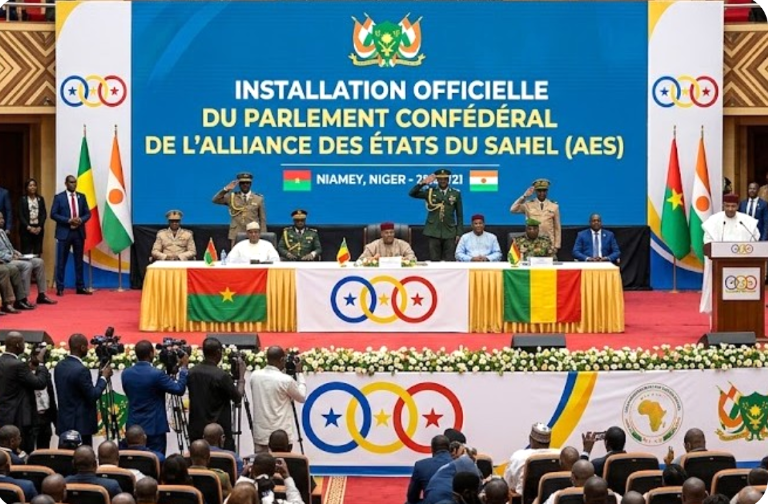
In Niamey, the Alliance of Sahel States (AES) has just inaugurated its parliamentary body, marking another milestone in the region’s evolving political landscape. Yet beneath the ceremonial display of unity lies a pressing concern: can a regional integration project built on military rule ever claim genuine democratic legitimacy?
Against the backdrop of careful symbolism, representatives from Burkina Faso, Mali, and Niger gathered in late August 2026 to formally establish the AES’s confederal parliament. With 45 lawmakers—15 from each nation—this new institution is tasked with shaping the future of the alliance. Already, its members have drafted internal regulations and set up three key committees: defense and security, diplomacy, and development.
The official narrative paints a picture of progress—a bold step toward regional sovereignty and shared governance. But a closer look raises doubts: who, exactly, do these parliamentarians represent?
Mirroring the CEDEAO: a paradox of institutional design
The AES’s new parliament shares striking similarities with the ECOWAS model it once criticized. Both feature a confederal structure, common political bodies, and a regional assembly meant to address cross-border issues. The ECOWAS Parliament, for instance, comprises 115 seats and has long debated direct universal suffrage for its members. While its current delegates are often selected from national assemblies, the principle remains the same: a regional body to foster integration.
The AES’s parliament follows this blueprint—just on a smaller scale. Its 45 members, equally distributed among the three member states, echo the same logic. Yet the critical difference lies not in form but in substance: legitimacy.
Democracy deferred: the shadow of military rule
The birth of this parliament coincides with a troubling reality: all three founding nations are under military leadership, born from recent coups. Mali has been under junta control since 2020–2021, Burkina Faso since 2022, and Niger since 2023. Promises of swift transitions to civilian rule have stalled, with elections repeatedly postponed and political space shrinking.
In Burkina Faso, the situation has reached a new extreme. In April 2026, military leader Ibrahim Traoré publicly declared that Burkinabè citizens should “forget” democracy, arguing it was incompatible with the country’s needs. His government has since banned political parties, further eroding democratic norms.
Mali, too, has seen its electoral calendar repeatedly pushed back. The junta, now entrenched in power, has deferred elections indefinitely, consolidating military control over state institutions.
The question is unavoidable: how can a parliament claim to represent the people when its members are chosen by regimes with no electoral mandate?
The illusion of representation
The AES’s leadership frames its new institution as a symbol of regained sovereignty. Yet sovereignty, in its truest sense, should empower citizens—not just states. If a regional parliament is to have meaning, it must be rooted in the will of the people. Otherwise, it risks becoming little more than a hollow facade: seats, committees, and speeches, but no real connection to those it claims to serve.
The forgotten citizen: when institutions fail the people
The people of the Sahel face daily struggles: insecurity, poverty, mass displacement, unemployment, and collapsing public services. Armed groups continue to terrorize vast territories, displacing millions. In this context, institutional grandstanding rings hollow. A new parliament cannot feed a hungry family. A development committee cannot rebuild a school. A rulebook cannot heal a patient in a village without a doctor.
True sovereignty begins with the citizen—not with the state. Yet in the AES’s three member countries, political freedoms are under siege. Opposition voices are silenced, the press is restricted, and civil society is muzzled. How can a parliament function meaningfully when its own people lack the space to dissent?
A flawed alternative to ECOWAS
The AES was born from frustration with ECOWAS, accused by its leaders of overreach and disregard for Sahelian interests. Yet the new alliance now replicates some of the very structures it condemned—without adopting the democratic safeguards that underpin them.
Why not go further? Why not establish a directly elected AES parliament? Why not enshrine constitutional protections for free speech, multiparty democracy, and judicial independence? These were the choices available. Instead, the alliance risks creating a pale imitation of ECOWAS—one that lacks its democratic ambition.
Togo’s uneasy alignment with the AES
Even Togo, though not an AES member, finds itself drawn into the region’s political realignment. President Faure Gnassingbé, in power since 2005, has steadily aligned his government with the Sahelian juntas despite mounting criticism of his own democratic record.
A 2024 constitutional reform shifted Togo from a presidential to a parliamentary system, concentrating executive power in the hands of the prime minister—now held by Gnassingbé himself. Critics argue this move was designed to bypass term limits and extend his rule. In June 2025, protests erupted against the reform, resulting in several deaths. Social media restrictions and arrests followed. By July 2026, demonstrators were still demanding a return to the old constitution, denouncing the consolidation of power in Gnassingbé’s hands.Recent arrests of foreign journalists have further alarmed observers, particularly as international broadcasters like RFI and France 24 remain blocked in the country since 2025.
Togo is no longer a passive observer. It is becoming an active participant in a regional shift that raises serious questions about governance and accountability.
The ultimate test: will the AES parliament serve the people?
The inauguration of the AES parliament may be historic, but history will judge it not by its ceremonies, but by its actions. A parliament is not democracy. Representatives are not legitimacy. And invoking the people’s name does not grant authority without their consent.
The AES now faces a choice. It can build a confederal system rooted in popular sovereignty, political freedom, and accountable leadership. Or it can become an institutional vehicle for entrenched military regimes, using the language of sovereignty to justify indefinite postponement of democracy.
That choice will define the Sahel’s future—and whether its people ever truly regain control of their destiny.