
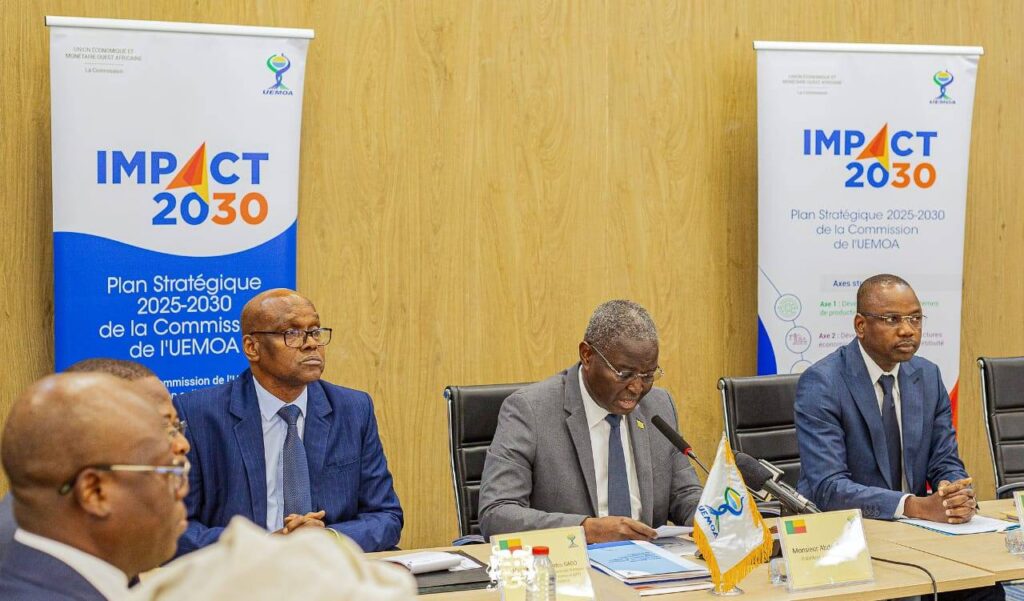
On Thursday, July 23, 2026, the Beninese Ministry of Economy and Finance hosted the 2026 edition of the Annual Policy Review for UEMOA community reforms, policies, programs, and projects. Following a thorough assessment encompassing 145 regulatory texts, Benin achieved an impressive implementation rate of 73%. This performance, surpassing the satisfactory threshold of 70%, clearly demonstrates Cotonou’s unwavering dedication to West African economic integration.
A pivotal institutional gathering for the UEMOA region
The harmonization of national legislations with community law stands as the bedrock of integration within the West African Economic and Monetary Union. Each year, the Annual Policy Review serves as a concrete mechanism to gauge member states’ resolve in applying decisions made at the highest levels of the Union.
It was within this framework that a delegation from the UEMOA Commission converged in Cotonou, engaging with representatives from various Beninese ministries and sectoral bodies. The objective of these discussions was unequivocal: to meticulously scrutinize all texts that Benin had transposed and implemented, while simultaneously identifying any administrative or technical obstacles that might impede the momentum of community integration.
Evaluation structured around three fundamental pillars
For the 2026 review, the assessment utilized a comprehensive analytical framework comprising 145 community texts. As emphasized by Mr. Abdoulaye DIOP, President of the UEMOA Commission, this review’s core purpose is to accurately determine the extent to which legal acts originating from the Council of Ministers and the Conference of Heads of State and Government have been transposed into national law.
The in-depth examination was structured around three essential domains crucial for the sub-region’s economic advancement. The first pillar focuses on economic governance and convergence, which includes standardizing budgetary frameworks, multilateral surveillance, and ensuring transparency in public management. The second pillar addresses the common market, emphasizing the free movement of individuals, goods, services, and capital, alongside the right of establishment. Finally, the third pillar delves into sectoral policies, aiming to align national initiatives across vital areas such as transport, energy, agriculture, environmental protection, and digital development.
Achieving a 73% implementation rate: surpassing the satisfaction mark
Upon the conclusion of the review, the results were clear: Benin recorded an overall implementation rate of 73%.
Within the UEMOA Commission’s evaluation metrics, the 70% mark signifies the critical threshold at which a member state is recognized for its substantial efforts in transposing community directives. By exceeding this benchmark, Benin reaffirms its position as a diligent and committed participant within the sub-regional bloc. This score underscores the consistent nature of reforms undertaken by the nation in recent years, while also highlighting specific key sectors where further progress can be made.
Leadership insights: commendation and a forward vision
The political discussions that followed the presentation of the results provided an opportunity for both parties to articulate their shared vision for the integration process.
For the President of the UEMOA Commission, this review transcends a mere audit exercise; it represents a strategic catalyst for transformation. Abdoulaye DIOP underscored the critical importance of recognizing the strong commitments demonstrated by Beninese authorities, expressing the expectation that significant advancements would be observed in areas still requiring attention by the time of the next review.
Taking the floor, Mr. Aristide MEDENOU, Benin’s Minister of Economy and Finance, responsible for Cooperation, commended the methodical work carried out by Beninese administrative teams. He attributed this positive outcome directly to a rigorous and continuous mechanism for monitoring community texts and the collective mobilization of all involved administrations.
The Minister further explained that this institutional gathering facilitates the precise identification of administrative or regulatory bottlenecks in certain domains, enables the sharing of best practices and experiences with the Commission’s delegation, and ultimately leads to agreement on concrete solutions to accelerate the transposition of pending directives.
Remaining challenges and future outlook
While the overall assessment is favorable, the remaining 27% represents a priority focus for the coming months. The transposition of complex sectoral policies, in particular, demands heightened inter-ministerial coordination.
Reaffirming the Beninese government’s resolve to continue with ongoing reforms, Aristide MEDENOU outlined the strategic roadmap for the upcoming period. The declared objective is to approach the next annual review with noticeable progress in the sectors identified as needing improvement.
A promising trajectory for West African integration
By achieving the 73% threshold in this 2026 evaluation, Benin demonstrates that rigorous governance and continuous institutional oversight can effectively transform abstract regional commitments into tangible legal and economic realities.
As the UEMOA region navigates significant global and regional economic challenges, Cotonou’s displayed fiscal discipline and regulatory alignment not only bolster the state’s credibility on the international financial stage but also contribute substantially to the construction of a more fluid and competitive sub-regional market.

More Stories
Burkina Faso: the digital battleground for independent journalism
Benin and Morocco consider visa exemption for ordinary passports
Gold mining in Cameroon and dr Congo faces scrutiny over revenue transparency