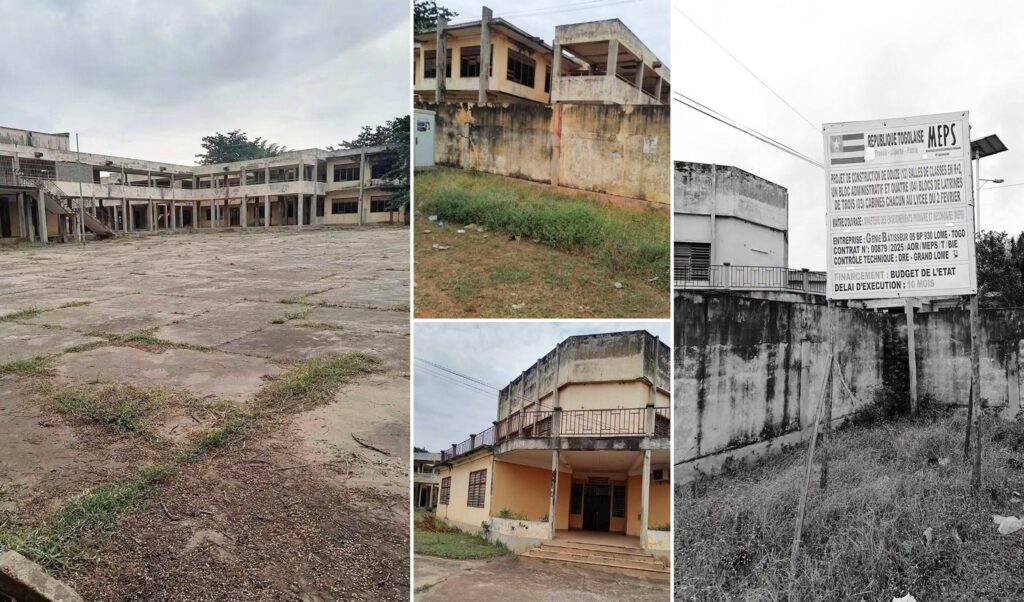
A meticulously corrected geographical map can never substitute for structurally sound walls. While the Togolese administration has executed a successful public relations campaign by promoting a cartography that accurately represents the true scale of the African continent, the reality on the ground presents a stark contrast. The nation’s largest public high school is currently deteriorating in near-total neglect, casting a shadow over this symbolic diplomatic achievement.
The contrast between symbolic sovereignty and educational neglect
The true measure of a nation extends beyond its cartographic representation. It is fundamentally reflected in the state of its educational institutions, the safety of its classrooms, and the environment provided for both students and educators. While adjusting continental proportions on a map can be achieved swiftly, rehabilitating a failing school demands concrete budgetary allocations, strategic decisions, and sustained political commitment.
In practice, pan-African rhetoric offers little comfort to students facing daily hardships. Thousands of youths gather each morning in dilapidated classrooms, lacking basic materials and studying under roofs that threaten to collapse during inclement weather. In these facilities, structural deficiencies are not abstract concerns; they directly compromise student safety and undermine the quality of learning required for future success.
True educational development begins in the classroom
Genuine continental empowerment must be rooted in the classroom. True dignity for African youth is not achieved merely by expanding the continent’s visual footprint on a map, but by ensuring access to secure, well-equipped schools. Students require functional laboratories, libraries, digital tools, and properly supported teachers to thrive.
This disparity raises critical questions regarding state priorities. Promoting national pride internationally while failing to provide basic learning conditions at home appears contradictory. An ambitious geopolitical narrative loses its substance when the very institutions tasked with preparing the next generation are allowed to decay.
The cost of deferred maintenance and policy choices
A crumbling school is more than a neglected structure; it represents a series of deliberate budgetary and administrative decisions. When a major educational institution deteriorates to a hazardous level, it reveals a profound failure in planning and preventative maintenance. Education must be treated as a primary investment for any nation aiming to secure its future, as inadequate infrastructure directly erodes student motivation and deepens social inequalities.
Ultimately, the issue transcends physical damage and touches the core relationship between the state and its citizens. A government cannot credibly inspire its youth while relegating them to outdated and hazardous learning environments. While symbols and speeches can shape a political narrative, citizens evaluate governance by the tangible realities before them: safe classrooms, desks, textbooks, and qualified educators.
Advocating for accurate cartography and investing in schools are not mutually exclusive goals. A state can champion pan-African ideals while simultaneously maintaining robust educational infrastructure. However, symbolic gestures must never serve as a substitute for effective public policy, as correcting a map requires only a pen, whereas building a sustainable educational system demands genuine resources and political will.