
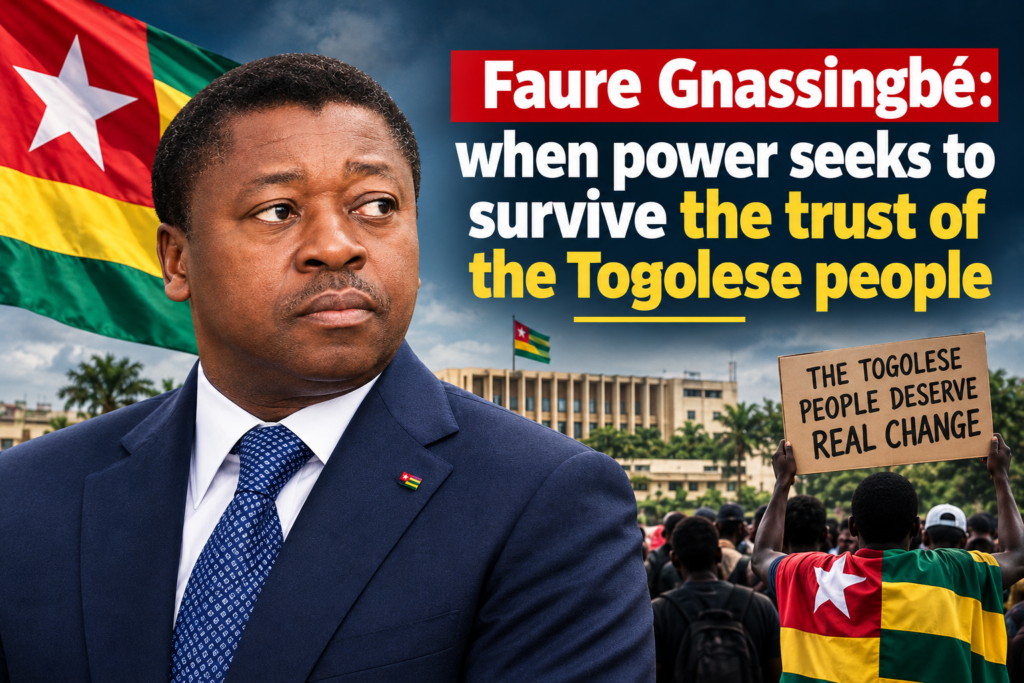
After more than two decades at the head of Togo, Faure Gnassingbé is facing an increasingly difficult equation: how to retain power when popular confidence alone is no longer enough to guarantee his legitimacy?
Since taking office in 2005, the Togolese president has weathered a series of political crises, fiercely contested elections and sustained opposition mobilisations. Over time, the criticism has moved beyond mere electoral results to the very conditions under which political competition is organised. For his detractors, the core issue is no longer simply who wins the vote, but whether the framework truly permits an alternation of power.
It is within this context that the various institutional manoeuvres should be examined. When a political system is repeatedly adjusted around the figure who leads it, every constitutional or institutional modification ends up raising the same question: is this a reform designed to strengthen state institutions, or another means of preserving the incumbent’s hold on power?
The matter has become even more sensitive with the latest institutional transformations. The shift to a new political system, the redistribution of powers and the creation of new functions at the highest level of the state have fuelled criticism from those who see less a clean break than a fresh mechanism for organising the regime’s continuity.
The most disputed point lies precisely here: the preservation of power does not always pass through a victory at the ballot box. It can also be secured through mastery of the institutions that organise the exercise of power.
This explains the questions raised by the failure to hold presidential elections according to the expected timetable and by the new institutional architecture that followed. For opponents, a change of mechanism does not necessarily mean a change of power. On the contrary, it could allow Faure Gnassingbé to remain at the centre of the political apparatus while altering the function through which he exercises influence.
The appointment of Jean-Lucien Savi de Tové to the presidency of the Republic has therefore generated further controversy. Officially, it is presented as a new institutional configuration. But for the regime’s adversaries, the genuine question lies elsewhere: who actually holds power and who sets the country’s major political directions?
It is precisely this uncertainty that fuels the accusation that the officially installed president lacks sufficient political autonomy in relation to Faure Gnassingbé. His detractors maintain that the true centre of decision-making remains in the hands of the former president, now president of the Council, and that the new institutional architecture would thereby have allowed him to preserve his influence without directly seeking a new presidential mandate.
Even if this interpretation is contested by those in power, it nonetheless reveals a persistent democratic unease: when an institutional reform enables a leader who has already spent more than two decades at the summit of the state to remain the dominant political actor, the question of the reform’s real purpose becomes unavoidable.
The problem therefore extends beyond the person of Faure Gnassingbé. It touches the very functioning of the Togolese state. A healthy democracy should not be built around an individual’s ability to remain indispensable, but around institutions capable of operating independently of the interests of those in power.
Added to this are recurring accusations of a shrinking political space, tensions with the opposition, disputed elections and criticism of governance. Taken individually, each episode can be interpreted in different ways. But when viewed across twenty-one years in power, they form, for opponents of the regime, a single trajectory: that of a system seeking less to prepare for alternation than to organise its own survival.
Here lies the true paradox of Faure Gnassingbé’s position. After so many years at the country’s helm, the question should no longer be how to remain in power through new institutional configurations, but how to durably convince the Togolese people that their choice can truly alter the country’s direction.
A democracy is not measured only by the number of institutions it possesses or the texts it adopts. It is measured above all by the real possibility of alternation, the independence of institutions and the capacity of citizens to sanction or renew their leaders through the ballot.
When institutional mechanisms become complex enough for power to change shape without necessarily changing hands, mistrust takes root.
And this is precisely the question that the Togolese authorities cannot indefinitely sidestep: if Faure Gnassingbé is genuinely convinced that he enjoys the trust of the Togolese people, why do so many transformations appear necessary to guarantee the continuity of his political influence?
Ultimately, the Togolese debate is no longer only about one man seeking to retain power. It is about a political system confronted with a simple demand: to finally enable citizens to determine freely, clearly and without ambiguity who should govern the country.
More Stories
Educational decay overshadows symbolic cartography in Togo
Mali’s year-long fuel blockade: the economic stranglehold that exposes the junta’s weakness
Senegal’s new PM promises stability and debt relief: what it means for the economy