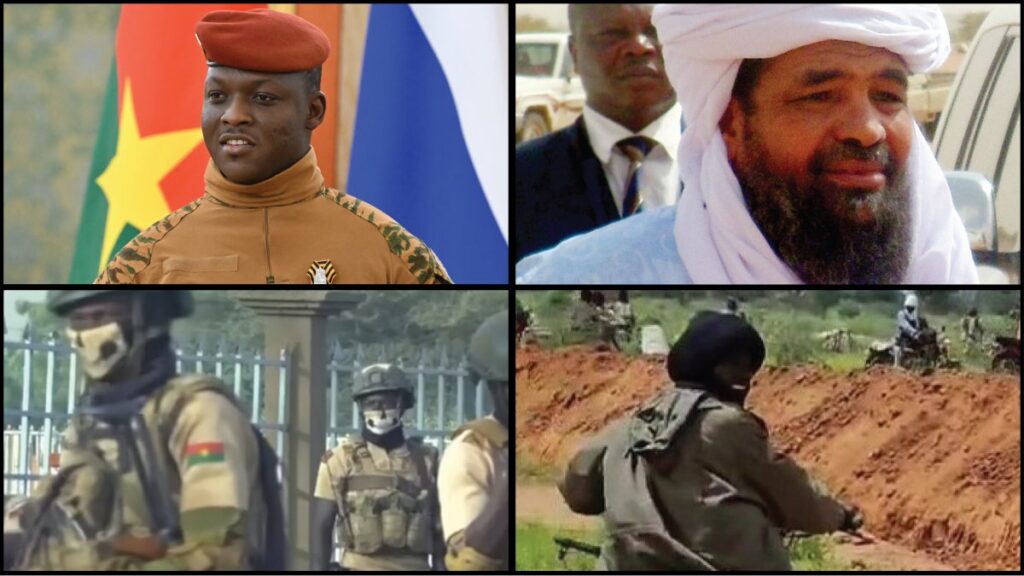
Unchecked atrocities in Burkina Faso: war crimes and crimes against humanity
Since 2023, the Burkina Faso armed forces—alongside allied militias and an Al-Qaeda-linked armed group—have been responsible for the deaths of over 1,800 civilians and the forced displacement of tens of thousands. These acts, including what witnesses describe as ethnic cleansing against the Fulani community, constitute war crimes and crimes against humanity. High-ranking leaders from all factions could face accountability for these grave violations.
- The military junta led by President Ibrahim Traoré has systematically suppressed political opposition, peaceful dissent, and independent media, creating a climate of terror and severely restricting access to information about the conflict.
- Researchers documented 57 incidents involving the Burkina Faso military, allied militias (Volunteers for the Defense of the Homeland, VDP), and the Group for the Support of Islam and Muslims (GSIM/JNIM), an Al-Qaeda affiliate, since the junta seized power in September 2022.
- International and regional bodies, including the United Nations, African Union, and European Union, alongside key partners like the United States, must take urgent action to address the cycle of abuse and impunity plaguing Burkina Faso.
« The scale of atrocities in Burkina Faso is staggering, matched only by the world’s indifference, » said Philippe Bolopion, Deputy Executive Director at Human Rights Watch. « The junta itself perpetrates horrific abuses, shields perpetrators from justice, and suppresses information to conceal civilian suffering. »
Human Rights Watch conducted over 450 interviews with victims, witnesses, and community leaders in Burkina Faso and neighboring countries like Bénin, Côte d’Ivoire, Ghana, and Mali. Researchers also analyzed satellite imagery, thousands of hours of audiovisual footage, and official documents to verify incidents and identify commanders across all warring factions.
Escalating violence and systemic impunity
Since the 2016 insurgency led by the GSIM and other Islamist armed groups, Burkina Faso has endured relentless violence. The junta’s brutal counter-insurgency campaigns—often targeting the Fulani community—have resulted in massacres, such as the December 2023 killings of over 400 civilians in 16 villages near Djibo. Survivors recount horrific details, including militias firing indiscriminately and executing civilians at close range.
In November 2023, government-aligned militias massacred 13 Fulani civilians, including six women and four children, in Bassé village. A survivor described finding bodies with hands bound, eyes covered, and gunshot wounds to the head. « My son… lay face down. He had been shot in the back of the neck, » he recounted.
The GSIM has also waged a campaign of terror, besieging towns and villages, blocking humanitarian access, and planting improvised explosive devices. In August 2024, GSIM fighters killed at least 133 civilians in Barsalogho, accusing the entire community of supporting the VDP. Survivors described attackers firing continuously, killing indiscriminately. « They came to exterminate us. They spared no one, » said one witness.
Both the Burkina Faso military and GSIM have employed tactics amounting to ethnic cleansing, unlawful killings, forced displacement, and pillage, violating international humanitarian law. These acts—when carried out as part of a widespread or systematic attack against a civilian population—constitute crimes against humanity.
Accountability remains elusive
Human Rights Watch’s investigation identifies Ibrahim Traoré, Burkina Faso’s military leader, and six senior commanders as potentially liable under the doctrine of command responsibility. Additionally, Iyad Ag Ghaly, GSIM’s supreme leader (wanted by the International Criminal Court for alleged crimes in Mali), and four GSIM commanders could face accountability for GSIM’s abuses in Burkina Faso.
Victims and families report a near-total lack of trust in national judicial institutions, which the government has undermined by denying or downplaying abuses by its forces. International actors, including the United Nations, African Union, European Union, and the United States, must prioritize accountability by imposing targeted sanctions on identified commanders and urging the International Criminal Court to open a preliminary examination into war crimes and crimes against humanity committed by all parties since September 2022.
« The world must recognize the scale of atrocities in Burkina Faso to bring them to an end, » Bolopion urged. « Regional bodies and international partners should press the junta to address abuses by all factions and ensure genuine accountability. »