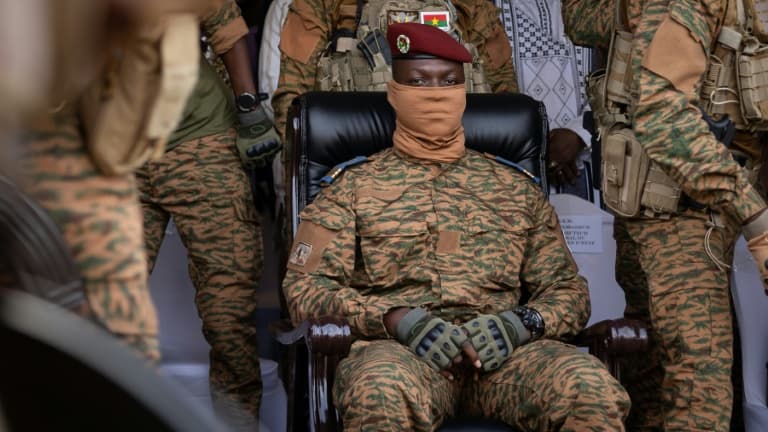
In a striking statement broadcast on national television, Burkina Faso’s transitional military leader, Captain Ibrahim Traoré, declared that the nation must abandon its pursuit of democracy, asserting it is “not for us.” The remarks, made during a rare extended interview aired on RTB (Burkina Faso’s state broadcaster), underscore a dramatic shift in the country’s political trajectory following recent upheavals.
The captain, who rose to power in September 2022 through a coup d’état—the second in eight months—has overseen sweeping changes that have effectively dismantled democratic institutions. A new charter adopted by the junta extends its rule by five years from July 2024, while also permitting Traoré to run in future presidential, legislative, and municipal elections, now postponed until 2029.
Democracy abandoned: elections deferred indefinitely
Traoré’s blunt dismissal of democracy as incompatible with Burkina Faso’s needs marks a stark departure from earlier transitional plans. Initially, the post-coup government had pledged to restore civilian rule by July 2024 through elections. However, the recently adopted charter not only scraps that timeline but allows the current leadership to consolidate power well beyond the original transition period.
Further consolidating control, the junta dissolved the Independent National Electoral Commission (Céni) in October 2025 and banned all political parties in February 2026, actions that have drawn widespread criticism from civil society and international observers.
Media crackdown and international isolation
Since seizing power, the military government has intensified restrictions on foreign media outlets perceived as critical of its policies. Several international news organizations have had their broadcasts suspended or banned, and journalists have been expelled. During his interview, Traoré defended these measures, framing them as necessary to curb external influence—particularly from Western nations and France, with whom relations have deteriorated.
The regime’s alignment with Russia has also intensified, though Traoré clarified that Moscow provides equipment without direct involvement in training Burkinabe forces. “No one trains our army,” he stated. “On the ground, it is Burkinabe soldiers who fight.”
Legal maneuvers and lingering instability
The junta’s actions have not gone unchallenged. Traoré’s predecessor, Lieutenant Colonel Paul-Henri Sandaogo Damiba—who was ousted in the September 2022 coup—remains in custody. Damiba, now facing charges of corruption and involvement in coup plots, was extradited from Togo in early 2026 and is under judicial review.
Meanwhile, Burkina Faso continues to grapple with a severe security crisis driven by jihadist insurgencies. Over the past decade, these conflicts have claimed thousands of lives and displaced millions. Traoré dismissed allegations of military abuses against civilians, asserting that “there is no evidence” to support such claims—a statement met with skepticism by human rights organizations.
The combination of political stagnation, institutional dismantling, and ongoing violence paints a concerning picture of Burkina Faso’s future under military rule. With elections postponed and democratic norms eroded, the nation faces growing uncertainty about its path forward.