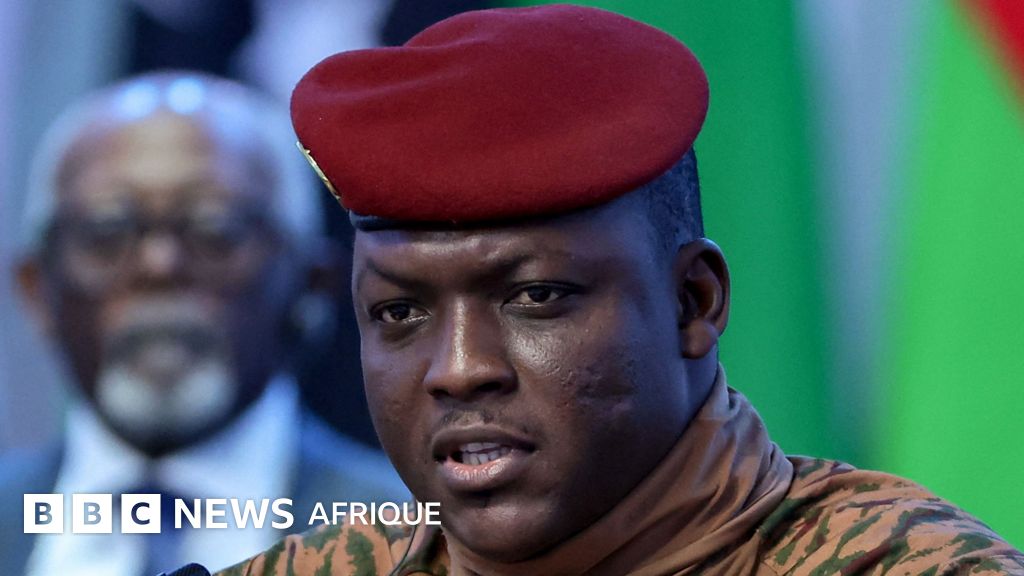
Captain Ibrahim Traoré, Burkina Faso’s military leader since 2022, has declared that the nation must abandon democracy, calling it an unsuitable system for the country. In a nationally televised address on Thursday evening, he argued that Burkina Faso should forge its own path without foreign influence.
democracy « kills » and must be abandoned
During the interview, Traoré bluntly stated: « People must forget about democracy. It is not for us. » He went further, suggesting that democracy has brought only suffering across Africa, citing Libya as a cautionary example. « Look at Libya, a close neighbor. Democracy brought nothing but destruction there, » he remarked, referencing the nation’s post-Gaddafi collapse into factional warfare.
Traoré, who presents himself as an anti-imperialist revolutionary, claimed that Western-backed democratic interventions worldwide have consistently led to bloodshed. « Wherever they try to impose democracy, it ends in tragedy, » he asserted.
a new vision for Burkina Faso
The 38-year-old leader, who seized power in a coup, had previously promised to restore democratic rule by July 2024. Yet with that deadline missed, his government announced a five-year extension of military rule, effectively postponing elections indefinitely.
In January, authorities banned all political parties, seizing their assets under the pretext of « rebuilding the state. » Traoré condemned traditional politicians as corrupt and divisive, stating: « In Burkina Faso, a real politician is a liar, a flatterer, a demagogue. »
He outlined a radical alternative vision, emphasizing sovereignty, patriotism, and revolutionary mobilization. « We are not copying anyone. We are changing everything, » he declared, stressing that grassroots leaders and traditional structures will drive the new system.
The junta also prioritizes economic and military self-reliance, insisting that shorter workdays are insufficient for national progress. « Six-hour workdays won’t help us catch up with richer nations, » Traoré argued.
controversial methods and growing unrest
Since taking control, Traoré has cracked down on dissent, targeting opposition groups, media outlets, and civil society. Critics face severe consequences, including forced deployment to frontline combat zones against Islamist militants.
Despite these measures, Traoré enjoys strong support across Africa for his anti-Western stance and pan-African rhetoric. Burkina Faso, along with neighboring juntas in Mali and Niger, has severed ties with Western powers—particularly France—in its fight against Islamist insurgencies. Instead, these nations have turned to Russia for military assistance, though violence in the Sahel continues unabated.
A recent Human Rights Watch report documented over 1,800 civilian deaths in Burkina Faso since Traoré’s rise to power in 2023. The report attributes two-thirds of these fatalities to state forces and allied militias, with Islamist militants responsible for the remainder.
The military government’s actions have drawn international condemnation, yet Traoré remains defiant, insisting that Burkina Faso’s revolutionary path will ultimately prevail.