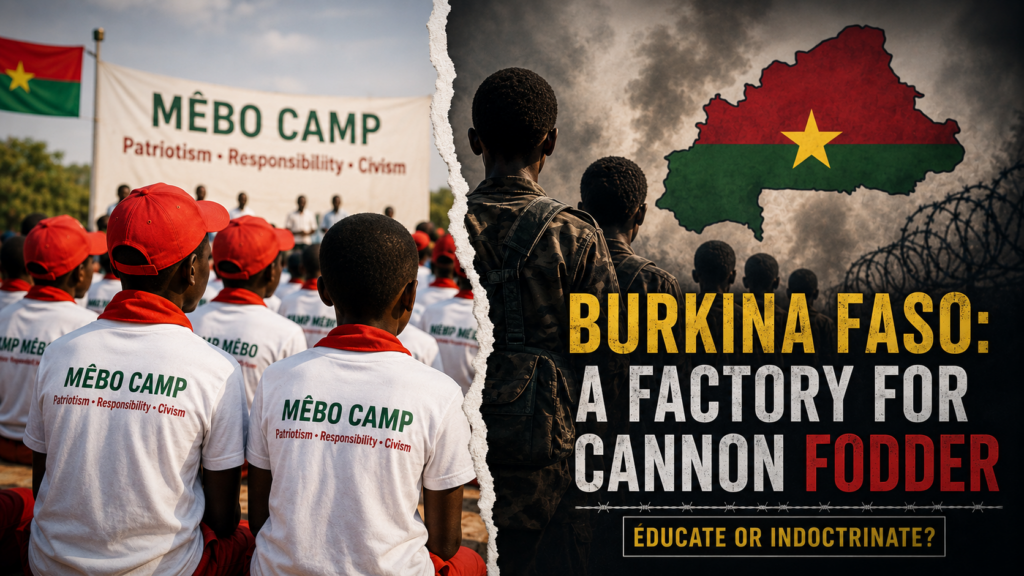
The camp, presented as an ordinary civic initiative, has drawn thousands of young participants in Burkina Faso. Under the guise of promoting national values such as responsibility and civic engagement, the Mêbo holiday camp has become the subject of growing scrutiny. Observers question whether these large-scale gatherings are inadvertently fostering a gradual militarisation of the country’s youth.
At face value, instilling a sense of duty and solidarity in young people is commendable. The concern arises when patriotism is weaponised, critical thinking is suppressed in favour of blind obedience, and the defence of the nation is framed as an unconditional obligation. This approach is not without precedent in Africa. History demonstrates that early indoctrination campaigns often blur the line between civic education, ideological mobilisation, and the recruitment of young people into conflict zones.
Patriotic discourse and its unintended consequences
The language employed in these initiatives plays a pivotal role. When terms such as nation, sacrifice, enemy, and military service are repeatedly associated in messages targeting youth, they risk normalising the idea that serving in the armed forces is the ultimate civic duty. However, a child’s development should prioritise intellectual curiosity, creativity, and constructive dialogue over premature exposure to military or political sacrifice.
In Burkina Faso, where the security crisis has uprooted communities and intensified national defence debates, the government’s strategy raises critical questions. How far can one go in instilling a defence mindset without stifling dissent or eroding the capacity for independent thought?
The fine line between education and indoctrination
While uniforms, military symbols, and war-related rhetoric may not individually indicate militarisation, their cumulative presence within a context of perpetual national mobilisation warrants close examination. Such practices risk conflating civic education with propaganda and psychological conditioning for military service.
The age of participants is particularly concerning. Adults possess the maturity and context to make informed decisions about national service. Children, however, lack the discernment to weigh such complex choices. Institutions must therefore safeguard their development, ensuring that education fosters emancipation rather than conformity to a confrontational ideology.
A cycle of violence or a path to stability?
In times of crisis, the temptation to militarise young minds is understandable. Yet, addressing insecurity by embedding confrontation as a cultural norm may perpetuate a dangerous cycle. Normalising violence as a response to political or social disagreements risks entrenching conflict rather than resolving it.
True patriotism transcends the readiness to die for one’s country. It encompasses the aspiration for a stable society where youth can thrive pursuing education, employment, and personal growth without perpetual exposure to war. It allows citizens to support their nation while holding its leaders accountable.
Ensuring a balanced approach
Before endorsing the rhetoric of patriotism and youth mobilisation, several questions must be addressed. What are the pedagogical objectives of these camps? How much emphasis is placed on critical thinking? Are participants free to dissent? Do activities include military or paramilitary components? Crucially, where does the line lie between cultivating responsible citizens and conditioning a generation to accept war as inevitable?
Burkina Faso requires an engaged, informed, and conscientious youth. Yet, it must also preserve their autonomy. The goal should not be to mould future soldiers, but to empower citizens who can build a nation. The choice between these two visions will define the country’s trajectory for decades to come.