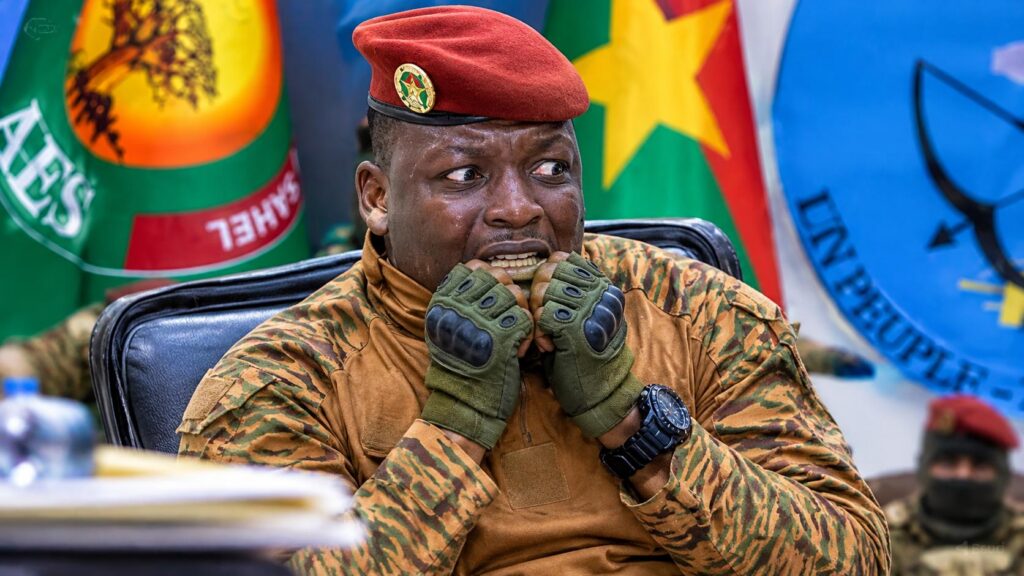
Ibrahim Traoré’s decision to skip the Russia-Africa Summit in Moscow has reignited concerns about the resilience of his leadership amid growing unease within Burkina Faso’s political and military circles. The absence of a head of state at such a high-profile event is not merely a diplomatic statement it may signal deeper fractures that could undermine the transitional government’s stability.
Diplomatic posturing vs. domestic fragility
The Burkina Faso interim leader has invested significant political capital in aligning his country with Moscow, positioning the partnership as a cornerstone of national sovereignty and resistance to foreign influence. Public statements and strategic engagements have cultivated an image of a leader unafraid to challenge traditional alliances in favor of a new geopolitical direction. Yet, this carefully crafted perception now faces scrutiny as questions arise about the internal cohesion sustaining it.
The rumored security concerns driving Traoré’s absence suggest a precarious balance between projecting strength abroad and managing vulnerabilities closer to home. Reports indicate he may fear a power grab by a trusted ally during his absence, raising doubts about the loyalty within his inner circle.
Propaganda’s double-edged sword
Since seizing power, Traoré’s administration has relied heavily on a narrative of national renewal, emphasizing anti-colonial rhetoric, military-led governance, and a rejection of Western partnerships. This messaging, amplified through digital platforms, has been instrumental in shaping public perception but at a cost. Critics argue that the focus on symbolic victories, such as forging ties with Russia, has overshadowed urgent domestic crises, including insurgency threats and humanitarian fallout.
Selective transparency: While the government touts its diplomatic victories, essential details about security failures and governance gaps remain obscured, fueling skepticism.
Symbolic over substance: The prominence of Traoré’s pro-Russian posturing contrasts with stagnation on critical issues like food insecurity and infrastructure collapse.
Internal credibility gaps: Exaggerated claims of progress risk alienating both the population and key stakeholders within the military and transitional council.
The army’s shifting loyalties
In transitional regimes where power is consolidated through military support, leadership stability hinges on the cohesion of security institutions. The junta’s survival depends on maintaining unwavering allegiance among officers yet trust erodes when short-term political gains prioritize foreign alliances over soldiers’ welfare or national defense.
Rumors of dissent within Traoré’s ranks point to a more insidious threat: the possibility that some allies view his ambitions as a liability. Without unequivocal proof of an imminent coup, these tensions nonetheless expose the fragility of a governance model built on personal loyalty amid shifting power dynamics.
When alliances abroad mask instability at home
A leader’s international image is only as strong as the foundations at home. Traoré’s diplomatic showmanship, while resonant with pan-African audiences seeking to challenge Western dominance, cannot indefinitely mask the erosion of institutional trust. The decision to skip a summit that doubles as a platform for asserting sovereign partnerships suggests a prioritization of immediate concerns over long-term strategy.
If confirmed, the absence stems from real security threats rather than mere protocol choices illustrating how external confidence in Burkina Faso’s leadership may be misplaced. The paradox is stark: a government projecting uncompromising autonomy abroad may simultaneously struggle to assert control within its own corridors of power.
A test of Burkina Faso’s transitional resolve
The coming weeks will reveal whether Traoré’s absence is a temporary setback or a harbinger of greater instability. Three key factors will define the trajectory:
External perception: How will regional and global partners reconcile Burkina Faso’s diplomatic absenteeism with its vocal calls for sovereignty?
Internal power plays: Could the perceived weakness embolden factions vying for influence, or will Traoré’s camp rally in a display of forced unity?
Public confidence: A population already strained by economic hardship and insecurity will demand clarity on the leadership’s priorities and consequences for perceived missteps.
For now, the Kremlin summit looms as a backdrop to a more pressing question: can Burkina Faso’s transition survive the contradictions between its international bravado and the realities of divided loyalties?
What this means for the future
Traoré’s challenge is no longer confined to geopolitical maneuvering; it has evolved into a battle for the survival of his transitional agenda. Domestic stability is not a peripheral issue it is the bedrock of all other ambitions. Without it, even the most audacious global partnerships risk being built on shifting sands.
As Burkina Faso grapples with these internal tremors, the world watches not just for declarations of alliances, but for signs that its leadership can reconcile its outward bravado with the urgent needs of its people.
By Marguerite Ndongo — Journalist