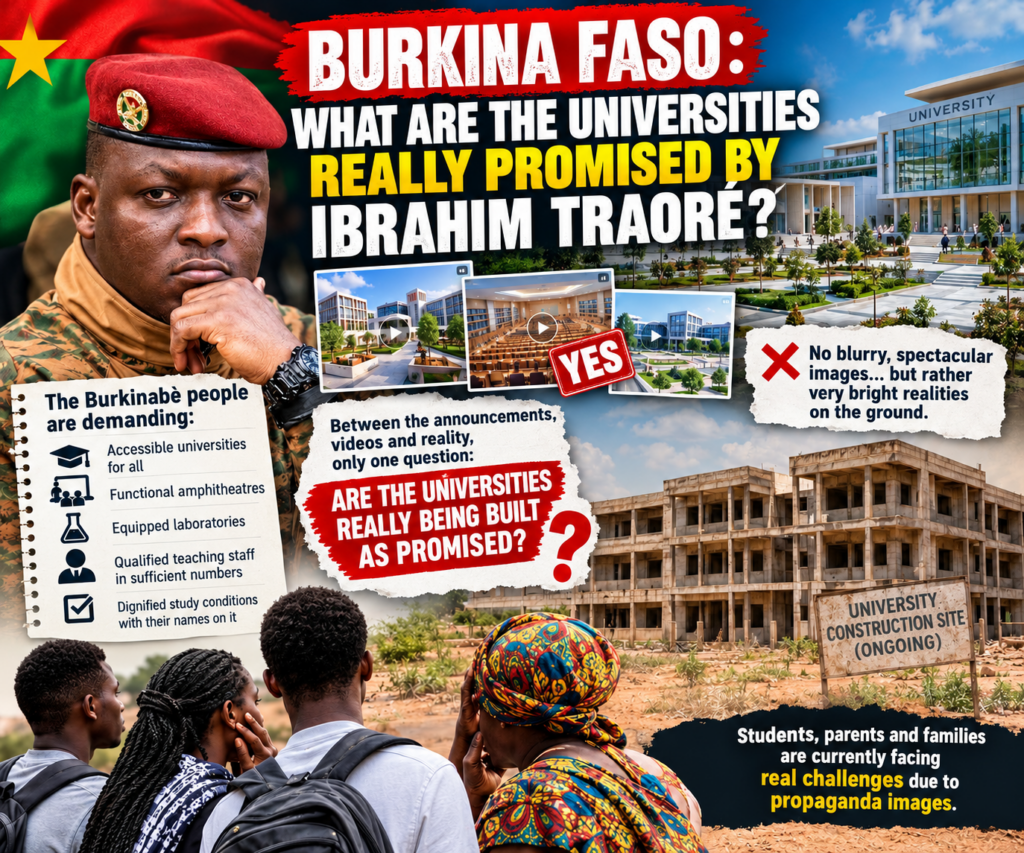
Behind the viral images: the urgent reality of Burkina Faso’s universities
The promise of a higher education transformation in Burkina Faso has dominated the national conversation, with vivid images of state-of-the-art campuses circulating widely online. Yet for students and families making life-altering investments in education, the gap between these visuals and on-the-ground reality remains a critical concern. How many of these promised institutions have actually materialized, and what concrete benefits are they delivering to Burkinabè youth?
From digital spectacle to concrete impact: what students actually experience
For parents scraping together savings for tuition, and for students preparing to enter university, the difference between announcement and implementation is everything. While marketing materials showcase pristine buildings and advanced facilities, many families report continuing struggles: limited seating capacity, absent equipment, and classrooms lacking even the most basic resources. The question persists: where are these buildings supposed to be serving their intended purpose?
The disappointment isn’t limited to unfulfilled promises. In some cases, students discover upon arrival that promised programs have been scaled back or delayed indefinitely. Others find themselves in temporary structures that were never meant to house full academic programs. The emotional and financial toll on these young learners and their families cannot be overstated as they confront a system failing to deliver on its commitments.
The artificial intelligence threat: when images replace infrastructure
The rise of AI-generated content has introduced a dangerous new dimension to political communication in Burkina Faso. Videos that appear to showcase completed university projects often turn out to be computer-generated or sourced from unrelated construction projects in other countries. These manipulated visuals create a deceptive halo effect around government initiatives, complicating efforts to distinguish fact from fiction.
In one verified instance, a video presented as evidence of President Ibrahim Traoré’s architectural achievements was traced back to an Algerian construction site. Similar cases have emerged across social media platforms, where AI-enhanced imagery creates an illusion of progress that doesn’t exist in Burkinabè territory. This pattern raises urgent concerns about transparency and accountability in national development reporting.
The government’s response: progress with persistent gaps
Official announcements point to some measurable progress. Most notably, a newly inaugurated complex at Nazi Boni University in Bobo-Dioulasso boasts a 1,200-seat auditorium, four 210-seat lecture halls, and six fully equipped laboratories. Government statements additionally reference several ongoing projects under the Presidential Initiative for Quality Education for All.
However, these achievements represent merely the starting point of what was promised. Verification reveals persistent inconsistencies between announcement and implementation:
- Several announced university projects remain at the blueprint stage without visible construction
- Other facilities, while structurally complete, lack essential teaching equipment and supplies
- Student enrollment capacity in newly inaugurated buildings often falls short of official projections
- Some programs begin operation with skeleton faculty, leaving students with limited academic support
These discrepancies between promise and practice suggest that Burkina Faso’s higher education transformation remains more aspirational than realized for the vast majority of its intended beneficiaries.
Education’s real cost: who pays for unfulfilled promises?
The consequences extend far beyond disappointment. Families have mortgaged their futures to invest in their children’s education, only to see those investments devalued by half-built institutions and abandoned programs. Small business owners who anticipated increased demand from university operations now face declining revenue as student intake fails to reach projected levels.
The broader economic impact manifests in qualified graduates entering the workforce without the skills needed for available positions. This skills mismatch perpetuates high unemployment and drives skilled labor migration out of the country. Rather than building the nation’s human capital, these unfulfilled commitments risk depleting it.
A call for accountability: moving from imagery to impact
Burkina Faso’s journey toward educational excellence demands more than visual spectaculars. It requires concrete evidence of:
- Physical realization: completed buildings, equipped laboratories, functional libraries
- Operational capacity: adequate enrollment numbers, qualified faculty, curriculum delivery
- Financial transparency: clear accounting of allocated funds and actual expenditures
Without these fundamentals, the higher education revolution risks becoming another example of symbolism over substance. Students deserve real institutions as much as they deserve the truth about their country’s progress. The national conversation must shift from how things look to how they actually work.
For a generation that has grown up with smartphones and social media, the distinction between reality and representation has never mattered more. Burkina Faso’s leaders face a simple choice: continue building the nation’s future on digital illusions, or demonstrate through tangible achievements that their promises extend beyond the screen.