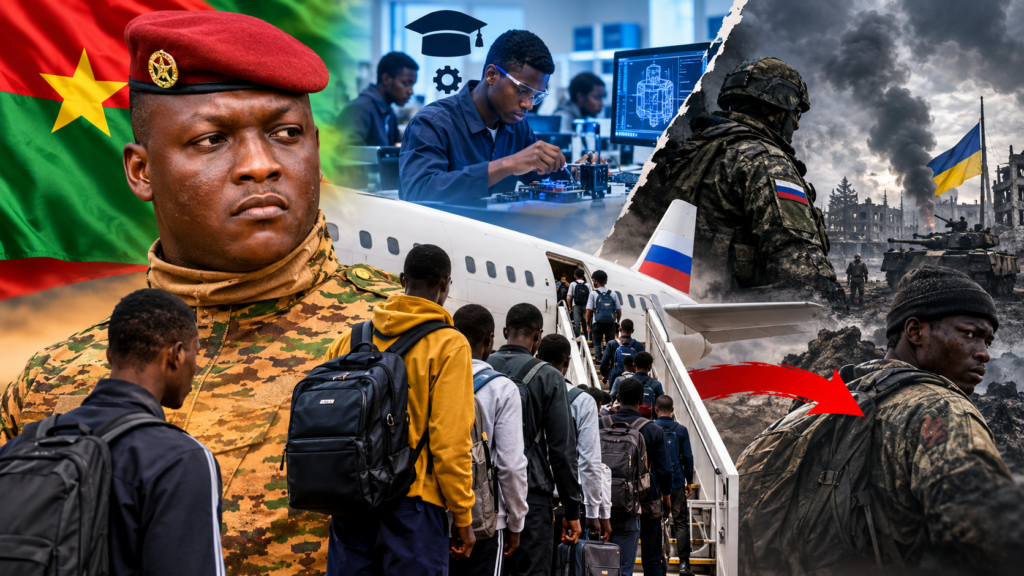
With the promise of advanced technological training, Burkina Faso is facing a high-stakes dilemma: are its young citizens being offered genuine educational opportunities or being funneled into a dangerous and uncharted path? The government’s decision to send Burkinabè youth to Russia for specialized programs has sparked intense debate, raising concerns about the true intentions behind this initiative.
From national promises to questionable alliances
Just months ago, Burkina Faso’s leadership emphasized the need to educate its youth domestically, reinforcing the vision of building a self-sufficient nation with skilled professionals nurtured within its borders. Yet today, this commitment appears to have shifted dramatically. Why, then, are young Burkinabè being directed toward Russia, a power entangled in a brutal conflict that shows no signs of resolution?
The contradiction is hard to ignore. Captain Ibrahim Traoré, who once championed education and technological sovereignty for Burkina Faso, now proposes sending its brightest minds across the globe to institutions in a country deeply involved in an ongoing war. Such a pivot demands urgent clarification: what exactly are the intended outcomes of this training?
Unanswered questions and looming risks
At the heart of the controversy lies a series of unresolved questions. How many young Burkinabè will participate? Which Russian institutions will oversee their education? What certifications or qualifications will they receive? And, most critically, what safeguards exist to prevent their involvement in military actions?
Past accounts of African citizens recruited to Russia under the guise of education or employment, only to end up on the front lines, underscore the gravity of these uncertainties. Testimonies from similar programs have revealed a pattern of deception, where individuals lured by professional promises found themselves in life-threatening situations entirely unrelated to their original expectations.
Economic development or human cost?
Proponents of the initiative argue that exposure to cutting-edge technology is essential for Burkina Faso’s progress. However, this perspective overlooks a fundamental issue: does this approach truly serve the nation’s long-term goals, or does it expose vulnerable youth to risks that far outweigh any perceived benefits?
The government has yet to present concrete details on how these programs will benefit Burkina Faso upon completion. Will the trained individuals remain in Russia, or will they return to contribute to their home country’s economy? Without transparency, these concerns remain unaddressed, leaving families in the dark about the fate of their children.
A government’s responsibility to protect its people
No cooperation agreement, no matter how diplomatically advantageous, should come at the cost of human lives. Burkina Faso’s government must ensure that its youth are not being used as pawns in an international conflict they neither understand nor signed up for.
The stark contrast between earlier commitments to national education and the current push for foreign training cannot be dismissed. If the nation possesses the capacity to educate its youth locally, why redirect resources and potential toward uncertain endeavors abroad? The answer lies in accountability demanding that Ibrahim Traoré’s administration provide clear, actionable responses to these pressing questions.
What lies ahead for Burkina Faso’s youth?
For the families of those being sent abroad, the uncertainty is unbearable. Their children Burkina Faso’s future engineers, scientists, and innovators deserve more than vague assurances and political grandstanding. They deserve assurance that their dreams will not be sacrificed in a war that has no connection to their homeland.
The government’s silence only amplifies fears. Unless concrete steps are taken to demilitarize these programs and guarantee the safety of all participants, the initiative risks becoming a stain on Burkina Faso’s reputation and a tragedy for the families involved.
In the absence of transparency, one thing is clear: the true cost of this Russian training initiative may extend far beyond classrooms and diplomas it could end in lives irrevocably altered by forces beyond their control.
By Emmanuel Mbarga — Journalist