Burundi urges stronger international action over ongoing violence in eastern DR Congo
- Sécurité
As current chair of the African Union and a witness to the signing of the Washington Peace Agreement between Félix Tshisekedi of the DR Congo and Paul Kagame of Rwanda—facilitated by former U.S. President Donald Trump—the Burundi government expressed deep concern that this landmark initiative has yet to yield tangible results on the ground. In the eastern DR Congo, hostilities continue unabated between government forces and the M23 rebel group, widely accused of receiving direct support from Rwanda.
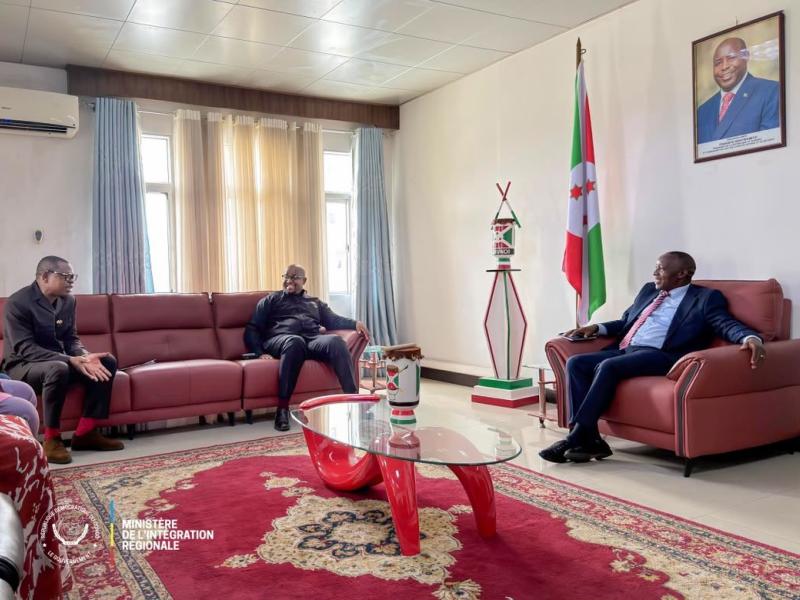
This sobering assessment was delivered by Burundi’s Minister of Foreign Affairs, Regional Integration, and Development Cooperation, Ambassador Édouard Bizimana, during a high-level meeting with his Congolese counterpart, Floribert Anzuluni, Minister of Regional Integration. Held on Monday, June 1, 2026, in Bujumbura, the talks underscored both countries’ shared commitment to regional stability and the urgent need for enhanced international involvement.
Minister Bizimana pointed out that while some Congolese refugees have been able to return home, many areas remain mired in insecurity, forcing renewed displacements toward neighboring countries. He called for a stronger, unified response from the international community to reinforce existing regional initiatives and ensure the full implementation of the Washington Agreement.
“The peace and security challenges in our region cannot be resolved by half-measures. The Washington Agreement, though a significant step, has not been fully respected. While some progress has allowed certain displaced populations to return, other zones continue to suffer from escalating violence, leading to fresh waves of displacement. We must act decisively to support the initiatives already underway,” he stated.
The meeting also highlighted the strong bilateral relations between Burundi and the DR Congo, with both ministers reaffirming their commitment to deepening cooperation. Beyond the security crisis in eastern DR Congo, discussions covered critical shared priorities, including the allocation of land for Burundi’s upcoming embassy in Kinshasa, the management of the Executive Secretariat of the International Conference on the Great Lakes Region (ICGLR), and preparations for the upcoming ICGLR summit—currently chaired by the DR Congo.
For his part, Congolese Minister Floribert Anzuluni praised Burundi’s diplomatic efforts, particularly its role in mobilizing humanitarian aid for Congolese refugees hosted in Burundi. Regarding the ICGLR, he announced that a Troika meeting is being organized to assess the regional security landscape and review member states’ statutory contributions.
Ambassador Bizimana reiterated Burundi’s unwavering dedication to silencing the guns across Africa—a key objective set by President Évariste Ndayishimiye during his acceptance speech as the new African Union Chair, succeeding Angola’s João Lourenço. He emphasized that Burundi remains fully engaged in this continental mission.
In the Great Lakes region, Burundi and the DR Congo are strategic allies, bound by a bilateral defense agreement signed in March 2023. Facing persistent insecurity in eastern DR Congo—widely attributed to what Kinshasa describes as Rwandan aggression through the M23 rebellion and its allied militias in South Kivu—Bujumbura has deployed thousands of troops to support the Congolese Armed Forces (FARDC) and secure the shared border. This military cooperation reflects a broader framework of joint efforts.
Despite the joint communiqué issued following the Montreux talks in Switzerland (April 13–17, 2026)—attended by representatives of the DR Congo government, the M23 Alliance, and mediators from the United States, Qatar, and Togo—violations of the ceasefire and non-compliance with commitments persist. The Washington process, too, has stalled, with each party interpreting the agreement’s terms differently, further complicating implementation.
This diplomatic impasse—under the watch of mediators such as the United States and Qatar—continues to exacerbate the security crisis, with fighting intensifying in eastern DR Congo.
Reporting by Clément Muamba