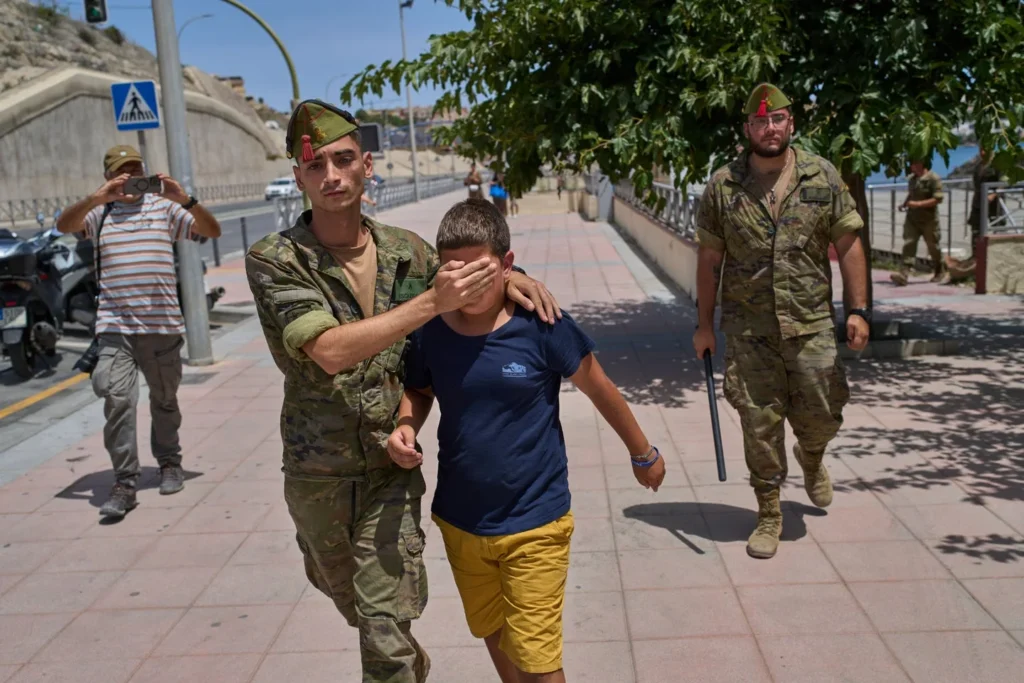
Moroccan justice minister urges repatriation of minors from Ceuta
The Moroccan Minister of Justice, Abdellatif Ouahbi, has formally requested the return of Moroccan minors currently in Spain, including those who arrived in Ceuta during the recent migration surge. This directive follows instructions from the Moroccan monarchy to government agencies, aiming to streamline the identification and repatriation processes for these minors.
Numbers and legal hurdles complicate the process
As of the latest update in early August, Spanish authorities reported 1,527 unaccompanied minors in Ceuta. However, this figure includes some children who were already present in the enclave before the migration wave on July 30 and 31. The exact number of new arrivals remains unclear, adding complexity to the repatriation efforts.
Existing agreement between Morocco and Spain
The belief that Spain prohibits the return of Moroccan minors is incorrect. Since 2007, Rabat and Madrid have maintained a bilateral agreement focused on preventing irregular migration by unaccompanied minors, ensuring their protection, and facilitating their coordinated return. The agreement outlines cooperation between the two nations to locate the minors’ families and, when feasible, reunite them with their relatives or transfer them to Moroccan authorities.
However, the agreement does not permit mass or automatic returns. Spanish law requires a case-by-case assessment to determine if repatriation aligns with the child’s best interests. Authorities must gather family background details, consult with Moroccan counterparts, and allow the minor to express their views. The public prosecutor’s office also plays a critical role in the process.
This rigorous evaluation process explains why minors could not be swiftly returned alongside adults during the immediate deportation efforts. Their irregular entry into Spain does not strip them of their status as minors under the protection of Spanish authorities.
Lessons from the 2021 Ceuta crisis
The 2021 Ceuta migration crisis serves as a cautionary tale. Following the mass arrival of migrants, hundreds of minors were repatriated to Morocco in an organized operation. However, the Spanish judiciary later ruled this process unlawful in January 2024, citing insufficient individual assessments of each minor’s situation. The Supreme Court emphasized that the guarantees required by Spanish law had not been met.
This precedent now looms large over any future repatriation efforts. Despite Morocco’s demands and Spain’s desire to alleviate Ceuta’s overcrowding, Spanish authorities must ensure that every return complies with legal safeguards. A collective operation, as seen in 2021, risks legal challenges and further scrutiny.
Alternative measures while awaiting repatriation
In the meantime, Spain faces a pressing challenge: the overcrowding in Ceuta. To address this, the government has activated mechanisms to redistribute some of the unaccompanied minors across other autonomous communities. This measure does not preclude the possibility of repatriation to Morocco, as the two processes operate independently.
The redistribution plan has sparked political debates in Spain. While the central government advocates for regional dispersal to ease Ceuta’s burden, the opposition Popular Party insists on prioritizing repatriation to Morocco. Juan José Imbroda, President of Melilla, has also called for the full implementation of the 2007 agreement with Rabat.
The current impasse is not due to Spain’s refusal to return the minors to Morocco. Rather, it stems from a legally binding process that demands thorough, individualized evaluations. Morocco has expressed readiness to receive the minors, but Spain’s hands are tied by judicial and administrative requirements.
The coming weeks will test the cooperation between the two nations. The key question is whether they can expedite family identification and meet the necessary conditions for repatriation. The 2021 judicial ruling underscores that haste could expose Spanish authorities to renewed legal challenges, making a carefully managed approach essential.



More Stories
Burkina Faso’s shrinking public payroll: a household burden as schools reopen
Simporé’s televised admission: can Burkina Faso’s army still hold the line?
Gabon’s ghost worker purge: can 11 billion CFA francs in savings really reach the people?