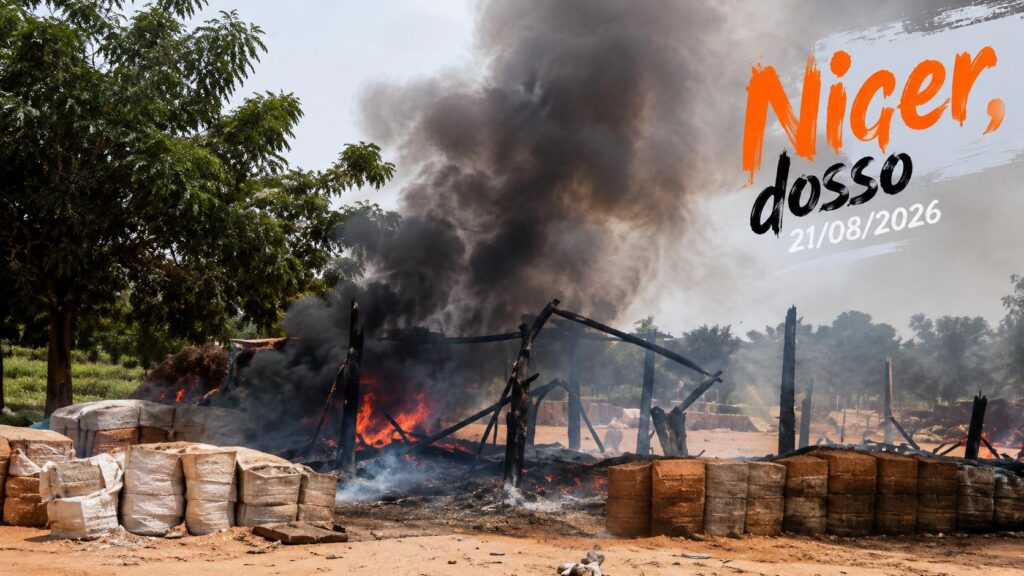
A shocking and violent assault struck Tessa, a rural commune in the Dosso region of southwestern Niger, on Friday, August 21, 2026. Local reports confirm that 18 gendarmes were killed during the brazen attack carried out by heavily armed men. The assault also left significant material damage and disrupted local economic activity.
An attack of unprecedented scale
Tessa, a rural municipality in the Dosso region, is home to several dozen villages and serves as one of the administrative territories in this southwestern part of Niger. It was here that an attack of rare violence unfolded on August 21, 2026, carried out by armed men described locally as terrorists.
The assailants arrived in large numbers, using around ten motorcycles to execute their plan. Their primary target was the security outpost stationed in the area. The ensuing firefight was intense, culminating in the burning of the gendarmerie camp and the tragic loss of military lives.
While local sources report 18 gendarmes killed, this figure remains unverified and must be officially confirmed by Nigerien authorities or independent observers to be considered final.
The shockwave through Tessa’s community
The attack sent shockwaves through the population of Tessa. Residents describe the assault as brutal, marked by the attackers’ overwhelming firepower and rapid execution. In an area already grappling with security threats, such a violent strike deepens fears among locals.
The presence of security forces is vital for residents to move freely, engage in trade, and access essential services. The destruction of a security post represents more than a military loss—it fuels a sense of vulnerability across the region.
The attackers’ use of motorcycles highlights the challenges faced by security forces in rural areas. These fast-moving groups can cover vast distances quickly, strike, and vanish before reinforcements arrive.
Financial services targeted in the chaos
The assault did not spare critical economic infrastructure. After targeting the gendarmerie camp, the attackers raided two money transfer agencies—Nita and Amana—allegedly looting them during the operation.
In rural Niger, these agencies are lifelines for liquidity. They enable traders, families, and workers to send and receive funds without traveling to distant urban centers. Their disruption could have far-reaching consequences, forcing operators to suspend services temporarily and leaving residents struggling to access their money.
A local economy under strain
The economic fallout of such an attack is immediate and severe. Violence often paralyzes local commerce, with markets operating at reduced capacity and transporters becoming more cautious. Fear grips business owners, who hesitate to store cash or goods in areas deemed unsafe.
The looting of Nita and Amana could exacerbate these challenges, compounding a troubling trend: a local economy increasingly crippled by insecurity. Families relying on remittances from relatives in cities or abroad may face even greater hardship if these services remain disrupted.
Dosso’s growing vulnerability exposed
The Dosso region has not historically been perceived as a hotspot for insecurity in Niger. However, its geographical position and the shifting dynamics of neighboring areas make it particularly susceptible to threats. If confirmed, the attack on Tessa signals a dangerous escalation.
It suggests that armed groups are increasingly targeting locales with weaker security setups than major urban centers. The attackers’ mobility—using motorcycles to traverse vast rural expanses—poses a significant challenge for security forces trying to prevent such strikes.
For authorities, the dual challenge is clear: protect civilians while ensuring rural areas do not become safe havens or staging grounds for armed factions.
Unanswered questions linger
Several critical details remain unclear. Who exactly carried out the attack? Which group do they belong to? How many assailants were involved? Were reinforcements deployed post-attack? Were any attackers neutralized or captured?
The reported death toll of 18 gendarmes also awaits official verification. In the aftermath of such violence, initial reports can be fragmented, and figures may shift as authorities secure the site and identify casualties. An official confirmation will be essential to clarify the attack’s circumstances and true human cost.
A community gripped by dual fears
Beyond the human toll, the attack on Tessa raises broader concerns about rural communities’ ability to sustain normal economic life amid persistent insecurity. The destruction of a security camp and the looting of financial services strike at two pillars of local stability: safety and economic flow.
For residents, the priority is restoring a secure environment to resume daily routines. For authorities, the task ahead is twofold: strengthening security presence while mitigating the attack’s long-term economic repercussions.
If the reports hold true, this attack stands as one of the gravest episodes in Niger’s ongoing security crisis. With 18 gendarmes killed, a camp burned, and financial agencies ransacked, its impact extends far beyond the military sphere. It underscores how insecurity directly undermines local economies and the livelihoods of ordinary people.
As authorities work to confirm the human toll and reconstruct the sequence of events, Tessa remains on edge. The restoration of safety and economic activity will now be the community’s—and the nation’s—top concerns.