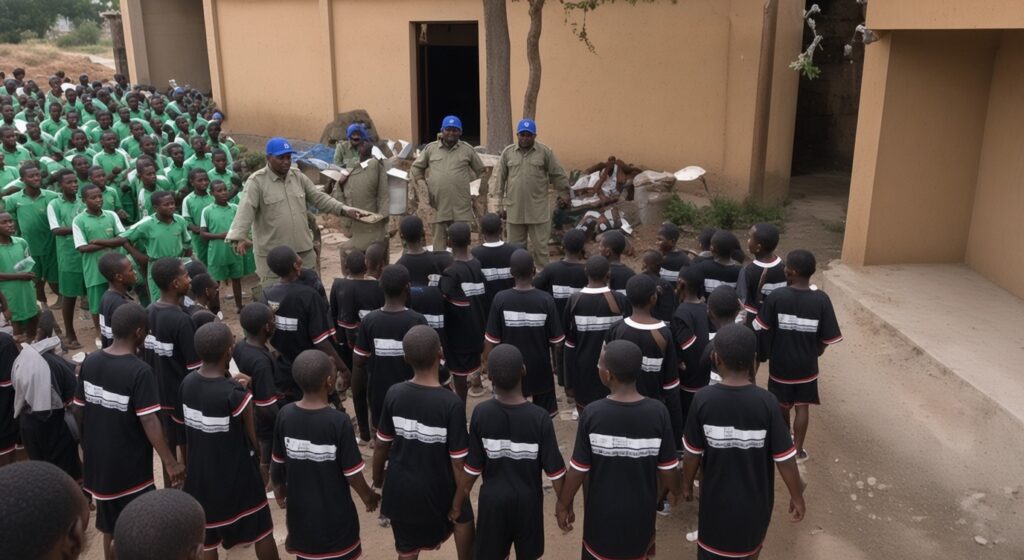
General Abdourahamane Tiani has formally introduced a youth training initiative involving more than 300 young citizens from Niger. Marketed as a platform for civic participation, national revitalisation, and social rebirth, this programme draws parallels with Burkina Faso’s approach, endorsed by Captain Ibrahim Traoré. Underneath its polished presentation and the romanticised portrayal of the ‘dedicated youth’ lies an underlying concern: the military leadership appears to be systematically fostering the early militarisation of the populace under the pretext of patriotism.
Ethical and developmental concerns
At a developmental stage where education, professional development, sports, cultural engagement, and civic learning should be the focal points, incorporating a militarised or paramilitarised framework poses significant ethical dilemmas. Impressionable minds exposed to military rigour, unconditional compliance, and constant mobilisation may normalise conflict-driven values, thereby normalising a culture of confrontation.
Political implications and civic responsibility
The foremost issue transcends the operational structure of the camp; it lies in the ideological message being communicated to an entire generation. When a government, led by military figures, portrays youth engagement as a patriotic obligation, it risks prioritising loyalty to the regime over the development of independent thought. Authentic civic engagement is rooted in the ability to challenge authority, foster dialogue, and advocate for collective welfare not in uncritical adherence to directives.
The distinction between civic education and indoctrination becomes increasingly blurred when young individuals are persistently exposed to narratives centred on combat, sacrifice, and national defence. While a motivated youth cohort can contribute meaningfully to national progress, their role must never be reduced to serving as an expendable resource for the indefinite consolidation of military authority.
Resource allocation and societal priorities
This initiative prompts a fundamental question: why divert significant public funds towards ideological mobilisation when countless young people in Niger lack access to functional educational institutions, certified vocational training, employment prospects, essential infrastructure, or hopeful futures? National pride, while a noble sentiment, cannot substitute for economic stability, educational attainment, or job creation.
The framing of ‘mandatory civic duty’ may function as a strategic diversion. By exhibiting an image of disciplined, selfless, and compliant youth, authorities might deflect scrutiny from pressing socio-economic issues, systemic educational deficiencies, rampant unemployment, and the destabilising effects of political turbulence.
Long-term risks of societal militarisation
The sustainability of this strategy raises further concerns. A generation raised within a culture of perpetual mobilisation may eventually regard societal militarisation as a natural state of affairs. What is currently presented as a temporary initiative could evolve into a systematic framework for the political and paramilitary conditioning of young minds.
Regional context and comparative analysis
The approach adopted in Niger invites a critical comparison with Burkina Faso. Although fostering national pride and defence readiness might appear as valid responses to regional security threats, Sahelian nations must refrain from engaging in an escalating cycle of population militarisation. Despite the gravity of the security environment, the answer cannot lie in transforming an entire generation into potential instruments of conflict.
Niger’s youth deserve opportunities that extend beyond serving as symbols in a political narrative. They merit access to high-quality education, marketable skills, gainful employment, intellectual independence, and the freedom to engage in civic life without coercion into a specific political or military ideology.
Enthusiasm among young people should not be exploited to mask governance shortcomings. A resilient state is one that nurtures knowledge, fosters freedom, and creates opportunities for its citizens to shape their nation’s destiny not one that accelerates the indoctrination of children into military obedience.
True patriotism is reflected in cultivating citizens who can construct, innovate, think critically, and defend their country when legitimately required not in prematurely conditioning them to accept military logic as their default framework. Niger must ensure that the pursuit of security does not inadvertently become a justification for the enduring militarisation of childhood and adolescence.