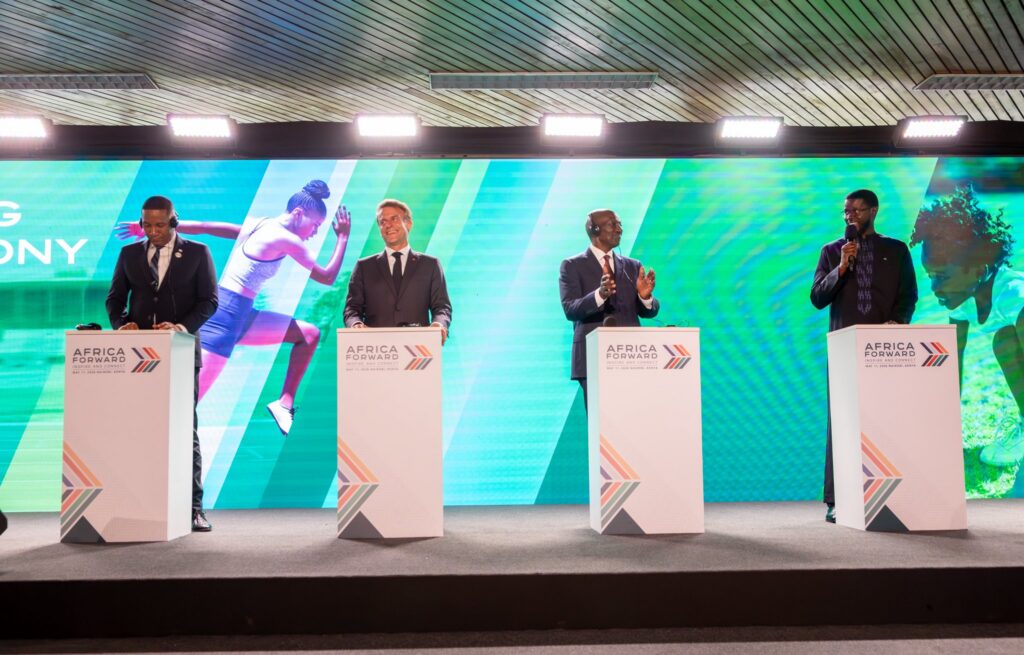
Four months after the controversial Africa Cup of Nations final between Senegal and Morocco was awarded to the latter on administrative grounds, diplomatic tensions between Dakar and Rabat continue to cast a shadow over continental summits. The dispute flared up again during the sport and development session of the Africa-France summit in Nairobi, where Senegalese President Bassirou Diomaye Faye seized the moment to celebrate his country’s African Cup victory—a title Senegal claims was unjustly stripped away.
Seated beside French President Emmanuel Macron and Kenyan counterpart William Ruto, Faye’s declaration drew thunderous applause from the audience, while Patrice Motsepe, president of the Confederation of African Football (CAF), watched with visible discomfort. The Senegalese leader’s ironic remark—“Thank you for this verdict!”—was a clear nod to the CAF Appeals Committee’s March 17 decision to award Morocco a 3-0 victory on the green table, despite Senegal’s 1-0 extra-time win on the field in Rabat on January 18. The Senegalese Football Federation (FSF) has since filed an appeal with the Court of Arbitration for Sport (CAS) in Lausanne against both CAF and Morocco’s football federation, FRMF. The case remains pending, with legal proceedings expected to drag on for months.
Morocco skips key sports session
While Morocco sent its Prime Minister Aziz Akhannouch to Nairobi to discuss industry and renewable energy, no Moroccan officials attended the sports-focused segment. “They chose not to prioritize this session,” noted an insider familiar with the dossier. Four months after the chaotic final at Rabat’s Moulay Abdellah Stadium, the avoidance is mutual: discussions in Nairobi carefully skirted the topic.
After the closing plenary, French delegate Eléonore Caroit stated, “Given the magnitude of this issue, I expected it to come up. I participated in numerous roundtables over two days, but personally heard nothing about it and detected no tensions.” Foreign Minister Jean-Noël Barrot added that while the dispute wasn’t raised during the summit, it remained a topic in bilateral talks. Pausing before concluding, he noted, “It’s not just about football.”
The fallout isn’t limited to sports. A legal case involving a French national—brother of a Senegalese staff member—accused of throwing a water bottle at police during stadium disturbances has added strain. After three months in a Moroccan prison, he was released on April 18 following an appeal that confirmed his sentence. Three of the 18 Senegalese fans imprisoned for violence and property damage were also freed on the same day. They returned to Dakar on May 7 after visiting the mausoleum of Ahmed Tidjani in Fes. The remaining 15, serving sentences ranging from six months to a year, remain detained pending a potential royal pardon—a prerogative exclusive to King Mohammed VI.
diplomatic channels remain open
Despite the acrimony, both sides insist on preserving appearances. A Moroccan source emphasized that “our shared religious and historical ties must always take precedence over a football match.” In Dakar, officials struck a conciliatory tone: “This is a quarrel among brothers—like the tongue and teeth, sometimes we bite each other. Diplomatic channels will play their role. Senegal respects each country’s sovereignty and expects the same in return.”
The dispute has already left a regulatory mark on global football. At FIFA’s April congress in Vancouver, the International Football Association Board (IFAB) adopted the so-called “Pape Thiaw Law,” named after Senegal’s coach, who encouraged players to walk off the pitch in protest over a controversial penalty awarded to Morocco late in the game. Under the new rule, referees can now issue a red card to any player who leaves the field—or to any team official who incites such an action. A CAF delegate present in Vancouver dryly remarked that the reform aims to prevent “a Senegalization of world football.”
From legal battles in Lausanne to imprisoned fans in Rabat and diplomatic maneuvering in Nairobi, the Africa Cup final is shaping up to be one of the most protracted sagas in African football history.