- Santé
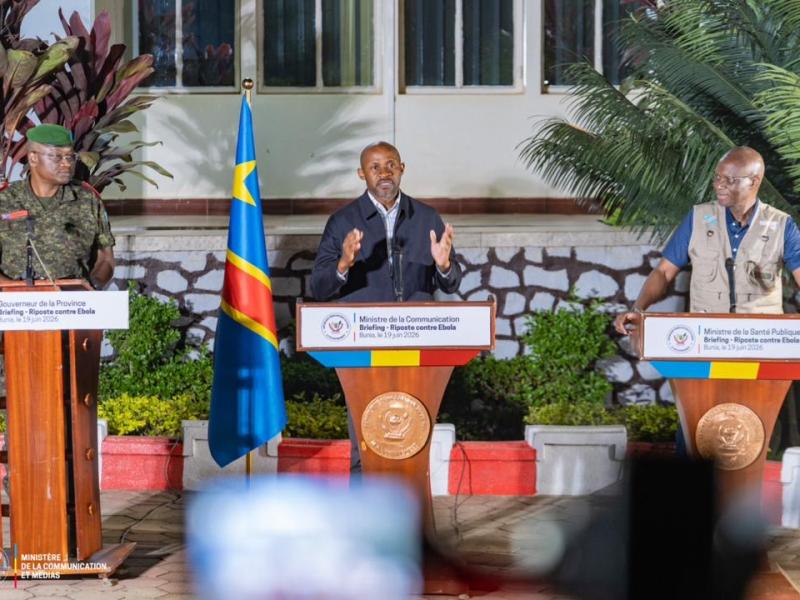
In a recent visit to Bunia, located in Ituri province, Patrick Muyaya, the government spokesperson and Minister of Communication and Media, urged for a balanced and “objective” assessment of the Democratic Republic of Congo’s (DRC) efforts to combat the ongoing Ebola virus disease (EVD) outbreak. This epidemic currently affects the eastern provinces of Ituri, Nord-Kivu, and Sud-Kivu.
During a joint press briefing on Thursday, June 18, 2026, alongside Roger Samuel Kamba, the Minister of Public Health, Hygiene, and Social Welfare, Muyaya addressed criticisms from certain non-governmental organizations involved in the health response. He reaffirmed the government’s commitment to transparency and openness to constructive feedback, while emphasizing the importance of acknowledging the progress made on the ground. While conceding that challenges persist, he firmly rejected any inclination towards alarmist rhetoric.
“I prefer not to name the criticizing NGOs. We are, without a doubt, transparent in our operations. You observed the various speakers earlier; no one was instructed on what to say. We are not asserting that everything is flawless, that is not our claim. We are stating that we are fulfilling our responsibilities,” the government spokesperson articulated.
Muyaya highlighted that the Congolese state proactively assumed its responsibilities, deploying its own financial resources before external partners provided support. He also sought to clarify the nature of international funding, particularly those announced by foreign partners.
“The government did not wait for partners. We have now allocated 50 million USD of government funds, because we must lead by example. All the international funding you hear about, from the American government and other partners, is not directly provided to the Congolese government. These funds are channeled directly to NGOs,” he elaborated during his address.
The Minister called upon all stakeholders engaged in the response to prioritize collective responsibility, suggesting that some criticisms might not accurately reflect the realities observed in the field.
“We are all united by a common goal: to end this epidemic. However, it is another matter for those who believe they can leverage this epidemic to solicit more resources. There are alternative mechanisms for advocacy,” he noted.
He appealed to the organizations involved for greater circumspection in their public statements: “To diminish the sacrifices of those working tirelessly on the ground is to undermine their efforts. I would urge these NGOs to exercise more restraint, as if we were to scrutinize their field activities, there would be much to comment on.”
Concurrently, Minister of Public Health, Hygiene, and Social Welfare, Roger Samuel Kamba, expressed his preference for focusing on tangible outcomes rather than engaging in controversies.
“I choose to remain focused on the facts,” he declared, proceeding to list the indicators he considers crucial for evaluating the response. “I prefer to look at the number of tests conducted in a month, count the treatment centers established, assess the community relays deployed, analyze the daily samples, and track the number of recovered individuals,” he added.
For Minister Kamba, the effectiveness of the response must be judged by concrete actions implemented in the field. “Such details are what concern me. Rumors and attempts by individuals to claim undue credit do not interest me,” he continued. Roger Samuel Kamba believes that a definitive assessment can only be made once the health crisis concludes: “When this epidemic is over, everyone will be able to reflect on their contributions and draw their own conclusions.”
On May 17, 2026, merely two days after the official declaration of the epidemic in the Democratic Republic of Congo, the World Health Organization (WHO) classified the Ebola outbreak, caused by the Bundibugyo virus and spreading from the DRC to Uganda, as a Public Health Emergency of International Concern (PHEIC).
According to the WHO, the epidemic has demonstrated substantial geographical expansion, and its true scope may be underestimated. This challenging situation is exacerbated by high population mobility, fragile healthcare systems, insufficient health infrastructure, and difficulties in accessing conflict-affected regions.
Adding to these complexities is the current absence of an approved vaccine and specific treatment for the Bundibugyo virus. Despite this alarming context, Congolese authorities maintain a hopeful outlook, drawing confidence from their extensive experience in successfully managing sixteen previous Ebola epidemics within the nation’s borders.