
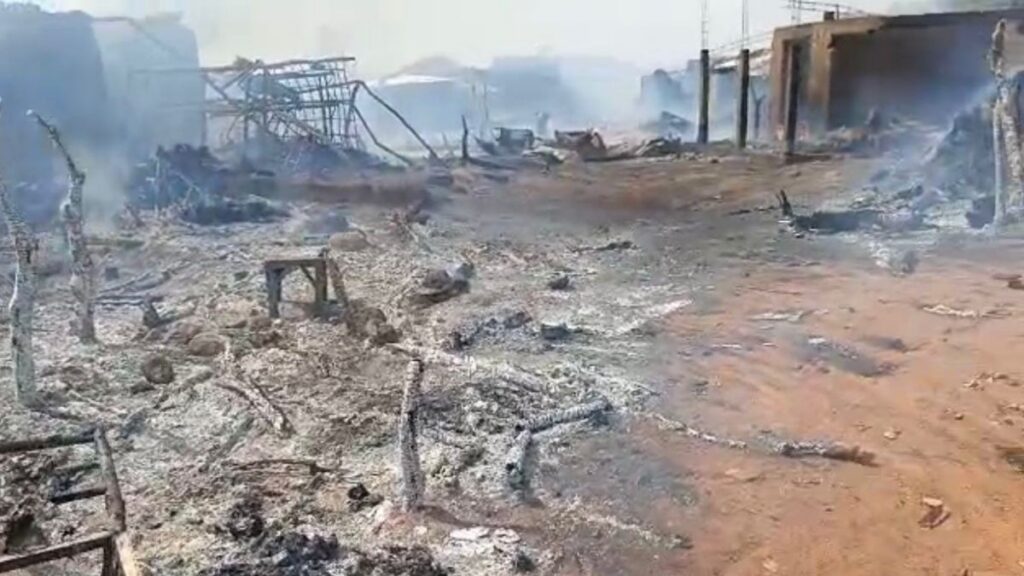
A drone strike in Niger’s Tillabéri region has left at least 17 civilians dead, including four children, and injured 13 others in a crowded market near the village of Kokoloko. The attack, which also killed three Islamist militants, is under scrutiny for potentially violating international humanitarian law.
The strike occurred on January 6, 2026, in a region plagued by insurgent activity. Local residents reported the presence of the Islamic State in the Sahel (EIS) in the area for years, with the group frequently clashing with military forces and civilians since 2019. The market was bustling with vendors and shoppers when the drone struck just before 1:30 p.m., according to witnesses.
Survivors described the drone as white and noted a whistling sound before a deafening explosion. The blast ignited fires fueled by market stalls and fuel reserves, turning the area into a scene of devastation. Rescue efforts revealed charred remains, making identification of victims extremely difficult. Among the dead were primarily women and children, buried in mass graves due to the severity of the injuries.
Human Rights Watch conducted interviews with 15 individuals, including witnesses and representatives from local and international NGOs, journalists, and Kokoloko residents. The organization also analyzed three publicly available videos and satellite imagery to corroborate the accounts. Despite multiple attempts to contact the Nigerien military junta for comment, no response has been received.
key details of the attack
- Location: Kokoloko market, Tillabéri region, near the Burkina Faso border
- Time: Approximately 1:30 p.m. on January 6, 2026
- Casualties: 17 civilians dead (11 women, 2 men, 4 children), 13 injured (4 women, 7 men, 2 children)
- Suspected perpetrator: Nigerien military drone
- Islamist presence: Three armed EIS militants were spotted in the market at the time of the strike
Satellite data from NASA’s Fire Information for Resource Management System (FIRMS) confirmed active fires in Kokoloko at 1:31 p.m. local time, with further damage visible in high-resolution images taken days later. Residents reported that the militants, dressed in civilian clothing with turbans, were unarmed at the time of the attack and had purchased goods before the strike.
international law and accountability
The Islamic State in the Sahel has been active in the region for years, but the attack raises serious concerns about the Nigerien military’s adherence to international law. Under international humanitarian law, parties to a conflict must distinguish between combatants and civilians at all times. Indiscriminate attacks, which fail to limit harm to civilians, are prohibited and may constitute war crimes if conducted with criminal intent.
This incident is not isolated. The Tillabéri region has seen a surge in civilian casualties, with reports from 2025 indicating it had the highest number of civilian fatalities in the central Sahel. Previous airstrikes in the region, including one in Injar in September 2025 and another in Tiawa in January 2024, have also resulted in significant civilian harm.
calls for transparency and justice
Ilaria Allegrozzi, Senior Sahel Researcher at Human Rights Watch, emphasized the need for accountability: “The Nigerien authorities must ensure a thorough, impartial investigation into this attack, hold those responsible to account, and provide adequate compensation to victims and their families.” She also urged foreign governments supporting the Nigerien military to pressure authorities into adopting measures that minimize harm to civilians.
Following the strike, nearly all 1,200 residents of Kokoloko fled to neighboring villages or crossed into Mali. Survivors described harrowing conditions, with many losing family members and belongings. The attack has left deep scars on the community, with calls for justice and reparations growing louder.



More Stories
Niger: Tiani faces fallout from special forces anger after Russian intervention
Mali : 17 morts dans les rangs des dozos, le JNIM accentue sa pression
Sahel : le pari des juntes tourne-t-il à l’échec sécuritaire ?