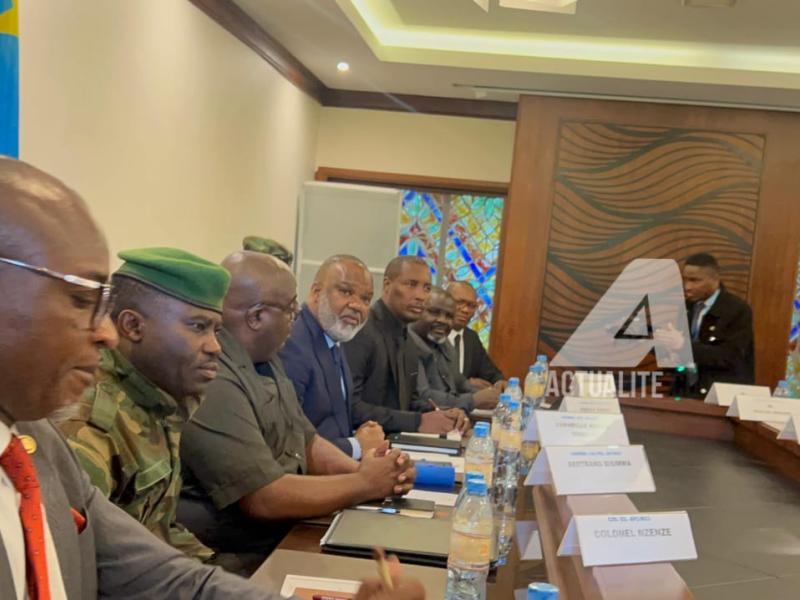
eastern DRC conflict: AFC/M23 accuses mediators of complicity in peace process failure
- Security
The AFC/M23 movement, through its political coordinator Corneille Nangaa, has sharply criticized what it terms the irresponsible and warlike rhetoric of President Félix Tshisekedi, delivered during his Houston address to Congolese expatriates following the DRC-Portugal World Cup match. The Head of State notably addressed the security crisis in eastern DRC, vowing imminent military reconquest of areas under the movement’s control.
During a press briefing held Thursday, June 18, 2026, in Goma, North Kivu’s provincial capital, Corneille Nangaa reaffirmed his movement’s determination to defend itself against threats from Kinshasa. He expressed bewilderment at the international community’s muted response to President Tshisekedi’s statements, suggesting this silence borders on complicity—particularly as global actors are fully aware of intensified government military operations violating both existing commitments and ongoing diplomatic efforts toward de-escalation.
“In light of this dire situation and the resulting calamities, we have a duty—before God, History, and our Nation—to highlight the deafening silence of peace process mediators and partners, which verges on complicity. The international community possesses detailed intelligence on ground realities, the staggering civilian casualty tolls, and the perpetrators of these atrocities,” Nangaa declared.
He continued: “Peace negotiators in Doha, diplomatic missions, international agencies, and human rights organizations are all apprised of the continuous deterioration of security and humanitarian conditions across the region—particularly in the Minembwe Highlands. This inaction fosters impunity and emboldens further violence.”
The AFC/M23 leader further condemned the persistent downplaying of eastern DRC’s security crisis, alleging that President Tshisekedi systematically undermines peace efforts while international partners remain passive observers.
“We refuse to accept that the suffering of eastern Congolese populations is treated as a peripheral tragedy occurring, as they often claim, more than 2,000 kilometers from Kinshasa. Every human life deserves equal protection and consideration. We call attention to the numerous obstructions, deceptions, manipulations, and intrigues orchestrated by President Tshisekedi and his international allies—all of which gravely compromise peace efforts in the Democratic Republic of Congo,” Nangaa lamented.
He emphasized that military escalations and continuous troop deployments directly contradict sincere de-escalation efforts. “While the AFC/M23 has released hundreds of prisoners of war as a confidence-building measure, reciprocal commitments from the Kinshasa regime remain unimplemented. Many peace process agreements have become dead letters.”
This latest verbal confrontation between Kinshasa and the AFC/M23 rebellion—backed by Rwanda—unfolds amid stalled diplomatic initiatives, including the Washington Accords and Doha Process, aimed at achieving a durable ceasefire and relaunching dialogue among conflict stakeholders. To date, these efforts have yielded no tangible results on the ground, where hostilities persist between rebel factions and government forces.
Calls for compliance with signed peace agreements continue to resonate at national, regional, and international levels. Yet these appeals have thus far proven ineffective. Bridging the persistent gap between diplomatic progress and ground realities remains an elusive goal, as each party interprets agreement provisions through its own lens, rendering implementation increasingly uncertain.