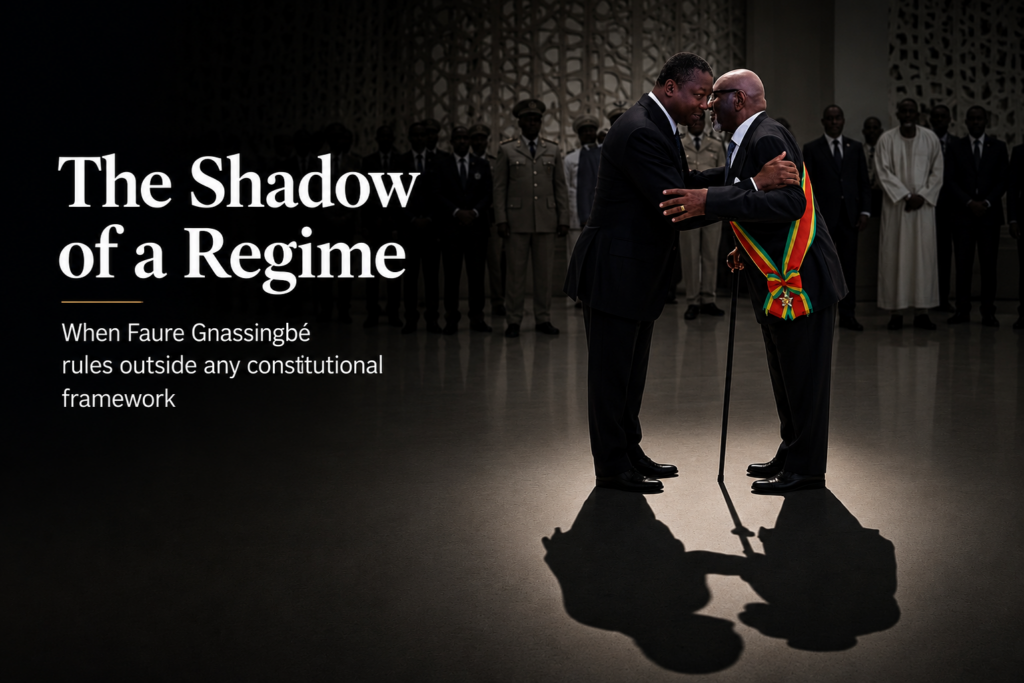
The arrest of two French nationals exposes Togo’s governance crisis
Two French citizens were recently detained in northern Togo, their fate seemingly sealed by an order from Faure Gnassingbé. Instructing Justice Minister Pacôme Adjourouvi to « resist any pressure », the president demonstrated how state institutions now operate at his behest. This episode, sparking diplomatic tensions, reveals a deeper malaise: the erosion of Togo’s constitutional framework.
Institutional engineering to perpetuate power
Since 2024, Togo’s governance has undergone a radical transformation. A constitutional amendment, pushed through a parliament dominated by the ruling UNIR party, redefined the presidency as a ceremonial role. Executive authority—including foreign policy, military command, and judicial appointments—was transferred to a newly created position: the « Council President ». Faure Gnassingbé assumed this role in May 2025, effectively centralizing power without term limits.
The 2024 legislative elections, widely boycotted by the opposition, ensured UNIR’s overwhelming majority. This allowed the party to reshape institutions to its advantage. The new system eliminates presidential term restrictions, replacing them with a structure that guarantees perpetual rule through the Council President. What was once a democratic system is now a dynastic arrangement in all but name.
The judiciary as a political tool
The case of the two detained French journalists is not an isolated incident. Their arrest during filming for a documentary reflects a broader pattern: the instrumentalization of justice. Courts and intelligence services now act on direct executive orders, bypassing judicial independence. The alleged instruction to « resist any pressure » underscores a chain of command that overrides legal norms.
This trend extends beyond high-profile detentions. Since mid-2025, security forces have used legal mechanisms to suppress dissent, targeting critics and activists. The law, once a pillar of governance, has become a weapon—enforced when convenient, ignored when expedient.
A legitimacy crisis
Who truly governs Togo? The answer lies in the hands of a leader who inherited power in 2005 and has since reshaped the state to retain it indefinitely. No referendum validated the 2024 constitutional changes, nor were elections conducted under fair conditions. The Senate, with a third of its members appointed by the Council President, further entrenches this unaccountable system.
What emerges is not a transition but a consolidation of personal rule. Titles change, procedures multiply, but decision-making remains firmly in the hands of Faure Gnassingbé—now Council President, military commander, and unchecked authority.
A regime beyond constitutional bounds
When arbitrary rule replaces law, when institutions serve only to legitimize power, the social contract frays. Togo is no longer grappling with a constitutional debate; it faces a regime that governs outside any stable republican framework. The question is no longer « who leads? » but « how long can this system endure before internal contradictions or popular pressure force change? »