-
A substantial €20 million loan is set to bolster seafood value chains, a crucial element of cooperation between Mauritania and the European Union.
-
Notably, 30% of the funding is specifically earmarked for enterprises led or owned by women, with another 30% dedicated to fostering youth employment initiatives.
-
This strategic financing actively supports the blue economy, an integrated development sector championed by the European Union under its comprehensive “Global Gateway” strategy.
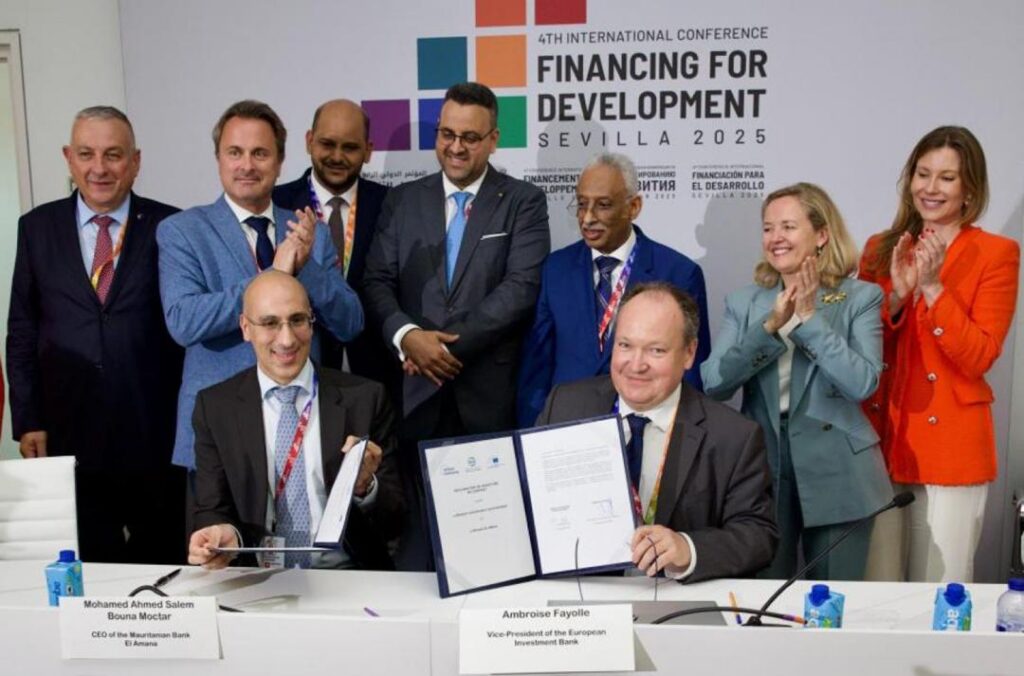
Banque El Amana (BEA) and the European Investment Bank (EIB), through its EIB Global arm, have formalized a €20 million agreement. This significant financial commitment aims to provide vital funding for small and medium-sized enterprises (SMEs) across Mauritania. The signing took place during the Fourth International Conference on Financing for Development (FfD4), underscoring the international importance of this collaboration.
A minimum of 30% of these funds will be channeled towards businesses either managed or owned by women, or those demonstrating a high proportion of female employees. Additionally, an equal 30% allocation is reserved for enterprises led or owned by young individuals, or those that significantly employ youth, promoting inclusive economic growth.
Mohamed Ahmed Salem Bouna Moctar, Director General of BEA, remarked, “This alliance with the EIB fortifies Banque El Amana’s pivotal role in advancing Mauritania’s blue economy. It reflects our unwavering dedication to sustainable, inclusive, and innovative growth, serving our youth, women, and the responsible utilization of our natural resources.”
Ambroise Fayolle, Vice-President of the EIB, stated, “By investing in sustainable fisheries, a cornerstone sector for the Mauritanian economy, we are committed to safeguarding natural resources while cultivating more resilient and inclusive value chains. I am particularly pleased that this initiative prioritizes the economic empowerment of young people and women, groups often facing limited access to finance yet whose contribution to local development is paramount. This dual environmental and social ambition truly embodies the spirit of our partnership with BEA and our EU collaborators under the ‘Global Gateway’ framework.”
Jozef Síkela, European Commissioner for International Partnerships, commented, “Through this ‘Global Gateway’ investment, we are further deepening our commitment to sustainable fisheries and the blue economy in Mauritania, simultaneously broadening opportunities for youth and women-led enterprises. I am delighted to see our partnership continue to strengthen following my mission to Mauritania last December.”
Financial inclusion for women and youth
The 30% target for businesses led or owned by women, or those with a significant female workforce, aligns with the international benchmarks of the 2X Challenge. Despite notable progress in Mauritania, women’s access to finance remains constrained, particularly within high-growth sectors such as fisheries and agro-processing.
The objective of creating sustainable economic prospects for Mauritanian youth is fully integrated into the EU-Mauritania migration partnership, launched in March 2024. This partnership aims to boost local employment in a country where over 60% of the active population is under 35, thereby enhancing regional stability.
Banque El Amana already demonstrates strong leadership in financial inclusion. A notable example is the opening of a banking agency within the Mbera refugee camp in 2023, in collaboration with the United Nations High Commissioner for Refugees (UNHCR), to facilitate access to financial services for displaced populations and their host communities.
Strategic partnership for sustainable fisheries
This operation is designed to fortify seafood value chains, a strategic pillar of cooperation between Mauritania and the European Union. This effort is underpinned by the Sustainable Fisheries Partnership Agreement (SFPA), which champions responsible management of marine resources.
All fishing sector businesses benefiting from the EIB-BEA partnership will be required to commit to improving their practices and obtaining international environmental certifications, including from the Marine Stewardship Council (MSC). Targeted technical assistance will be provided to support these transformative efforts.
This agreement reflects the shared goals of Mauritania and Team Europe. It builds upon existing collaboration between KfW and the German Federal Ministry for Economic Cooperation and Development (BMZ), alongside several Mauritanian banks, including BEA. The aim is to develop the value chain for small pelagic fish intended for human consumption. This initiative serves the blue economy, an integrated development area supported by the European Union via the “Global Gateway” strategy. It complements the ongoing project for constructing a modernized landing site for artisanal pirogue fishing along Mauritania’s southern coast. This funding is provided under the European Fund for Sustainable Development Plus (EFSD+), part of the European Union’s “Global Gateway” strategy.
Background information
About EIB Global
The EIB, owned by the European Union (EU) member states, serves as the EU’s long-term financing institution. Its mandate is to fund investments that align with the EU’s overarching objectives.
EIB Global is the specialized branch of the EIB Group dedicated to enhancing the impact of international partnerships and development finance. It stands as a pivotal partner in the Global Gateway strategy, aiming to support €100 billion in investments by the close of 2027, representing approximately one-third of the strategy’s total objective. Operating within Team Europe, EIB Global fosters robust and targeted partnerships with other development finance institutions and civil society organizations. EIB Global connects the EIB Group closer to communities, businesses, and institutions through its worldwide network of offices.
https://www.linkedin.com/company/eib-global/
About Banque El Amana
Established in 1996, Banque El Amana (BEA) is a private commercial bank in Mauritania, operating under national legislation and supervised by the Central Bank of Mauritania. BEA offers a comprehensive suite of services to a diverse client base, ranging from individuals to large corporations and SMEs. With a network of nine branches spread across the territory, including Nouakchott, Nouadhibou, Assaba, Trarza, Hodh El Gharbi, and Dakhlet Nouâdhibou, BEA holds a prominent position in several strategic sectors of the Mauritanian economy, such as fisheries, agro-industry, energy, telecommunications, and infrastructure. BEA cultivates trusted partnerships with key national and international stakeholders in strategic areas like energy, industry, agri-business, services, humanitarian aid, and development. It collaborates closely with United Nations agencies supporting refugees and vulnerable communities, as well as leading actors in financial inclusion. The bank also leverages an extensive international network of correspondent banks, including Société Générale Paris, UniCredit, and BRED Banque Populaire. In 2023, BEA intensified its commitment to sustainability by implementing a loan facility in partnership with KfW, the German development bank, to promote local processing and availability of small pelagic fish, demonstrating its dedication to Mauritania’s economic and ecological transition. In a similar vein, also in 2023, it launched Amanty, its proprietary mobile wallet, enabling payments, transfers, and phone top-ups, thereby enhancing financial inclusion and reducing reliance on cash.
Website: www.bea.mr
LinkedIn: Banque El Amana: Aperçu | LinkedIn
Facebook: Banque El Amana – Facebook
About the European Union’s priorities in the Islamic Republic of Mauritania
The European Union has been actively involved in Mauritania for 50 years, dedicated to the country’s socio-economic development. Its engagement spans health, education, technical and vocational training, environmental protection, energy, and support for the private sector, particularly in fisheries, agriculture, and livestock. The EU also assists Mauritania in governance, working towards modernizing public administration, and is involved in security, stability, and migration management. Under the program for the 2021-2024 period, an allocation of €125 million has been made available to promote human development, the transition to green and blue economies, and good governance. The European Union’s actions in Mauritania are aligned with the Global Gateway initiative, which aims to foster sustainable and reliable connections for the benefit of people and the planet.