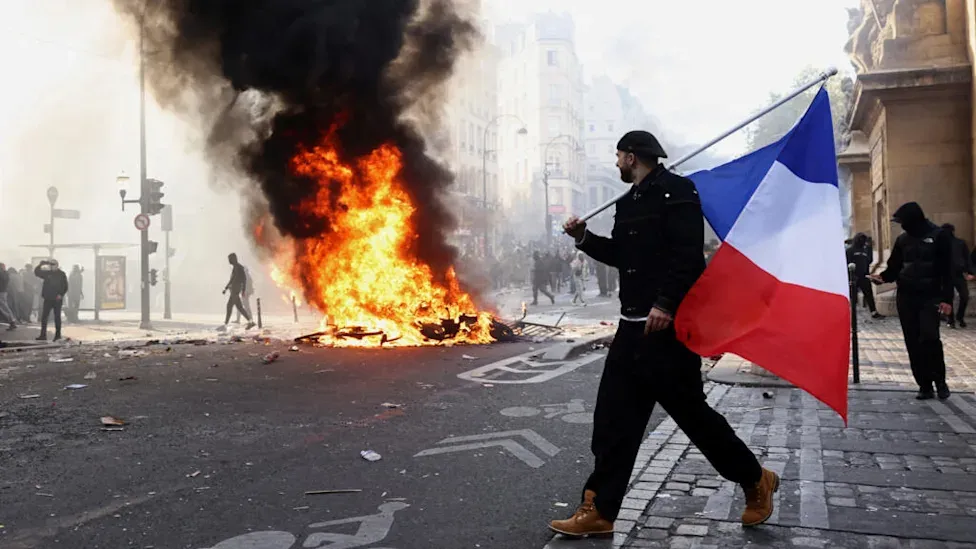
The streets of France are engulfed in vandalism, clashes with law enforcement, and tear gas fumes—scenes beamed across social media feeds in Bamako, Ouagadougou, and Niamey. While Paris frames these images as domestic turbulence, Africa’s Sahel military juntas see them as irrefutable ammunition to dismantle Western narratives and consolidate their own authority.
The Domino Effect: From French Streets to Sahel Narratives
The Alliance of Sahel States (AES) has weaponized France’s urban turmoil to reframe global perceptions. Where Western outlets highlight a societal crisis, pro-regime influencers in the Sahel spin these moments into a triumphant historical reckoning—presenting them as proof of the West’s hypocrisy and the inevitability of its decline.
The trio of leaders—Assimi Goïta, Ibrahim Traoré, and Abdourahamane Tiani—have transformed their political divorce from France into a sustained information war. Each protest flare-up, teargassed confrontation, or parliamentary controversy in France is seized upon as evidence that Western democracy is not a global standard but a decaying relic. The irony? These regimes were once propped up by the very electoral processes they now discredit.
How Sahel Juntas Turn French Chaos into Political Advantage
The strategic maneuvers of AES communicators go beyond schadenfreude. Their tactics serve clear political objectives:
- Undermining democratic legitimacy: By depicting liberal democracy as inherently unstable and chaotic, they position authoritarian rule as the only viable path to order and sovereignty. The message is simple: ‘Look at France—do you still want democracy?’
- Redirecting attention from local failures: As food insecurity, militant violence, and power rationing cripple Sahel societies, the frenzy around French disturbances monopolizes regional media attention, burying urgent domestic crises.
- Accelerating geopolitical realignment: These narratives, amplified by state-aligned networks and foreign allies, reinforce the narrative of a declining West. They justify Sahel nations’ pivot toward Russia, Turkey, and Iran—partners more tolerant of political silence and military control.
The Paradox of Europe’s Democratic Mirror
Critics caution against equating France’s civic space with Sahel regimes’ repression. They point out that the very freedom to burn cars, topple statues, and denounce leaders on prime-time news is a luxury unavailable under military rule—where dissent is met with detention, exile, or far worse. Yet, in the court of public opinion across the Sahel, the damage is done.
The myth of France as a bastion of stability and moral authority has cracked. Every Molotov cocktail tossed in a Paris suburb chips away at French diplomatic capital south of the Sahara. And for juntas that stake their survival on opposition to Paris, there is no better propaganda than a France appearing to crumble from within.
The ripple effects on regional trust and alliances
As ordinary citizens and business leaders in Niger, Mali, and Burkina Faso witness the scenes, many report a growing disillusionment. ‘If even France can’t maintain order, why should we trust Western-style governance?’ asked a Bamako-based entrepreneur during a recent conversation. Vendors in markets across Ouagadougou echoed similar sentiments: ‘They preached democracy to us for decades. Now they can’t even govern themselves.’
Meanwhile, the juntas double down. State television in Bamako now dedicates prime-time slots to panels dissecting France’s ‘systemic failure to protect its own people.’ These segments are not about empathy—they’re about eroding one of the last pillars of Western soft power in the region.
Is there a way back? The limits of damage control
Diplomatic historians warn that trust, once lost, is hard to rebuild. France’s attempts to frame its unrest as a sign of vibrant civic life are drowned out by the sheer volume of junta-sponsored content flooding social feeds. French exports—from culture to education—are already declining in influence, replaced by Russian training programs and Turkish entertainment content.
The Sahel junta’s propaganda machine is not going silent. And as long as the streets of Europe burn, Africa’s military rulers will keep stoking the flames—and fanning their own survival.