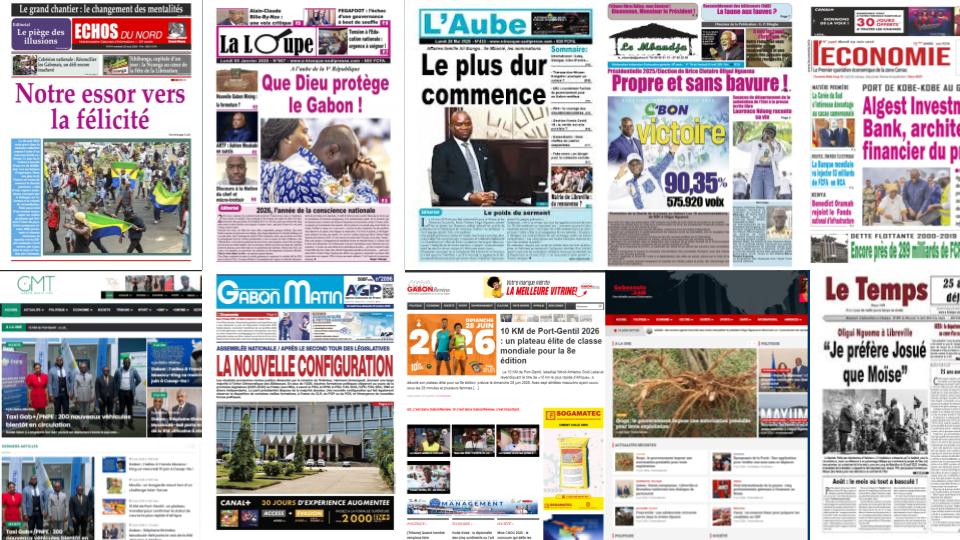
As Gabon aims to establish a modern Fifth Republic, its media sector is experiencing one of the worst crises in its history. Print newspapers are in decline, online outlets are struggling, advertising revenue is drying up, access to public information is difficult, and many publications are gradually disappearing. Beyond the economic survival of media companies, the very quality of our democracy is now at stake.
Some silences should worry us more than controversies. The silence surrounding the economic state of Gabonese media is one of them.
While national attention focuses on major projects, infrastructure, political deadlines, and economic ambitions, a sector essential to democratic life is deteriorating in near-total indifference.
Yet a democracy without viable media always ends up talking to itself. When a government hears only its own voice, the risk of disconnection from reality becomes immense.
Print press, a mirror of silent decline
The plight of print newspapers perfectly illustrates this gradual decay. There was a time when newsstands were genuine public debate spaces. Newspapers were read, discussed, and anticipated.
Titles like La Loupe, L’Aube, and Échos du Nord survived even harder periods. Back then, their critical analyses sometimes led officials to label them as hostile press or symbols of systematic opposition. Yet these newspapers continued to be published. They were still bought. They still fueled national debate.
Today, in a striking paradox, those same issues have become almost collector’s items, sought after by nostalgic readers who remember when print media still had a real presence in the public sphere. This phenomenon is not merely economic. It is political. When a newspaper disappears, it is not just a business closing. It is a voice falling silent.
A symbol of setback
The case of Gabon Matin alone deserves national reflection.
For decades, the government daily was an institution in Gabon’s media landscape. It was a daily, then a biweekly, and during the transition it tried a weekly format.
Today, the newspaper is no longer available at newsstands. Its distribution is mainly digital. Officially, this is adaptation to technological change.
But who can seriously believe this shift is purely an editorial choice?
The reality is simpler. The economic difficulties of the sector affect everyone.
Even media historically backed by the state.
Where did the sector restructuring go?
Another question remains unanswered. For several years, the sector has heard about support mechanisms to help restructure. Significant amounts have been mentioned. Announcements have been made. Hopes have been raised. Yet on the ground, publishers continue to fight for survival.
Many now wonder about the concrete results of these programs. The best way to evaluate a public policy is not through speeches but through its effects. And the effects observed today are alarming.
Digital press on life support
The situation of digital media is hardly more reassuring. Gabon’s media landscape certainly sees a proliferation of platforms and websites. But how many actually have a structured newsroom? How many have an identifiable headquarters? How many transparently publish the identity of their publisher or journalists? Very few.
In this environment, some outlets still strive to maintain high professional standards despite limited resources. But even they face an almost impossible economic equation. Private advertising is scarce. Digital revenues remain low.
Costs are rising. And access to major institutional campaigns is often concentrated among a small number of players.
A democracy cannot function with a weakened press
The issue now goes beyond economics. It directly affects how democracy works. How can we speak of pluralism when media struggle to survive?
How can we guarantee diversity of opinions when press companies disappear one after another? How can we demand editorial quality when newsrooms live in permanent precarity?
An economically weakened press becomes mechanically more vulnerable. Vulnerable to influences. Vulnerable to pressures. Vulnerable to compromises. Yet a strong democracy needs exactly the opposite. It needs independent, solid, credible media capable of working without fearing for their survival each month.
The disappearance of media would mark a collective failure
The paradox is cruel. The authority in charge of regulating the media sector could tomorrow find itself regulating an empty landscape. Because what is the use of regulation when the actors disappear?
What is the use of a legal framework when the companies meant to apply it can no longer survive? What is the use of pluralism enshrined in law when independent voices are gradually silenced? This question must be asked with gravity. For what is at stake is not only the future of media. It is Gabon’s ability to maintain a living, contradictory, and democratic public space.
Saving media to save democratic debate
The time has come to face reality. The media crisis is not a corporatist affair. It is not exclusively the problem of journalists or publishers.
It concerns the whole society. A country that lets its media disappear always ends up impoverishing its public debate. And an impoverished public debate always ends up weakening democracy itself.
Gabon now has a choice. Continue watching the sector’s gradual decline. Or finally engage in a deep reform of its media economy, based on transparency, fairness, pluralism, and economic viability. Because in the end, a democracy does not only die when newspapers are shut down. It also begins to weaken when they are left to die.