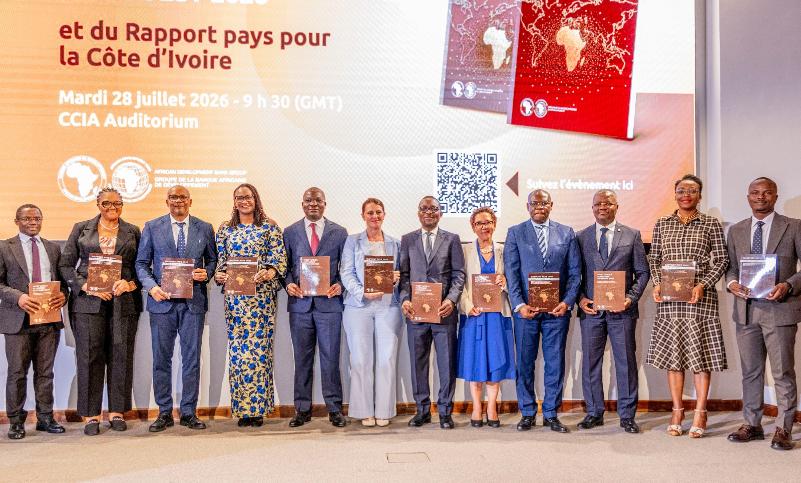
The Ivory Coast Government, represented by the Minister of Planning and Development, Dr. Souleymane Diarra ssouba, through his Cabinet Director, Professor Loesse Jacques Esso, presided over the launch ceremony of the 2026 Côte d’Ivoire Country Report (RP-CI) and the West Africa Economic Outlook (PER-AO) by the African Development Bank (AfDB) in Abidjan. Held under the banner of “mobilizing large-scale resources for Africa’s development in a fragmented world,” the event brought together AfDB officials, national and international financial institutions, private sector representatives, and Ivorian government officials.
This theme aligns closely with the Ivory Coast’s development priorities. Under the leadership of His Excellency President Alassane Ouattara, the government has positioned resource mobilization as a key driver of economic transformation. This vision is embedded in the National Development Plan (PND) 2026–2030, which aims to accelerate growth by leveraging both public and private funding sources.
Speaking on behalf of the Minister of Planning and Development, Professor Loesse Jacques Esso praised the strength of the partnership between Côte d’Ivoire and the African Development Bank. He emphasized that the reports serve as critical decision-making tools, shaping public policies and guiding collaboration with development partners.
Highlighting the economic landscape, he noted that Africa’s projected growth of 3.9% in 2025 reflects resilience across the continent, with Côte d’Ivoire maintaining a robust growth rate of 6.5%—approaching the level needed to meet the African Union’s Agenda 2063 aspirations.
He stressed that financing the PND 2026–2030, valued at 114.8 trillion CFA francs (approximately $209 billion), represents a major challenge in the country’s economic transformation. The success of the July 8–9, 2026 Consultative Group meeting, which secured commitments totaling $80 billion (about 47.8 trillion CFA francs), demonstrates strong international confidence in Côte d’Ivoire’s development strategy and its ability to attract substantial financing for national priorities.
Beyond Ivory Coast’s experience, Professor Esso underscored that the reports’ findings reflect a shared continental concern: the urgent need to mobilize massive resources to fast-track structural economic transformation across Africa. This requires boosting domestic revenue, expanding private capital engagement, strengthening African financial systems, and deepening regional integration through initiatives like the Pan-African Payment and Settlement System (PAPSS) and the African Continental Free Trade Area (AfCFTA).
He urged participants to carefully consider the insights and recommendations in both reports, calling for active contributions to enrich discussions. His call aimed to foster collective reflection on the challenges, opportunities, and shared responsibilities facing public administrations, the private sector, financial institutions, and civil society in designing more effective development financing strategies—both in Côte d’Ivoire and across the region.

More Stories
Ivory Coast’s Baleine deal: how SOCAR’s 10% stake will hit jobs, revenue and energy bills
Benin’s 60-37 AirBadminton win over Algeria: what it means for the tournament and the sport’s growth
Togo: how a journalist’s sanction resonates far beyond newsrooms