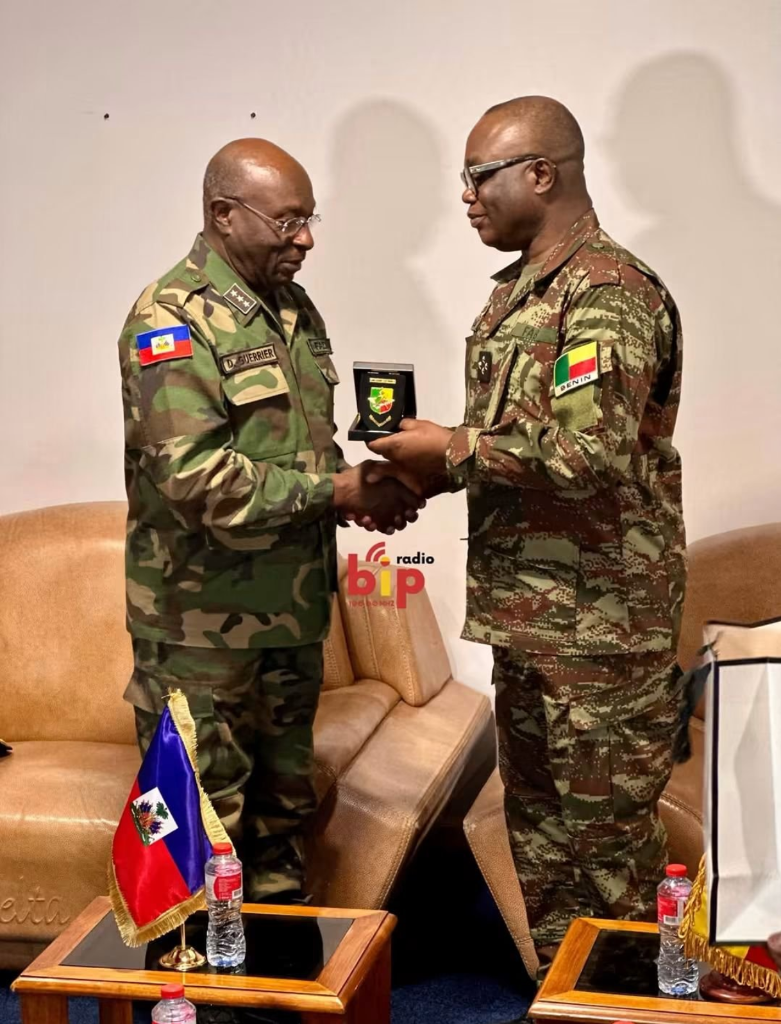
The visit of Haiti’s top military chief to Cotonou this November could have far-reaching consequences for the Caribbean nation’s security crisis, with real-world implications for citizens, businesses, and the broader economy.
Lieutenant General Derby Guerrier, chief of staff of Haiti’s Armed Forces (FAd’H), arrived in Benin on November 3, 2026, for working meetings with senior military officials. The timing of this visit underscores the urgent need for international cooperation to address Haiti’s escalating insecurity, where armed groups have seized control of key infrastructure, public institutions are weakened, and security forces struggle to restore order. This high-level encounter between the two nations’ military leaders signals more than just diplomatic protocol—it could reshape the trajectory of Haiti’s security struggle.
Haiti’s worsening instability creates urgent demand for regional solutions
Haiti remains trapped in a deepening security crisis, with armed gangs expanding their territorial control, kidnappings skyrocketing, and essential services collapsing. The Haitian government has repeatedly called for international support to restore stability, but sustainable security remains elusive. Against this backdrop, the visit of General Guerrier to Benin highlights a potential pathway forward: strengthening military cooperation with African partners who possess relevant experience in countering asymmetric threats.
The convergence of Haiti’s urgent security needs and Benin’s long-standing offer of military support creates a unique window of opportunity. Cotonou has previously expressed willingness to contribute up to 1,500 troops to international stabilization efforts in Haiti—a proposal that remains on the table, though its implementation has faced delays due to logistical and strategic concerns.
Benin’s past pledge casts new light on current negotiations
In February 2024, Benin’s president formally committed the country to participating in multilateral security efforts in Haiti under a UN-backed mission coordinated by Kenya. While this announcement marked a significant diplomatic gesture, actual deployment has stalled due to unresolved questions about command structure, operational coordination, and financial arrangements. These lingering uncertainties make this week’s talks in Cotonou all the more consequential—they present a chance to revisit and resolve the challenges that have delayed Benin’s support.
The stakes are high. A potential deployment of Beninese troops could provide much-needed reinforcements to Haiti’s overstretched security forces. Additionally, collaboration between the two militaries could extend beyond troop deployment to include training, intelligence sharing, and operational best practices—areas where Benin has developed expertise through its own ongoing counterterrorism operations.
Shared security challenges spark ideas for deeper military collaboration
Both Haiti and Benin face complex security threats that demand innovative, adaptive responses. Benin, located in West Africa’s volatile Sahel region, has been grappling with the spread of terrorism and insurgency. Its military has invested in modernizing training programs, enhancing intelligence gathering, and improving rapid response capabilities. These initiatives could offer valuable lessons for Haiti’s own military, which is working to rebuild its operational effectiveness amid limited resources and escalating violence.
The discussions in Cotonou are expected to explore several key areas of cooperation:
- Military training: Benin could share expertise in counterinsurgency tactics, urban security operations, and crisis management.
- Intelligence exchange: Collaborative efforts could focus on tracking armed group movements, disrupting criminal networks, and improving early warning systems.
- Logistical and operational support: Haiti could benefit from Benin’s experience in managing large-scale security deployments, particularly in resource-constrained environments.
Beyond troops: reimagining security partnerships in the global south
The Haiti-Benin dialogue reflects a broader shift in how nations in crisis look beyond traditional Western allies for support. Historical and cultural ties between Haiti and Africa provide a strong foundation for South-South cooperation, offering alternatives to the slow-moving international bureaucracy that has often delayed aid delivery in Haiti.
For Benin, contributing to Haiti’s stabilization efforts would not only support a fellow Global South nation but also reinforce its role as a regional security actor. This partnership could set a precedent for future collaboration among African states facing similar threats, fostering a network of mutual assistance grounded in shared challenges and goals.
What’s next? From dialogue to real-world impact
While the visit has generated considerable interest, the true measure of its success will lie in the tangible outcomes it produces. The meeting between General Fructueux Gbaguidi, Benin’s chief of staff, and General Derby Guerrier opens the door to concrete steps, including joint military exercises, technical assistance, and potentially the deployment of Beninese forces.
Yet, critical questions remain unanswered. Will Benin formalize its commitment to send troops? How will command structures be negotiated to ensure seamless integration with existing missions? And, most importantly, can this cooperation translate into measurable improvements in Haiti’s security landscape?
One thing is clear: the visit has reignited discussions that could determine the future trajectory of Haiti’s fight against insecurity. Whether these talks lead to real action will depend on the ability of both nations to bridge their differences and turn shared intentions into operational reality.