Rejection of 2026 fiscal adjustment deepens national economic strain
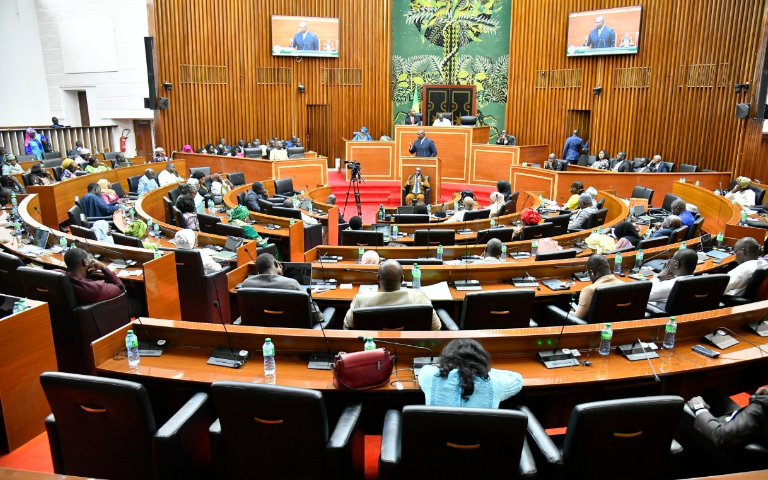
The political fracture between Senegalese President Bassirou Diomaye Faye and his former party, the Pastef movement, is now yielding severe economic and institutional consequences. On November 3, 2026, the National Assembly overwhelmingly rejected the government’s 2026 budget rectification bill, escalating tensions between the executive branch and a parliamentary majority aligned with Ousmane Sonko, former Prime Minister and Pastef leader.
The vote—a decisive 109 to 20 with three abstentions out of 132 deputies—ended all deliberation on the fiscal adjustment, signaling a sharp departure from the automatic support that once characterized relations between the two branches. The setback leaves the government scrambling to address its financial plans amid growing skepticism over its economic strategy.
Parliamentary rebellion challenges executive authority
This legislative outcome reflects more than a policy dispute; it reveals a profound institutional rift. Although President Faye leads the executive and Pasteur Sonko, once a close ally, now presides over the National Assembly, their political alliance has fractured. Since Sonko’s removal from the premiership in May 2026, the Pastef-controlled parliament has asserted increasing independence, refusing to rubber-stamp government initiatives despite shared origins.
The rejection of the rectification bill—spearheaded by Pastef member Amadou Ba through a preliminary motion—was not a technical oversight but a strategic assertion of parliamentary oversight. This vote marks a turning point: the government can no longer assume automatic legislative allegiance, especially on core economic matters.
Budget disputes highlight competing visions for Senegal’s economy
At the heart of the conflict are fundamental disagreements over fiscal discipline, debt management, and public investment priorities. The government’s draft projected revenues of 5,848.7 billion CFA francs—down from an initial 6,188.8 billion—with expenditures rising to 7,583.9 billion, pushing the deficit to 7.6% of GDP from the original 5.4%. Notably, the plan slashed 555 billion CFA francs in investment funding, threatening key infrastructure projects.
Parliamentarians, led by the Pastef caucus, have criticized the government’s financial transparency and demanded greater scrutiny of allocations—especially in energy subsidies, family security grants, and priority social sectors. While the Ministry of Economy and Finance insists it fulfilled all requests for data and justification, including a detailed statement issued on October 31 addressing specific concerns, the rejection signals a deeper trust deficit.
What emerges is a standoff: an executive racing to adjust to economic constraints versus a legislature determined to exercise full fiscal oversight—raising questions about the credibility of both the budget and the government’s economic roadmap.
International financiers watch closely as budget deadlock threatens funding
The impasse extends beyond domestic politics. Senegal remains in active negotiations with the International Monetary Fund (IMF) for a new financing program—an effort heavily dependent on demonstrating fiscal responsibility and macroeconomic stability. The failed vote jeopardizes not only the budget’s passage but also the government’s ability to secure IMF support, potentially delaying access to critical funds needed to stabilize the economy.
Domestically, delayed fiscal approvals risk disrupted payments to businesses, contractors, and strategic sectors, exacerbating cash flow crises and undermining investor confidence. The stakes are high: without swift resolution, public and private sectors alike face mounting financial uncertainty, with ripple effects on employment, service delivery, and economic growth.
Institutional test: Can cohabitation without consensus survive?
Senegal now confronts an uncharted political terrain. Though not a formal cohabitation, the situation mirrors its tensions: a president in power with a government, yet facing a legislative majority that no longer acts as a rubber stamp. The November 3 vote forces a reckoning: how far can the conflict escalate between leaders who once marched together without undermining the very institutions they lead?
With no clear path to consensus in sight, the government must chart a course forward—whether through revised negotiations, targeted concessions, or alternative legislative strategies. Meanwhile, Pastef parliamentarians appear resolute in maintaining pressure, signaling that the present standoff may persist until their demands for fiscal clarity and accountability are met.
The rejection of the 2026 rectification bill is not merely procedural. It is a watershed moment in Senegal’s political evolution—one that will shape not only the nation’s fiscal future but the delicate balance of power between its highest institutions.