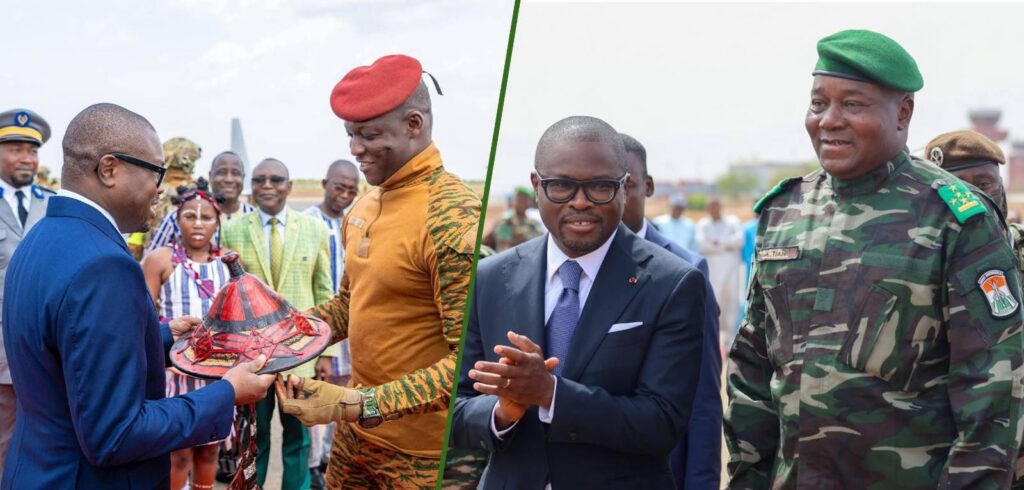
The recent official visits by Benin’s President Romuald Wadagni to Abuja, Niamey, and Ouagadougou signal a fresh chapter in restoring and strengthening cross-border relations across West Africa. This renewed diplomatic momentum is driven by deep-rooted economic and security imperatives that have long tied these neighboring nations together.
Following a prolonged period of strained relations—fueled by political transitions in the Sahel and evolving regional policies—Benin has taken the lead in reopening direct diplomatic channels with its most critical neighbors. The shift reflects a pragmatic recognition that national progress cannot be achieved in isolation.
a web of economic and logistical interdependence
Benin, Niger, and Burkina Faso form a tightly woven economic network, especially in trade and transportation. For landlocked Niger and Burkina Faso, access to global markets and essential goods depends heavily on Benin’s port infrastructure and transit corridors, particularly the Cotonou-Niamey route and connections to Ouagadougou. Meanwhile, Benin’s economic vitality—especially at the Port of Cotonou and within its logistics sector—relies on the steady flow of goods moving through and from these Sahelian markets.
This interdependence extends into the energy sector. The Agadem oil fields in Niger feed into the Sèmè-Kpodji terminal in Benin via a major pipeline. This critical infrastructure binds the two economies: Niger depends on Benin’s facilities to export its crude, while Benin benefits from transit revenues. A newly established expert committee, tasked with identifying and removing barriers to free movement within 15 days, underscores the urgency of protecting these shared interests to ensure seamless regional trade.
securing borders in the parc w zone
Security challenges in the Sahel—particularly the threat of armed groups and cross-border banditry—demand coordinated action. The Parc W region, a shared ecological and strategic zone linking Benin, Niger, and Burkina Faso, remains a hotspot for instability. The recent diplomatic outreach to Niamey and Ouagadougou is not only timely but necessary to restore joint security mechanisms.
By reviving direct dialogue, these nations are better positioned to share intelligence, clarify local military dynamics, and coordinate patrols. Such collaboration is vital to mitigating asymmetric threats that no single state can address alone. For Benin, this coordination is especially crucial, as the security of its territory is directly linked to the stability of the wider Sahel.
balancing regional alliances and regional interests
The timing of these visits is strategic. The initial stop in Abuja—regional hub of the Economic Community of West African States (ECOWAS)—followed by engagements in Niamey and Ouagadougou, reflects a deliberate effort to serve as a bridge between the region’s evolving political landscape and the need to maintain functional communication channels.
In a context of shifting alliances, including the emergence of the Alliance of Sahel States (AES), preserving direct bilateral dialogue is key to reducing geopolitical risk. This approach supports the resumption of trade flows and enhances the safety of local communities, ensuring that economic and security cooperation remain on solid ground.
The normalization of relations between Benin, Nigeria, Niger, and Burkina Faso is not a matter of choice—it is a technical necessity shaped by geography, shared security concerns, and the realities of interconnected economies. It is a step toward resilient regional integration in West Africa.